- The glacier burst has created a lake spanning around 8 kilometers, over 60 downstream schools evacuated
- Pakistan is currently witnessing an intense monsoon season that has claimed over 770 lives since late June
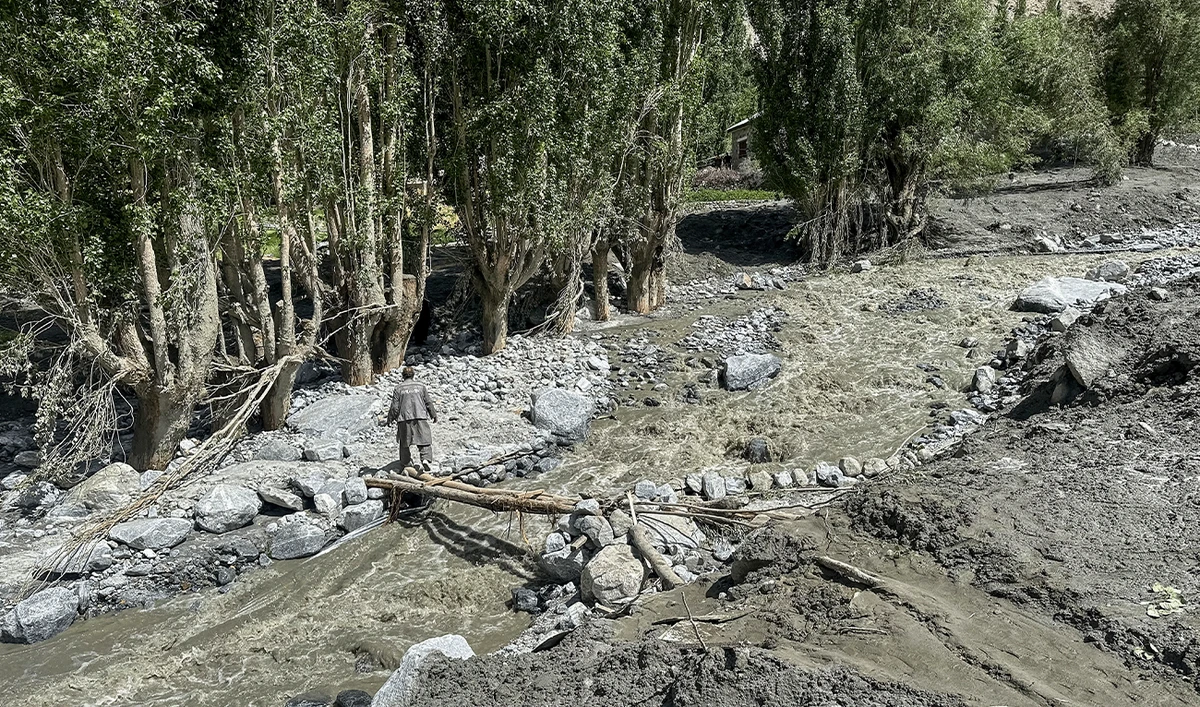
ISLAMABAD: A glacier burst damaged more than 100 houses in Pakistan’s northern Gilgit-Baltistan (GB) region, a regional government spokesman said on Friday, with relief efforts underway in affected areas.
A glacier burst, also known as a Glacial Lake Outburst Flood (GLOF), is a sudden release of water from a glacial lake, caused by the accelerated melting of glaciers due to rising global temperatures.
The GLOF event occurred at around 3am on Friday in Rowshan and Talidas areas of Ghizer district in GB, home to thousands of glaciers and five of the world’s 14 peaks above 8,000 meters.
Faizullah Faraq, a GB government spokesman, said the glacier burst has created a lake spanning an area of 8 kilometers and damaged multiple villages in the district.
“One kilometer of road stretch was damaged in the flooding. The main road of Ghizer is closed,” Faraq told Arab News. “Over 100 houses were damaged and huge financial losses occurred, but local population was rescued by volunteers with the help of GB government and Pakistan Army.”
The GB Disaster Management Authority (GBDMA) said helicopters were used to evacuate stranded people to safety, while alerts have been issued for downstream populations from the lake site till Biarchi area, which connects Ghizer with Gilgit district.
“All downstream 63 schools have been safely evacuated,” it said in a statement. “Drinking water supply is being ensured to the affected villages. Tents and relief items have been requested from GBDMA Headquarters.”
The mountainous region has witnessed heavy monsoon rains, cloudbursts and flash floods that have claimed 45 lives since June 26, according to Pakistan’s National Disaster Management Authority (NDMA).
Nationwide, the death toll stands at 771, with the northwestern Khyber Pakhtunkhwa province reporting the highest 465 fatalities.
Pakistan is one of the most climate-vulnerable nations in the world, despite contributing less than 1 percent of global greenhouse gas emissions.
Annual monsoons are vital for agriculture and water needs but in recent years have unleashed destructive flooding and landslides.
Urban floods triggered by heavy rains this week inundated the country’s commercial hub of Karachi, while local media reported overflowing rivers in southern parts of the most populous Punjab province.
In an advisory on Thursday, the Met Office said strong monsoon currents from the Arabian Sea and Bay of Bengal were likely to penetrate upper parts of the country from Aug. 22. A westerly wave was also expected to reach the same regions by the night of Aug. 22.
“Torrential rains with wind/thundershower predicted in upper and central parts from 23rd to 27th with occasional gaps,” it said. “Heavy rains expected in Sindh and eastern/southern Balochistan from 27th to 29th August.”
The advisory warned of flash floods in local streams of Chitral, Swat, Shangla, Kohistan, Abbottabad, Charsadda, Nowshera, Murree, Galliyat, Islamabad, Rawalpindi, northeastern Punjab, Azad Kashmir and the hill torrents of Dera Ghazi Khan between Aug. 23-26.
It also cautioned of possible urban flooding in low-lying areas of Lahore, Gujranwala, Faisalabad, Sialkot, Peshawar, Nowshera and Mardan from Aug. 23 till Aug. 27.
“Landslides/mudslides may cause roads closure in the vulnerable hilly areas of Khyber Pakhtunkhwa, Gilgit-Baltistan Murree, Galliyat and Kashmir during the forecast period,” the Met Office said.
In 2022, unprecedented rainfall and glacier melt submerged a third of Pakistan and killed more than 1,700 people, inflicting an estimated $30 billion losses.