

Israel vows to destroy Gaza City if Hamas doesn’t disarm, free hostages

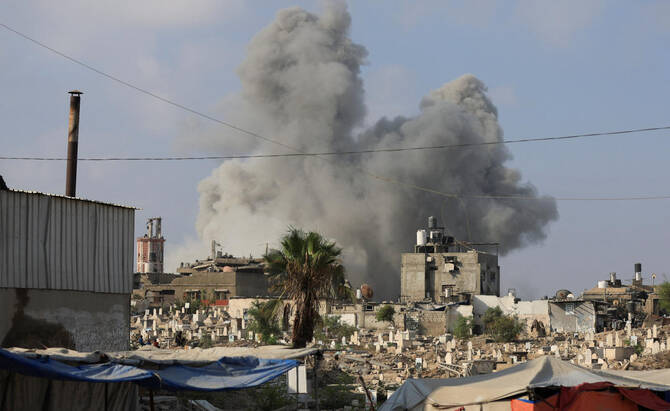
Above, smoke rises following an Israeli strike in Gaza City on Aug. 22, 2025. Israel’s defense minister warned on Friday that Gaza City could be destroyed unless Hamas accepts Israel’s terms. (Reuters)
Short Url
Updated 22 August 2025
Follow

Israel vows to destroy Gaza City if Hamas doesn’t disarm, free hostages

  • Israel Katz warns that the enclave’s largest city could ‘turn into Rafah and Beit Hanoun’
  • Israeli defense ministry earlier authorize the call-up of roughly 60,000 reservists to help seize Gaza City

JERUSALEM: Israeli Defense Minister Israel Katz vowed Friday to destroy Gaza City if Hamas did not agree to disarm, release all remaining hostages in the territory and end the war on Israel’s terms.

“Soon, the gates of hell will open upon the heads of Hamas’s murderers and rapists in Gaza – until they agree to Israel’s conditions for ending the war, primarily the release of all hostages and their disarmament,” the minister posted on social media.

“If they do not agree, Gaza, the capital of Hamas, will become Rafah and Beit Hanoun,” he added, referring to two cities in Gaza largely razed during previous Israeli operations.

The statement came after Israeli Prime Minister Benjamin Netanyahu said late Thursday that he had ordered immediate negotiations aimed at freeing all the remaining hostages in Gaza.

Netanyahu added that the push to release the hostages would accompany the operation to take control of Gaza City and destroy the Hamas stronghold.

Earlier this week, the defense ministry authorized the call-up of roughly 60,000 reservists to help seize Gaza City.

“These two matters – defeating Hamas and releasing all our hostages – go hand in hand,” Netanyahu said in a video statement, without providing details about what the next stage of talks would entail.

Mediators have been waiting for days for an official Israeli response to their latest ceasefire proposal, which Hamas accepted earlier this week.

Palestinian sources have said the new deal involves staggered hostage releases, while Israel has insisted that any deal see all the captives freed at once.

Israel’s plans to expand the fighting and seize Gaza City have sparked an international outcry as well as domestic opposition.

Hamas’s October 2023 attack on Israel resulted in the deaths of 1,219 people, mostly civilians, according to an AFP tally based on official figures.

Israel’s offensive has killed more than 62,000 Palestinians, most of them civilians, according to figures from the health ministry in Hamas-run Gaza that the United Nations considers reliable.


Morocco to secure 60% of water needs from desalination

Nizar Baraka
Updated 14 sec ago
Follow

Morocco to secure 60% of water needs from desalination

  • Rabat boosts investment in facilities powered by renewable energy, minister tells Marrakech conference

MARRAKECH: Morocco, which has endured seven years of drought, plans to supply 60 percent of its drinking water from treated seawater by 2030, up from 25 percent, its water minister said, as Rabat accelerates investment in desalination plants powered by renewable energy.

The push is crucial to ensure a steady water supply and to maintain Morocco’s status as a key producer and exporter of fresh produce amid climate change, as droughts have dried up some of its main water reservoirs and depleted underground resources.

FASTFACT

The plant will have a capacity of 350 million cubic meters and will supply urban centers in Morocco’s food basket as well as farmlands.

The North African country plans to produce 1.7 billion cubic meters of desalinated water annually by 2030 from projects under construction and plants for which it will hold tenders starting next year, Nizar Baraka said on the sidelines of the World Water Congress in Marrakech.
The largest plant — with planned investment of about 10 billion dirhams ($1 billion) — will be located near Tiznit, 615 km south of the capital Rabat. 
It will have a capacity of 350 million cubic meters and will supply urban centers in the country’s food basket as well as farmlands, he said.
“Studies are underway as part of preparations for the plant’s tender, to be announced by mid next year,” Baraka said.
Besides the northern cities of Nador and Tangier, plants are also planned in Rabat in partnership with the French group Veolia, as well as in Tantan, where the government is considering building a port dedicated to green hydrogen and ammonia exports, Baraka said.
Morocco currently operates 17 desalination plants producing 345 million cubic meters annually. 
Four additional plants are under construction with a combined capacity of 540 million cubic meters, scheduled to be ready by 2027, including a major facility in Casablanca, the country’s most populous city.
“All new desalination plants will be powered by renewable energy,” Baraka said.
Morocco has also faced rising temperatures and worsening evaporation in dams. 
To counter this, it installed floating solar panels on a dam near Tangier to reduce evaporation, which accounts for 30 percent of the country’s surface water loss, according to the minister.
“The experiment will be expanded to include dams in the south and mountainous regions,” Baraka said.