



ISLAMABAD: Pakistani foreign policy analysts on Thursday urged the government to undertake “serious efforts” to ensure implementation of long-delayed projects part of the China-Pakistan Economic Corridor (CPEC), which include special economic zones (SEZs), modernizing railway lines and extending the corridor to Afghanistan.
Islamabad and Beijing said on Thursday they would prioritize “high-quality” cooperation under CPEC, unveiling plans for an upgraded version of the multibillion-dollar flagship Belt and Road project. CPEC was launched in 2015 and is essentially an infrastructure network that includes energy, highways, railways projects, and the development of the Gwadar Port on the Arabian Sea connecting Pakistan and China.
The announcement came during Chinese Foreign Minister Wang Yi’s visit to Pakistan, who met Prime Minister Shehbaz Sharif and Zardari in Islamabad on Wednesday. Sharif reiterated Pakistan’s desire to deepen bilateral cooperation with China in trade, investment, ICT, agriculture, industrialization, mines and minerals and other key sectors, according to the Prime Minister’s Office.

Chinese Foreign Minister Wang Yi speaks during a meeting with Pakistan Prime Minister Shehbaz Sharif at the Prime Minister’s Office in Islamabad on August 21, 2025. (Handout/PMO)
While Pakistan has said the project is extremely vital to revive its struggling economy, political, security and economic challenges have caused CPEC projects to suffer delays.
Pakistani economists and foreign policy experts said that while CPEC holds vast economic potential, consistent policies by Pakistan and its accelerated implementation are required for tangible results. Shakeel Ramay, an economist, said SEZs were a key part of the CPEC that could not be established at the required pace due to governance, political, and other challenges.

Pakistan President Asif Ali Zardari gestures during a meeting with Chinese Foreign Minister Wang Yi at the Presidential House in Islamabad on August 21, 2025. (Hanout/Presidency)
“The positive point is that the government has now realized their importance and is working on it, but serious efforts are needed to expedite the implementation,” Ramay added.
Ramay also highlighted delays in the Main Line-1 (ML-1) railway project.
The ML‑1, a $6.7 billion upgrade of Pakistan’s 1,687-kilometer Karachi–Peshawar rail artery first agreed upon in May 2017, is central to CPEC. The overhaul, involving track doubling, advanced signaling and higher-speed trains, is expected to boost cargo and passenger capacity while easing the transport of trade goods to and from the country’s southern ports.

China's Foreign Minister, Wang Yi (left) shaking hands with Pakistani counterpart, Ishaq Dar, at the Ministry of Foreign Affairs in Islamabad, Pakistan, on August 21, 2025. (Government of Pakistan)
“The hope is there for the project to kickstart with Pakistan and China’s openness to third-party inclusion creating opportunities for the Asian Development Bank, World Bank, and other investors,” Ramay said.
China is also involved in the development of a deep-sea port in Pakistan’s Gwadar city, located in its impoverished southwestern Balochistan province. In January this year, Pakistan operated the first commercial flight at the Gwadar International Airport, which has been developed with Chinese funding.
Ramay noted that implementation of CPEC projects in Gwadar was visible, despite hurdles.
“The Chinese government has donated 5,000 solar units, built a state-of-the-art hospital, and, along with Pakistan, is investing in skills development,” he said, adding that 30 Chinese and Pakistani companies have invested almost 3 billion Yuan ($418 million) in the Gwadar Free Trade Zone.
CPEC’s EXPANSION INTO AFGHANISTAN
Yi and the foreign ministers of Pakistan and Afghanistan held trilateral talks in Kabul this week. The three sides agreed to strengthen economic, trade and security cooperation, and extend CPEC to Afghanistan.
However, ties between Pakistan and Afghanistan remain tense as Islamabad blames Kabul for not taking action against militants it alleges launch attacks on Pakistan from its soil. Kabul denies the allegations.

Foreign ministers of Pakistan, China and Afghanistan hold the Sixth Trilateral Foreign Ministers Dialogue in Kabul on August 20, 2025. (Handout/MOFA)
Naghmana Hashmi, Pakistan’s former ambassador to China, said extending CPEC to Afghanistan had always been seen as a natural step to link Central Asia together. However, she said security issues delayed the plan.
“Without peaceful Afghanistan and secure transit, CPEC could not completely develop for Pakistan,” she told Arab News.
Hashmi noted that while the Taliban initially stayed away from the idea to extend CPEC into Afghanistan, they later endorsed it. She said that with the Taliban now in power in Afghanistan, internal security for CPEC projects in the country might not be a “major challenge.”
Dr. Talat Shabbir, director of the China-Pakistan Study Center at the Institute of Strategic Studies Islamabad, said CPEC’s expansion into Afghanistan could take time given the complex bilateral relationship between Islamabad and Kabul.
“Political and bilateral connectivity is essential for such a venture, but I am hopeful that progress will be made soon as the Chinese are actively working on this aspect,” Shabbir said.
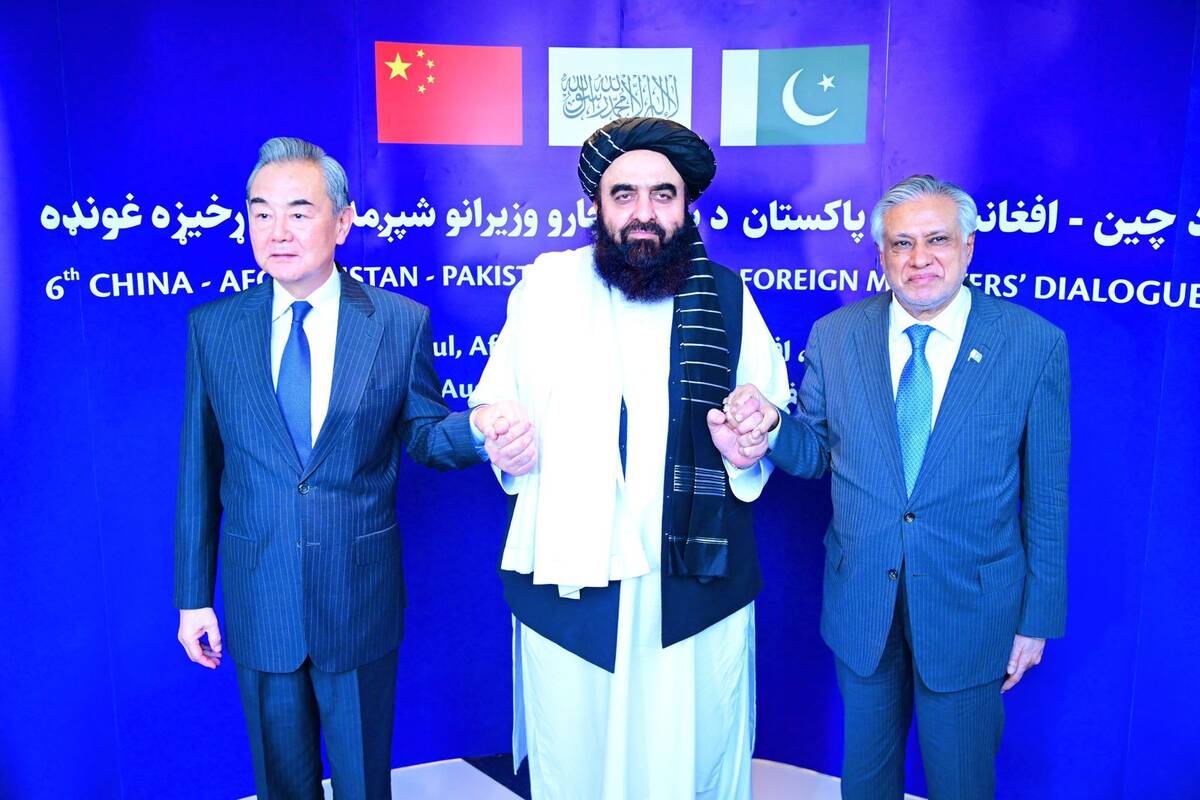
(From left to right) Chinese Foreign Minister Wang Yi gestures for a group photograph with his counterparts from Afghanistan, Mawlawi Amir Khan Muttaqi, and Pakistan, Ishaq Dar, during a Sixth Trilateral Foreign Ministers Dialogue in Kabul on August 20, 2025. (Handout/MOFA)
Security of Chinese nationals in Pakistan working on CPEC projects, however, has been an area of concern for both nations. Militant attacks in Balochistan, northwestern Pakistan and Karachi targeting Chinese nationals have urged Beijing to express concern over the safety of its citizens in Pakistan.
Shabbir noted that Pakistan had bolstered security for Chinese citizens in the wake of these attacks.
“Looking ahead into 2025, Pakistan is further upgrading its security protocols with a mix of technology, intelligence sharing, and community-level engagement in CPEC areas,” he said.


