China, Pakistan set upgraded CPEC as top priority during strategic dialogue in Islamabad

1 / 2
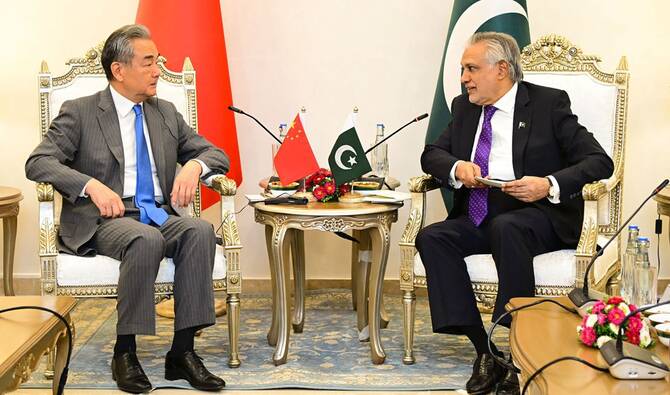
In this handout photograph taken and released by Pakistan's Ministry of Foreign Affairs on August 21, 2025, Pakistan's Foreign Minister Ishaq Dar (R) speaks with his Chinese counterpart Wang Yi, during their meeting in Islamabad. (Pakistan's Ministry of Foreign Affairs / AFP)
2 / 2
Delegation from China (left) headed by Chinese Foreign Minister Wang Yi in conversation with Pakistan's Deputy Prime Minister and Minister for Foreign Affairs, Ishaq Dar, in Islamabad, Pakistan, on August 21, 2025. (Government of Pakistan)
Short Url
Updated 21 August 2025
Follow

China, Pakistan set upgraded CPEC as top priority during strategic dialogue in Islamabad

  • Wang Yi says cooperation to expand into green, innovation and livelihood corridors
  • Dar confirms PM Shehbaz Sharif to visit China for SCO summit, hold talks with Xi

ISLAMABAD: China and Pakistan on Thursday said they would prioritize “high-quality” cooperation under the China-Pakistan Economic Corridor (CPEC), unveiling plans for an upgraded version of the multibillion-dollar flagship Belt and Road project. 

The CPEC infrastructure program was launched in 2015 and includes energy projects, highways, railways and the development of the Gwadar Port on the Arabian Sea, aimed at improving connectivity between western China and the Indian Ocean while boosting Pakistan’s infrastructure and economy.

“The two sides agree that the current priority for China-Pakistan cooperation is high-quality CPEC cooperation and build an upgraded version of CPEC,” Chinese Foreign Minister Wang Yi told reporters during a joint press conference with his Pakistani counterpart Ishaq Dar after they held strategic talks in Islamabad, covering trade, security, counterterrorism and preparations for Prime Minister Shehbaz Sharif’s visit to China later this month. 

“We will build on our past achievements to build a growth corridor, a livelihood enhancing corridor, an innovation corridor, a green corridor and an open corridor to promote greater synergy between the five corridors with Pakistan’s development planning.”

Wang said China would also deepen cooperation in industry, agriculture and mining to improve welfare and boost Pakistan’s ability for self-sustained development. 

“We will also jointly support the development and operation of the Gwadar Port and promote the KKH realignment project in an orderly manner and we welcome third-party participation in ML1 project,” the Chinese foreign minister added.

He was referring to upgrading the Karakoram Highway, the main road link between Pakistan and China through the Himalayas, and the Main Line-1 railway project, a massive plan to upgrade Pakistan’s Karachi–Peshawar railway line, the backbone of the country’s rail network. 

Wang also praised Pakistan’s counterterrorism campaign:

“China firmly believes that Pakistan’s counterterrorism efforts will help secure victory, and Pakistan will effectively protect the safety and security of Chinese personnel, projects and institutions.”

Both sides also vowed to “deepen counterterrorism and security cooperation and enhance regional coordination.”

Speaking at the joint press conference, Dar welcomed China’s vision for expanding cooperation in trade, investment and people-to-people ties under “CPEC 2.0,” which would focus on industrial zones, green energy and agricultural modernization.

The Pakistani leader confirmed that PM Sharif would travel to China to attend the Shanghai Cooperation Organization Council of Heads of State Summit, scheduled to be held from Aug. 31-Sept. 1.

He will also meet the top Chinese leadership, including President Xi Jinping and Premier Li Qiang. A Pakistan-China business-to-business investment conference would also be organized during Sharif’s visit, Dar added. 


Pakistan, ADB ink $61.8 million agreements for three development projects

Updated 4 sec ago
Follow

Pakistan, ADB ink $61.8 million agreements for three development projects

  • Agreements pertain to the upgradation of ML-1 railway link, key bus project in Quetta and water sector development in Balochistan
  • Pakistani official says projects will “significantly contribute” to long-term, sustainable economic growth, address infrastructure needs

ISLAMABAD: Pakistan and the Asian Development Bank (ADB) on Friday signed agreements for three major development initiatives worth $61.8 million to boost connectivity, urban transport and water sector in various parts of the country, state-run media reported. 

The two side signed agreements relating to project readiness financing for the Karachi-Rohri Section of the Main Line-I, a critical link needed to transport copper and gold from the Reko Diq mine in southwestern Pakistan to export hubs, for $10 million. 

Another project readiness financing agreement was signed for a bus rapid transit project in the southwestern city of Quetta worth $3.8 million. The last agreement pertained to additional financing for the Balochistan Water Resources Development Sector Project, which amounts to $48 million. 

“The secretary, Ministry of Economic Affairs, expressed appreciation for ADB’s role as a trusted development partner, and its continued support to Pakistan to complement the development agenda of the country,” the state-run Associated Press of Pakistan (APP) said. 

He said the critical projects would “significantly contribute” to Pakistan’s long-term and sustainable economic growth, address urban infrastructure needs of the provincial capital of Quetta, and enhance agricultural productivity in Balochistan.

ADB’s Country Director for Pakistan Emma Fan appreciated Pakistan’s commitment toward development initiatives. 

“She also reaffirmed ADB’s continued commitment to working closely with the Ministry of Economic Affairs and other stakeholders to ensure its support remains aligned with Pakistan’s development priorities,” APP said. 

ADB has undertaken initiatives to support Pakistan’s economic recovery by strengthening its public finances, social protection systems and helping Islamabad with its post-flood reconstruction efforts. 

The bank says it has committed 764 public sector loans, grants, and technical assistance to the South Asian country totaling $43.4 billion to date.