China’s Xi pushes development, ethnic unity in rare visit to Tibet

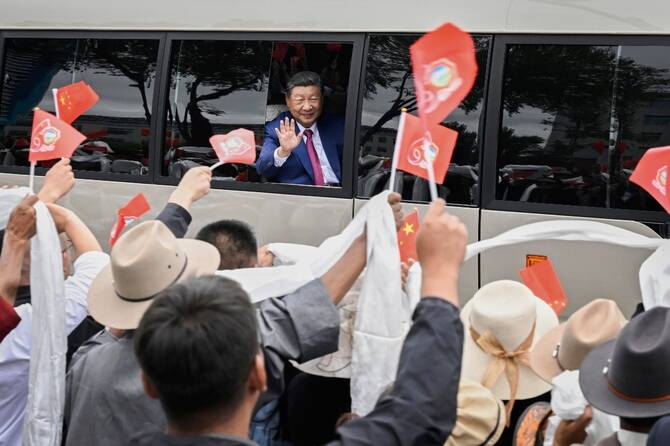
Chinese President Xi Jinping waves to people from a vehicle as he arrives at Lhasa in western China's Tibet Autonomous Region. (AP)
Short Url
Updated 21 August 2025
Follow

China’s Xi pushes development, ethnic unity in rare visit to Tibet

  • Xi’s visit comes ahead of potential tensions over the succession of the 90-year-old Dalai Lama, who lives in India, where he established a Tibetan government in exile

BEIJING: President Xi Jinping attended a grand ceremony in Lhasa on Thursday during a rare visit to Tibet, where he urged “ethnic unity and religious harmony” in a region where China is accused of rights abuses.
The vast high-altitude area on the country’s western edge, established as an autonomous region in 1965 — six years after the 14th Dalai Lama fled into exile — was once a hotbed for protest against Communist Party rule.
Rights groups accuse Beijing’s leaders of suppressing Tibetan culture and imposing massive surveillance, though authorities claim their policies have fostered stability and rapid economic development in one of China’s poorest regions.
“To govern, stabilize and develop Tibet, we must first safeguard political stability, social stability, ethnic unity and religious harmony,” Xi, visiting for the first time since 2021, told a group of the region’s officials on Wednesday, according to state broadcaster CCTV.
On Thursday, party officials lauded the region’s progress and urged ethnic unity during an event to mark the 60th anniversary of the founding of the autonomous region.
The ceremony was held in front of the vast Potala Palace, the ancient residence of Dalai Lamas — Tibetan Buddhism’s spiritual leaders.
Wang Huning, China’s fourth-ranked leader, called for “deepening the anti-secession struggle and ensuring the consolidation and security of the border areas.”
“Any attempt to split the motherland and undermine Tibet’s stability is doomed to failure,” he said.

A giant portrait of Xi flanked a crowd numbering 20,000, according to CCTV, which included military personnel, school children and other members of Tibetan society, many in traditional Tibetan dress.
A parade followed, showcasing Tibetan dancers, floats emblazoned with official slogans, and formations of troops.
Xi’s visit comes ahead of potential tensions over the succession of the 90-year-old Dalai Lama, who lives in India, where he established a Tibetan government in exile.
In July, the Dalai Lama said the spiritual institution would continue after his death, with a successor decided “exclusively” by his office.
China’s rulers insist the next Dalai Lama must be approved by the government in Beijing, raising the prospect of two rival leaders of Tibetan Buddhism emerging.
Xi called Wednesday for “guiding Tibetan Buddhism to adapt to socialist society in accordance with the systematic Sinicization of religion.”
He made no mention of the Dalai Lama in CCTV’s coverage.
Xi also promoted the “vigorous, orderly, and efficient” completion of the massive Yarlung Tsangpo dam, which began construction in July.
The 1.2 trillion yuan ($167 billion) hydropower project, potentially the largest in the world, has prompted concerns from India and Bangladesh, which sit downstream.
India’s government said it had raised the dam this week during talks with Chinese foreign minister Wang Yi in New Delhi.
They also discussed advancing talks on the two countries’ disputed border in the region, which was the site of deadly border clashes in 2020.


N Korean leader’s daughter fuels succession speculation with mausoleum visit

Updated 2 sec ago
Follow

N Korean leader’s daughter fuels succession speculation with mausoleum visit

SEOUL: The North Korean leader’s daughter Kim Ju Ae has made her first public visit to a mausoleum housing her grandfather and great-grandfather, state media images showed Friday, further solidifying her place as likely next in line to run the nuclear-armed dictatorship.
The Kim family has ruled North Korea with an iron grip for decades, and a cult of personality surrounding their so-called “Paektu bloodline” dominates daily life in the isolated country.
Current leader Kim Jong Un is the third in line to rule in the world’s only communist monarchy, following his father Kim Jong Il and grandfather Kim Il Sung.
The two men — dubbed “eternal leaders” in state propaganda — are housed in the Kumsusan Palace of the Sun, a vast mausoleum in downtown Pyongyang.
The state-run Korean Central News Agency (KCNA) reported that Kim Jong Un had visited the palace, accompanied by top officials. Images released by the agency showed daughter Ju Ae alongside him.
South Korea’s spy agency said last year she was now understood to be the next in line to rule North Korea after she accompanied her father on a high-profile visit to Beijing.

- ‘Presented as Kim’s successor’ -

And Cheong Seong-chang at Seoul’s Sejong Institute said he expected her to soon be “formally confirmed as the next successor both domestically and internationally.”
Cheong, author of a book on the Kim leadership, said her placement in the center of the front row during her visit to the place — a place typically reserved for her father — was especially notable.
It could be “interpreted as reporting to the ‘eternal leaders’ Kim Il Sung and Kim Jong Il that she is being presented as his successor,” he said.
Ju Ae was publicly introduced to the world in 2022 when she accompanied her father to an intercontinental ballistic missile launch.
North Korean state media have since referred to her as “the beloved child,” and a “great person of guidance” — “hyangdo” in Korean — a term typically reserved for top leaders and their successors.
Before 2022, the only confirmation of her existence had come from former NBA star Dennis Rodman, who made a visit to the North in 2013.
Analysts have suggested that she could be elected First Secretary of the Central Committee, the second most powerful position in the North Korean ruling party, at a landmark congress due to be held in the coming weeks.
On Thursday, footage showed Ju Ae accompanying her parents at New Year celebrations in Pyongyang.
While first lady Ri Sol Ju kept a low profile, state TV showed Ju Ae placing one hand on the North Korean leader’s face and kissing him on the cheek — a rare public display of affection which drew headlines in South Korea.