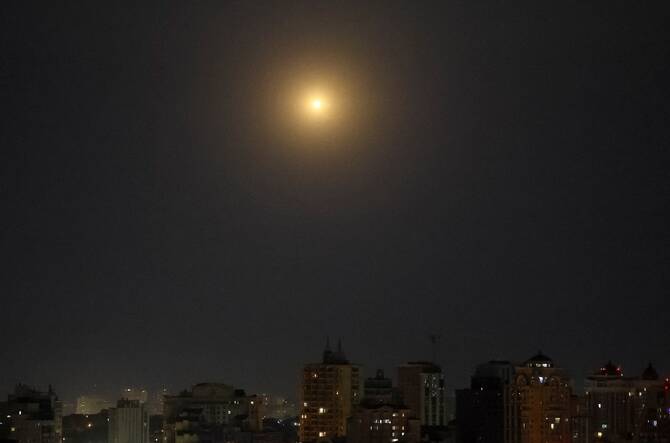

When a Ukrainian-made drone attacked an ammunition depot in Russia last September, it showcased Kyiv’s determination to strike deep behind enemy lines and the prowess of its defense industry.
The moment was especially gratifying for the woman in charge of manufacturing the drones that flew more than 1,000 kilometers (620 miles) to carry out this mission. For months after, Russia no longer had the means to keep up devastating glide bomb attacks like the one that had just targeted her native city of Kharkiv.
“Fighting in the air is our only real asymmetric advantage on the battlefield at the moment. We don’t have as much manpower or money as they have,” said Iryna Terekh, head of production at Fire Point.
Terekh spoke as she surveyed dozens of “deep-strike drones” that had recently come off the assembly line and would soon be used by Ukrainian forces to attack arms depots, oil refineries and other targets vital to the Kremlin’s war machine and economy.
Spurred by its existential fight against Russia — and limited military assistance from Western allies — Ukraine has fast become a global center for defense innovation. The goal is to match, if not outmuscle, Russia’s capabilities — and Fire Point is one of the companies leading the way.
The Associated Press was granted an exclusive look inside one of Fire Point’s dozens of covert factories. In a sprawling warehouse where rock music blared, executives showed off their signature FP-1 exploding drones that can travel up to 1,600 kilometers (994 miles). They also touted publicly for the first time a cruise missile they are developing that is capable of traveling 3,000 kilometers (1,864 miles), and which Ukrainian President Volodymyr Zelensky hopes will be mass-produced by the end of the year.
Even as US President Donald Trump presses for an end to the 3 1/2-year war — and dangles the prospect of US support for NATO-like security guarantees — Ukrainian defense officials say their country is determined to become more self-sufficient in deterring Russia.
“We believe our best guarantee is not relying on somebody’s will to protect us, but rather our ability to protect ourselves,” said Arsen Zhumadilov, the head of the country’s arms procurement agency.
Ukraine’s government is now purchasing about $10 billion of weapons annually from domestic manufacturers. The industry has the capacity to sell triple that amount, officials say, and they believe sales to European allies could help it reach such potential in a matter of years.
Drone innovation grew out of necessity
Like most defense companies in Ukraine, Fire Point grew out of necessity after Russia’s full-scale invasion in 2022. Despite pleas from Ukrainian military officials, Western countries were unwilling to allow Kyiv to use their allies’ longer-range weapons to strike targets deep inside Russian territory.
That’s when a group of close friends, experts from various fields, set out to mass-produce inexpensive drones that could match the potency of Iranian-made Shahed drones that Russia was firing into Ukraine with devastating consequences.
The company’s founders spoke with AP on the condition of anonymity out of concern for their safety and the security of their factories.
By pooling together knowledge from construction, game design and architecture, the company’s founders — who had no background in defense — came up with novel designs for drones that could fly further and strike with greater precision than most products already on the market. Their long-range drones had another benefit: they did not need to take off from an air field.
When Terekh — an architect — was hired in the summer of 2023, she was given a goal of producing 30 drones per month. Now the company makes roughly 100 per day, at a cost of $55,000 apiece.
The FP-1 looks more like a hastily made science project than something that would roll off the production lines of the world’s biggest defense contractors. “We removed unneeded, flashy glittery stuff,” she said.
But the FP-1 has been extremely effective on the battlefield.
With a payload of explosives weighing 60 kilograms (132 pounds), it is responsible for 60 percent of strikes deep inside Russian territory, including hits on oil refineries and weapons depots, according to Terekh. These strikes have helped to slow Russia’s advance along the 1,000 kilometer-long (620 mile-long) front line in eastern Ukraine, where army units have reported a sharp decline in artillery fire.
“I think the best drones, or among the best, are Ukrainian drones,” said Claude Chenuil, a former French military official who now works for a trade group that focuses on defense. “When the war in Ukraine ends, they will flood the market.”
Ukraine is becoming the ‘Silicon Valley’ of defense
Fire Point’s story is not entirely unique. Soon after Russia’s 2022 invasion, hundreds of defense companies sprouted almost overnight. The Ukrainian government incentivized innovation by relaxing regulations and making it easier for startups to work directly with military brigades.
Patriotic entrepreneurs in metallurgy, construction and information technology built facilities for researching and making weapons and munitions, with an emphasis on drones. The ongoing war allowed them to test out ideas almost immediately on the battlefield, and to quickly adapt to Russia’s changing tactics.
“Ukraine is in this very unique moment now where it is becoming, de facto, the Silicon Valley of defense,” said Ukrainian defense entrepreneur Yaroslav Azhnyuk. “The biggest strategic asset that we have is that we have been at war with Russia for 11 years.”
A case in point: Fire Point had initially sourced navigational equipment for its drones from a major Western firm, but before long Russia was able to disrupt their effectiveness using electronic warfare; so Fire Point developed its own software to outwit the enemy.
Because defense companies are high-value targets for Russia, many operate underground or hidden within civilian centers to evade detection. Although they are guarded by air defenses, the strategy has the disadvantage of putting civilians at risk. Many Ukrainians have died in imprecise Russian attacks that were likely targeting weapons facilities. Entrepreneurs said the alternative is to operate openly and face attacks that would set back the war effort.
Supplies of drones don’t last long
On the day AP reporters visited the Fire Point factory, there were dozens of drones awaiting delivery. They would all be gone within 72 hours, shipped to the battlefield in inconspicuous cargo trucks.
The Fire Point team receives regular feedback from army units, and the company has reinvested most profits toward innovating quickly to keep pace with other drone makers. Increasingly, those profits are being directed to develop a new, more potent weapon.
The company completed testing this year for its first cruise missile, the FP-5. Capable of traveling 3,000 kilometers (1,864 miles) and landing within 14 meters (45 feet) of its target, the FP-5 is one of the largest such missile in the world, delivering a payload of 1,150 kilograms (2,535 pounds), independent experts said. Because initial versions of the missile came out pink after a factory error, they called it the Flamingo — and the name has stuck.
Fire Point is producing roughly one Flamingo per day, and by October they hope to build capacity to make seven per day, Terekh said.
Even as Zelensky and other Ukrainian officials pursue ways to end the war, Terekh said she is skeptical that Russia will accept terms for a real peace. “We are preparing for a bigger, much scarier war.”