

Pakistan slams Muslim-only UN terror list, flags global rise of right-wing extremism

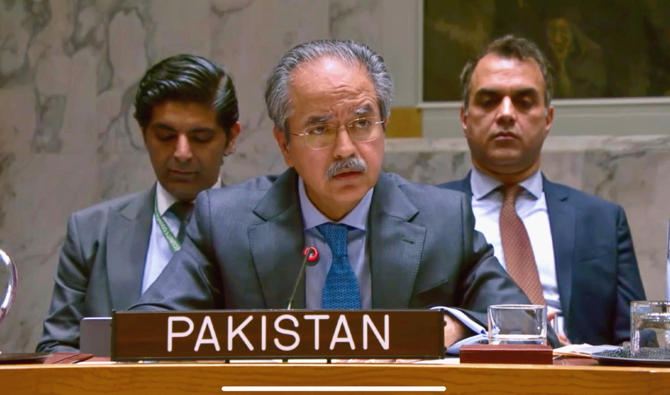
Pakistan's Ambassador to the United Nations, Asim Iftikhar Ahmad, speaking during a UN Security Council's session in New York, US, on August 20, 2025. (@PakistanUN_NY/X)
Short Url
Updated 21 August 2025
Follow

Pakistan slams Muslim-only UN terror list, flags global rise of right-wing extremism

  • Pakistan says UN terror list contradicts the world body’s own stance that terrorism is not tied to any religion
  • Its envoy maintains TTP, BLA and Majeed Brigade are collaborating in cross-border attacks against Pakistan

ISLAMABAD: Pakistan on Wednesday highlighted a global policy blindspot at the United Nations Security Council that was allowing right-wing and fascist movements to fuel extremist violence without attracting the same level of scrutiny as Muslim groups, despite posing serious threats in various parts of the world.

In remarks at a high-level Security Council briefing on threats to international peace, Pakistan’s UN envoy Asim Iftikhar Ahmad said his country had suffered deeply from militancy and condemned terrorism in all its forms. However, he urged the international community to revisit the global counterterrorism discourse, calling for a uniform application of the term “terrorism.”

“There has been a surge in the emergence of right-wing, extremist and fascist movements in several countries and regions of the world leading to terrorist violence,” he told the Council. “Yet, we see a strong inclination to see acts by non-Muslims not as terrorism, but often described just as violent crime.”

“It is not understandable, and is indeed unacceptable, that every name on the Security Council’s terrorism lists is Muslim, while terrorists and violent extremists elsewhere escape scrutiny,” he said. “There is no non-Muslim in the lists. This must change.”

Ahmad pointed out this approach ran counter to the UN’s own position that terrorism should not be associated with any religion, nationality, civilization or ethnic group.

The Pakistani envoy also reiterated his country’s concern over the challenge of militant violence emanating from Afghanistan, calling it “the single most potent threat” to the region and the world.

He cited the Tehreek-e-Taliban Pakistan (TTP) as the largest UN-designated militant outfit operating from Afghan soil, with nearly 6,000 fighters posing a direct threat to Pakistan’s national security.

“With safe havens close to our borders, it directly threatens our national security,” Ahmad continued, adding there was “credible evidence of collaboration” between the TTP and the separatist Balochistan Liberation Army (BLA) and Majeed Brigade.

These groups, he noted, had jointly targeted Pakistan’s strategic infrastructure, economic projects and civilians.

He recounted recent attacks including the hijacking of a passenger train in Balochistan earlier this year in March and a school bus attack in Khuzdar in May that left 10 people dead, eight of them children, pointing out that these acts were carried out by the same groups.

Ahmad accused Pakistan’s “principal adversary in the region” of sponsoring militant violence on its soil without naming India, saying it was also carrying out “extra-territorial assassinations that have gone global.”

He also condemned a cross-border strike by New Delhi in May that killed 54 Pakistani civilians, including 15 children, and led to an intense four-day war between the two nuclear-armed neighbors.


Imran Khan not a ‘national security threat,’ ex-PM’s party responds to Pakistan military

Updated 06 December 2025
Follow

Imran Khan not a ‘national security threat,’ ex-PM’s party responds to Pakistan military

  • Pakistan’s military spokesperson on Friday described Khan’s anti-army narrative as a “national security threat”
  • PTI Chairman Gohar Ali Khan says words used by military spokesperson for Khan were “not appropriate”

ISLAMABAD: Former prime minister Imran Khan’s Pakistan Tehreek-e-Insaf (PTI) party on Saturday responded to allegations by Pakistan military spokesperson Lt. Gen. Ahmed Sharif Chaudhry from a day earlier, saying that he was not a “national security threat.”

Chaudhry, who heads the military’s media wing as director general of the Inter-Services Public Relations (ISPR), spoke to journalists on Friday, in which he referred to Khan as a “mentally ill” person several times during the press interaction. Chaudhry described Khan’s anti-army narrative as a “national security threat.”

The military spokesperson was responding to Khan’s social media post this week in which he accused Chief of Defense Forces Field Marshal Asim Munir of being responsible for “the complete collapse of the constitution and rule of law in Pakistan.” 

“The people of Pakistan stand with Imran Khan, they stand with PTI,” the party’s secretary-general, Salman Akram Raja, told reporters during a news conference. 

“Imran Khan is not a national security threat. Imran Khan has kept the people of this country united.”

Raja said there were several narratives in the country, including those that created tensions along ethnic and sectarian lines, but Khan had rejected all of them and stood with one that the people of Pakistan supported. 

PTI Chairman Gohar Ali Khan, flanked by Raja, criticized the military spokesperson as well, saying his press talk on Thursday had “severely disappointed” him. 

“The words that were used [by the military spokesperson] were not appropriate,” Gohar said. “Those words were wrong.”

NATURAL OUTCOME’

Speaking to reporters earlier on Saturday, Pakistan’s Defense Minister Khawaja Asif defended the military spokesperson’s remarks against Khan.

“When this kind of language is used for individuals as well as for institutions, then a reaction is a natural outcome,” he said. 

“The same thing is happening on the Twitter accounts being run in his [Khan’s] name. If the DG ISPR has given any reaction to it, then I believe it was a very measured reaction.”

Khan, who was ousted after a parliamentary vote of confidence in April 2022, blames the country’s powerful military for removing him from power by colluding with his political opponents. Both deny the allegations. 

The former prime minister, who has been in prison since August 2023 on a slew of charges he says are politically motivated, also alleges his party was denied victory by the army and his political rivals in the 2024 general election through rigging. 

The army and the government both deny his allegations.