Palestinian Authority condemns Israel’s approval of key West Bank settlement

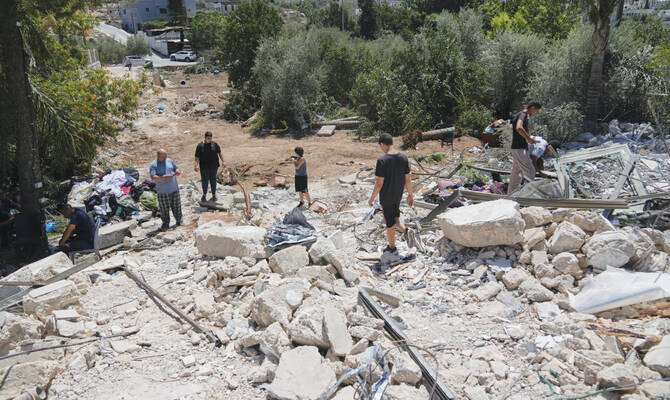
Palestinians check the rubble of a house after it was demolished by the Israeli army in the West Bank village of Beit Sira, near Ramallah. (AP)
Short Url
Updated 20 August 2025
Follow

Palestinian Authority condemns Israel’s approval of key West Bank settlement

  • E1 project has no purpose other than to sabotage political solution, rights group says

TEL AVIV: The Palestinian Authority has slammed Israel’s approval of a key settlement project in the occupied West Bank, saying it undermined the chances of a two-state solution.

The approval of the project in the area known as E1 “fragments ...  geographic and demographic unity, entrenching the division of the occupied West Bank into isolated areas and cantons that are disconnected from one another, turning them into something akin to real prisons,” the Palestinian Foreign Ministry said in a statement.

Israel gave final approval Wednesday for the controversial settlement project that would effectively cut the territory in two, and that Palestinians and rights groups say could destroy hopes for a future Palestinian state.

Settlement development in E1, an open tract of land east of Jerusalem, has been under consideration for more than two decades, but was frozen due to US pressure during previous administrations. 

The international community overwhelmingly considers Israeli settlement construction in the West Bank to be illegal and an obstacle to peace.

Far-right Finance Minister Bezalel Smotrich, a former settler leader, cast the approval as a rebuke to Western countries that announced their plans to recognize a Palestinian state in recent weeks.

“The Palestinian state is being erased from the table not with slogans but with actions,” he said on Wednesday. 

“Every settlement, every neighborhood, every housing unit is another nail in the coffin of this dangerous idea.”

A German government spokesperson commenting on the announcement said that settlement construction violates international law and “hinders a negotiated two-state solution and an end to the Israeli occupation of the West Bank.”

Israeli Prime Minister Benjamin Netanyahu rejects the idea of a Palestinian state alongside Israel and has vowed to maintain open-ended control over the occupied West Bank, annexed east Jerusalem, and the war-ravaged Gaza Strip — territories Israel seized in the 1967 war that the Palestinians want for their state.

Israel’s expansion of settlements is part of an increasingly dire reality for Palestinians in the occupied West Bank as the world’s attention focuses on the war in Gaza. 

There have been marked increases in attacks by settlers on Palestinians, evictions from Palestinian towns, Israeli military operations, and checkpoints that choke freedom of movement, as well as several Palestinian attacks on Israelis.

More than 700,000 Israeli settlers now live in the West Bank and East Jerusalem.

The location of E1 is significant because it is one of the last geographical links between the major West Bank cities of Ramallah, in the north, and Bethlehem, in the south.

The two cities are 22 km apart, but Palestinians traveling between them must take a wide detour and pass through multiple Israeli checkpoints, spending hours on the journey. 

The hope was that, in an eventual Palestinian state, the region would serve as a direct link between the cities.

“The settlement in E1 has no purpose other than to sabotage a political solution,” said Peace Now, an organization that tracks settlement expansion in the West Bank. 

“While the consensus among our friends in the world is to strive for peace and a two-state solution, a government that long ago lost the people’s trust is undermining the national interest, and we are all paying the price.”

If the process proceeds quickly, infrastructure work in E1 could begin within the next few months, and construction of homes could commence around a year later. The plan includes around 3,500 apartments that would surround the existing settlement of Maale Adumim. Smotrich also hailed the approval, during the same meeting, of 350 homes for the settlement of Ashael near Hebron.

Israel’s government is dominated by religious and ultranationalist politicians, like Smotrich, with close ties to the settlement movement. 

The finance minister has been granted Cabinet-level authority over settlement policies and vowed to double the settler population in the West Bank.


Netanyahu says Israel and Hamas will enter ceasefire’s second phase soon

Updated 08 December 2025
Follow

Netanyahu says Israel and Hamas will enter ceasefire’s second phase soon

  • Says the second phase addresses the disarming of Hamas and withdrawal of Israeli troops from Gaza
  • Second stage also includes the deployment of an international force to secure Gaza and forming a temporary Palestinian government

TEL AVIV, Israel: Israeli Prime Minister Benjamin Netanyahu said Sunday that Israel and Hamas are “very shortly expected to move into the second phase of the ceasefire,” after Hamas returns the remains of the last hostage held in Gaza.
Netanyahu spoke during a news conference with visiting German Chancellor Friedrich Merz and stressed that the second phase, which addresses the disarming of Hamas and the withdrawal of Israeli troops from Gaza, could begin as soon as the end of the month.
Hamas has yet to hand over the remains of Ran Gvili, a 24-year-old police officer who was killed in the Hamas-led Oct. 7, 2023, attack that sparked the war. His body was taken to Gaza.
The ceasefire’s second stage also includes the deployment of an international force to secure Gaza and forming a temporary Palestinian government to run day-to-day affairs under the supervision of an international board led by US President Donald Trump.
A senior Hamas official on Sunday told The Associated Press the group is ready to discuss “freezing or storing or laying down” its weapons as part of the ceasefire in a possible approach to one of the most difficult issues ahead.

Netanyahu says second phase will be challenging
Netanyahu said few people believed the ceasefire’s first stage could be achieved, and the second phase is just as challenging.
“As I mentioned to the chancellor, there’s a third phase, and that is to deradicalize Gaza, something that also people believed was impossible. But it was done in Germany, it was done in Japan, it was done in the Gulf States. It can be done in Gaza, too, but of course Hamas has to be dismantled,” he said.
The return of Gvili’s remains — and Israel’s return of 15 bodies of Palestinians in exchange — would complete the first phase of Trump’s 20-point ceasefire plan.
Hamas says it has not been able to reach all remains because they are buried under rubble left by Israel’s two-year offensive in Gaza. Israel has accused the militants of stalling and threatened to resume military operations or withhold humanitarian aid if all remains are not returned.
A group of families of hostages said in a statement that “we cannot advance to the next phase before Ran Gvili returns home.”
Meanwhile, Israeli military Chief of Staff Lt. Gen. Eyal Zamir on Sunday called the so-called Yellow Line that divides the Israeli-controlled majority of Gaza from the rest of the territory a “new border.”
“We have operational control over extensive parts of the Gaza Strip and we will remain on those defense lines,” Zamir said. “The Yellow Line is a new border line, serving as a forward defensive line for our communities and a line of operational activity.”
Germany says support for Israel is unchanged
Merz said Germany, one of Israel’s closest allies, is assisting with the implementation of the second phase by sending officers and diplomats to a US-led civilian and military coordination center in southern Israel, and by sending humanitarian aid to Gaza.
The chancellor also said Germany still believes that a two-state-solution is the best possible option but that “the German federal government remains of the opinion that recognition of a Palestinian state can only come at the end of such a process, not at the beginning.”
The US-drafted plan for Gaza leaves the door open to Palestinian independence. Netanyahu has long asserted that creating a Palestinian state would reward Hamas and eventually lead to an even larger Hamas-run state on Israel’s borders.
Netanyahu also said that while he would like to visit Germany, he hasn’t planned a diplomatic trip because he is concerned about an arrest warrant issued by the International Criminal Court, the UN’s top war crimes court, last year in connection with the war in Gaza.
Merz said there are currently no plans for a visit but he may invite Netanyahu in the future. He added that he is not aware of future sanctions against Israel from the European Union nor any plans to renew German bans on military exports to Israel.
Germany had a temporary ban on exporting military equipment to Israel, which was lifted after the ceasefire began on Oct. 10.
Israel kills militant in Gaza
The Israeli military said it killed a militant who approached its troops across the Yellow Line.
Gaza’s Health Ministry says Israeli forces have killed more than 370 Palestinians since the start of the ceasefire, and that the bodies of six people killed in attacks had been brought to local hospitals over the past 24 hours.
In the original Hamas-led attack in 2023, the militants killed around 1,200 people and took more than 250 others hostage. Almost all the hostages or their remains have been returned in ceasefires or other deals.
Israel’s offensive in Gaza has killed at least 70,360 Palestinians, according to Gaza’s Health Ministry, which operates under the Hamas-run government. The ministry does not differentiate between civilians and combatants, but says that nearly half the dead have been women and children. The ministry is part of Gaza’s Hamas government and its numbers are considered reliable by the UN and other international bodies.