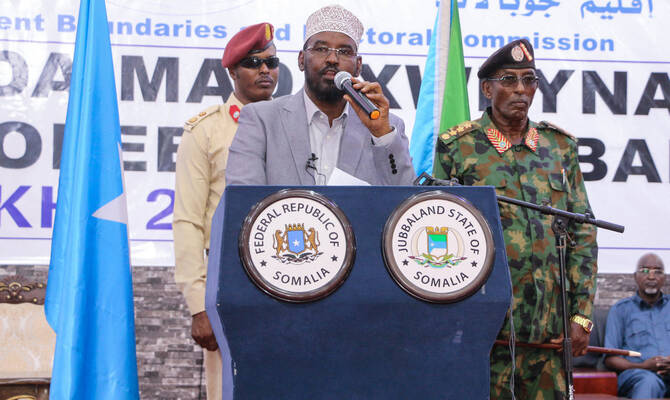
NAIROBI: Recent clashes in Somalia’s semi-autonomous Jubaland region are alarming experts, exposing cracks in the country’s federal system and creating an opening for extremist militant group Al-Shabab to gain ground.
Following years of conflict, Somalia is a loose federation of five semi-autonomous member states — Puntland, Jubaland, Galmudug, Hirshabelle and South West — that maintain often fractious relations with the central government in the capital Mogadishu.
But ahead of elections next year, Somalia has sought to assert control over its member states, which security analysts said has created gaps for Al-Shabab infiltration.
Last week, two Somali soldiers were killed in clashes between pro-government forces and Jubaland loyalists, days after both sides called for mobilization in the area. Five Somali soldiers had already died in July.
The Horn of Africa nation has battled Al-Shabab since the mid-2000s, with its fortunes rising and falling over the years. This year, the Al-Qaeda-linked group has won back major towns.
“Once the attention shifted from the fight against Al-Shabab to politics we started seeing losses and setbacks in the battlefield,” Samira Gaid, a security analyst in the Horn of Africa, told AFP.
According to Gaid, the group is using the power struggle as a “recruitment drive.”
“It really doesn’t favor anyone when these sort of incidents happen,” she said.
The deadly clashes have underscored the weakness of Somalia’s federal government, analysts said.
“There wasn’t enough political agreement at the time of the formation of the Somali federal government in 2012 and that’s why you have this constant struggle and tension within the federal model,” said International Crisis Group’s senior analyst Omar Mahmood.
Jubaland severed relations with Mogadishu last year after its leader, Ahmed Madobe, a former warlord in power since 2012, was elected for a third term in polls that the central government labelled “unlawful.”
An arrest warrant was issued against Madobe, who is based in the de facto state capital of Kismayo.
“The reason why this is spiking up now is because we are heading into the election,” Mahmood said.
Somali President Hassan Sheikh Mohamud has been pushing for the country to hold its first-ever one-man, one-vote election next year — a move opposed by Madobe.
Jubaland’s Gedo region, where last week’s clashes took place, appears to be critical for the central government.
Both Madobe and Mohamud “want to exert control over Gedo, which they also can then use to exert control over the election process,” Mahmood said.
Last month, Mohamud appointed Madobe’s former security minister, Abdirashid Hassan Abdinur, known locally as Janan, as the head of security operations in Jubaland.
Janan, seen as an influential power broker in Gedo, has previously been accused by the United Nations of serious human-rights violations.
After last week’s clashes, he announced the takeover of a key border town in Gedo, Beled Hawo, saying a new administration will be formed in the region.
The violence has taken a toll on the population. Since June, clashes in the Gedo region have displaced 38,000 people internally and forced 10,200 across the border to Kenya, according to official data.
Clan politics generally play a key role in Somalia, Jubaland included.
“The clan that resides in Gedo area has never been politically aligned to the leadership of Ahmed Madobe,” security analyst Gaid said, as the dominant clan feels marginalized by him.
In the government’s eyes, that divide could be a way to unseat Madobe. But the opposition to him is also split, and the federal government does not enjoy absolute support.
Mohamed Jumale, a traditional elder in Jubaland, is convinced Mogadishu will fail.
“We are hearing that the federal government is trying to annex Gedo from the rest of the Jubaland-administered territories before they can form a loyal administration. It will not work,” he said.


![]()

Somalia-Jubaland power struggle benefits Al-Shabab militants
Short Url
https://arab.news/pwatd
Somalia-Jubaland power struggle benefits Al-Shabab militants
- Jubaland severed relations with Mogadishu last year after its leader, Ahmed Madobe, a former warlord in power since 2012, was elected for a third term in polls that the central government labelled “unlawful”


Latest updates




© 2026 SAUDI RESEARCH & PUBLISHING COMPANY, All Rights Reserved And subject to Terms of Use Agreement.