Indonesia to make plastic recycling mandatory for producers

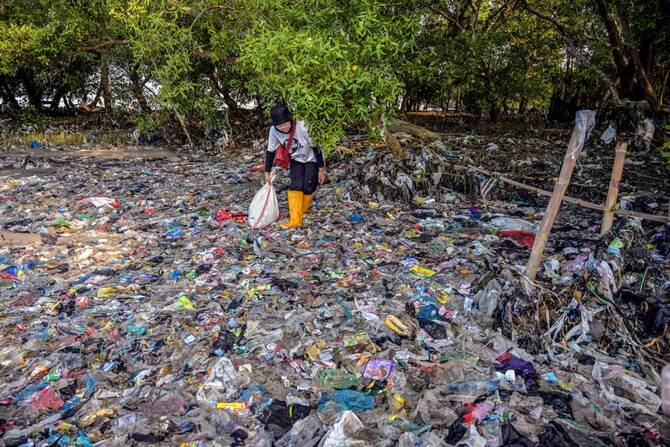
A volunteer from the Ecological Observation and Wetlands Conservation (ECOTON) collects plastic waste from a mangrove swamp in Surabaya. (File/AFP)
Short Url
Updated 20 August 2025
Follow

Indonesia to make plastic recycling mandatory for producers

  • Indonesia started to ban imports of plastic waste from developed countries on Jan. 1
  • Indonesians are the top global consumers of microplastics, according to a 2024 study

JAKARTA: Indonesia, one of the world’s nations most affected by plastic pollution, will make recycling mandatory for producers, the government has announced in a new move to tackle the crisis, following a ban on shipments of plastic waste from developed countries.

Indonesia produces around 60 million tonnes of waste annually, government data shows, around 12 percent of which is plastic. Less than 10 percent of waste is recycled in the country, while more than half ends up in landfills.

Indonesians are also the top global consumers of microplastics, according to a 2024 study by Cornell University, which estimated that they ingest about 15 grams of plastic particles per month.

“Plastic is problematic for the environment, especially the single-use ones. It creates various problems, and contains hazardous toxic materials,” Environment Minister Hanif Faisol Nurofiq told reporters earlier this week. Nurofiq was speaking after a UN summit in Geneva failed to produce the world’s first legally binding treaty to tackle plastic pollution.

“We are making an intervention through the Extended Producer Responsibility, or EPR, which is still voluntary at the moment, but we are working to make it mandatory.”

The rules of EPR are in place under a 2019 Ministerial Regulation, which requires producers in Indonesia to take full responsibility for the plastic waste generated by their products.

But the mechanism also encourages producers to design environmentally friendly products and packaging, said Muharram Atha Rasyadi, urban campaigner at Greenpeace Southeast Asia.

“EPR is not only about recycling, it’s also about prioritizing reduction schemes from the very start of the production process, including redesigning the products or transitioning to reuse alternatives,” he told Arab News on Wednesday. 

“The producer responsibility scheme should be made into an obligation that needs to be regulated in the management of plastic pollution and waste. If it’s voluntary in nature as we currently have with the 2019 Ministerial Regulation, implementation will be slow and less than ideal.”

As both a major producer and consumer of plastics, Indonesia has poor waste-management practices that has contributed to its plastic pollution problem over the years.

The country of more than 270 million people is the second-largest ocean plastic polluter, just behind China, according to a 2015 study published in the journal Science.

As the government seeks to tackle the crisis by 2029, it started to ban imports of plastic waste on Jan. 1. This comes after years of being among other Southeast Asian nations receiving this plastic scrap from developed countries including the US, UK and Australia.

Indonesia has also introduced measures to reduce single-use plastics, including Bali province’s 2019 ban on single-use plastic bags, straws, and Styrofoam, and a similar one enforced in the capital, Jakarta, in 2020.


Pakistan wary of militant attacks after Afghanistan air strikes

Updated 6 sec ago
Follow

Pakistan wary of militant attacks after Afghanistan air strikes

  • Pakistan boosts security, arrests suspects after air strikes in Afghanistan
  • Intelligence warns of potential surge in terror attacks in Pakistan
ISLAMABAD: Pakistan has boosted security and arrested dozens ​of suspects as it fears rising wave of militant attacks following its air strikes in Afghanistan, Pakistan’s Junior Interior Minister said on Wednesday. “Our forces are on high-alert to combat any attacks,” the minister, Talal Chaudhry, told Reuters. “You know the militants always react whenever we go after their hideouts in Afghanistan.” Pakistan carried out air strikes on targets in Afghanistan over the weekend on what it said were militant targets responsible for a spate of recent suicide bombings ‌on Pakistani soil.
Islamabad ‌blames Kabul for allowing the fighters to ​use Afghanistan ‌as ⁠a safe ​haven. ⁠Kabul denies the charges, saying the militancy is Pakistan’s internal problem.
Pakistani and Afghan forces exchanged fire along their border on Tuesday, with each side accusing the other of initiating the clash.
There have also been a number of militant attacks, including the ambush of a police vehicle in Kohat city in Pakistan’s northwestern Khyber Pakhtunkhwa province in which five officers and two civilians were killed and ⁠a suicide bombing at a checkpoint that killed two policemen.
Chaudhry ‌said the retaliatory attacks by militants proved Islamabad’s ‌case that they had linkages in Afghanistan, ​adding that the forces had averted ‌several attacks in recent weeks and arrested a number of suspects, including ‌Afghans.
Security forces have accelerated search and intelligence based operations and “have arrested dozens of suspected militants, their handlers and their facilitators,” the minister said.
Multiple sources added that Pakistan’s intelligence agencies have issued alerts for a possible surge in terror attacks in Pakistan in coming days.
Urban ‌centers, markets, security forces and places of worship could be possible targets, according to the alerts, the sources said.
“We have ⁠been given a ⁠strong caution about more terror attacks in our official communications. In this regard, we have almost doubled our search operations across Pakistan,” said an intelligence official.
Another intelligence official added the provinces of Khyber Pakhtunkhwa and Balochistan are already under terror attacks and “we fear that Afghanistan will retaliate against Pakistan through terror networks in Punjab and Sindh as well.”
Militancy is a growing problem for Pakistan with the number of attacks rising every year since 2022, according to Armed Conflict Location & Event Data (ACLED), a global monitoring organization.
Data from ACLED shows attacks in Pakistan rose nearly fourfold to 2,425 in 2025 from 658 ​in 2022 and over the ​same period, TTP attacks increased more than seven-fold to 838 from 118.