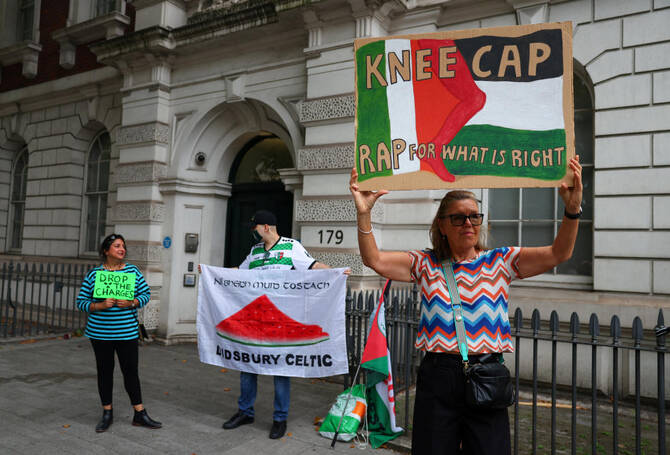
LONDON: A member of Irish rap group Kneecap was welcomed by hundreds of supporters as he arrived at a London court on Wednesday, charged with a terrorism offense for allegedly displaying a flag in support of Iran-backed Lebanese militia Hezbollah.
Liam Óg Ó hAnnaidh, who was initially charged under the Anglicized name Liam O’Hanna and whose stage name is Mo Chara, is alleged to have waved the flag of the banned militant group Hezbollah during a Kneecap gig in London in November 2024.
The 27-year-old was charged in May under the Terrorism Act, under which it is a criminal offense to display an article in a way which arouses reasonable suspicion that someone is a supporter of a proscribed organization.
Wednesday’s hearing at Westminster Magistrates’ Court is expected to deal with Óg Ó hAnnaidh’s argument that the charge was brought too late and should be thrown out, failing which he is likely to formally enter a plea.
Belfast-based Kneecap, who rap in Irish and English and regularly display pro-Palestinian messages during their gigs, previously said the flag had been thrown on stage and described the charge as an attempt to silence them.
The group – who rap about Irish identity and support the republican cause of uniting Northern Ireland with the Republic of Ireland – have been increasingly vocal about the war in Gaza since Óg Ó hAnnaidh was charged.
Kneecap led a 30,000-strong crowd at Glastonbury Festival in June in chants against Prime Minister Keir Starmer and accused Israel of committing war crimes in Gaza, which Israel denies.

Member of Irish rap group Kneecap appears at UK court on terrorism charge
Short Url
https://arab.news/g9gp5
Member of Irish rap group Kneecap appears at UK court on terrorism charge
- Belfast-based Kneecap, who rap in Irish and English and regularly display pro-Palestinian messages during their gigs
France to vaccinate cattle for lumpy skin disease as farmers protest against cull
PARIS: France will vaccinate 1 million head of cattle in the coming weeks against lumpy skin disease, Agriculture Minister Annie Genevard said on Saturday, as protesting farmers blocked roads in opposition to the government’s large-scale culling policy.
The announcement comes after several outbreaks of the highly contagious disease prompted authorities to order the culling of entire herds, sparking demonstrations by farmers who consider the measure excessive.
Lumpy skin disease is a virus spread by insects that affects cattle and buffalo, causing blisters and reducing milk production. While not harmful to humans, it often results in trade restrictions and severe economic losses.
“We will vaccinate nearly one million animals in the coming weeks and protect farmers. I want to reiterate that the state will stand by affected farmers, their losses will be compensated as well as their operating losses,” Genevard told local radio network ICI.
France says that total culling of infected herds, alongside vaccination and movement restrictions, is necessary to contain the disease and allow cattle exports. If the disease continues to spread in livestock farms, it could kill “at the very least, 1.5 million cattle,” Genevard told Le Parisien daily in a previous interview.
A portion of the A64 motorway south of Toulouse remained blocked since Friday afternoon, with about 400 farmers and some 60 tractors still in place on Saturday morning, according to local media.
The government, backed by the main FNSEA farming union, maintains that total culling of infected herds is necessary to prevent the disease from spreading and triggering export bans that would devastate the sector.
But the Coordination Rurale, a rival union, opposes the systematic culling approach, calling instead for targeted measures and quarantine protocols.
“Vaccination will be mandatory because vaccination is protection against the disease,” Genevard said, adding that complete culling remains necessary in some cases because the disease can be asymptomatic and undetectable.
France detected 110 outbreaks across nine departments and culled about 3,000 animals, according to the agriculture ministry. It has paid nearly six million euros to farmers since the first outbreak on June 29.
The announcement comes after several outbreaks of the highly contagious disease prompted authorities to order the culling of entire herds, sparking demonstrations by farmers who consider the measure excessive.
Lumpy skin disease is a virus spread by insects that affects cattle and buffalo, causing blisters and reducing milk production. While not harmful to humans, it often results in trade restrictions and severe economic losses.
“We will vaccinate nearly one million animals in the coming weeks and protect farmers. I want to reiterate that the state will stand by affected farmers, their losses will be compensated as well as their operating losses,” Genevard told local radio network ICI.
France says that total culling of infected herds, alongside vaccination and movement restrictions, is necessary to contain the disease and allow cattle exports. If the disease continues to spread in livestock farms, it could kill “at the very least, 1.5 million cattle,” Genevard told Le Parisien daily in a previous interview.
A portion of the A64 motorway south of Toulouse remained blocked since Friday afternoon, with about 400 farmers and some 60 tractors still in place on Saturday morning, according to local media.
The government, backed by the main FNSEA farming union, maintains that total culling of infected herds is necessary to prevent the disease from spreading and triggering export bans that would devastate the sector.
But the Coordination Rurale, a rival union, opposes the systematic culling approach, calling instead for targeted measures and quarantine protocols.
“Vaccination will be mandatory because vaccination is protection against the disease,” Genevard said, adding that complete culling remains necessary in some cases because the disease can be asymptomatic and undetectable.
France detected 110 outbreaks across nine departments and culled about 3,000 animals, according to the agriculture ministry. It has paid nearly six million euros to farmers since the first outbreak on June 29.
© 2025 SAUDI RESEARCH & PUBLISHING COMPANY, All Rights Reserved And subject to Terms of Use Agreement.


