

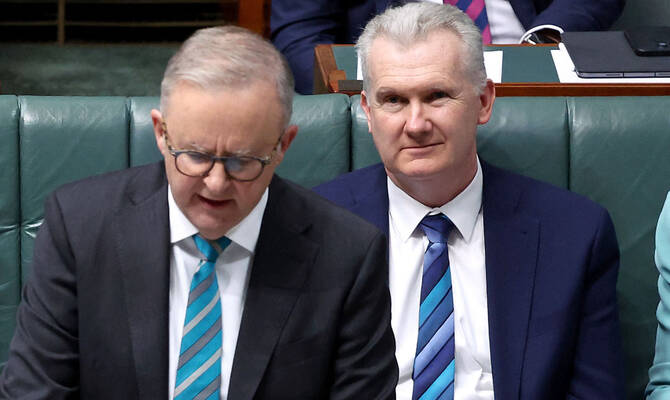

SYDNEY: Australia lashed Israeli leader Benjamin Netanyahu on Wednesday after he said the country’s prime minister was weak, with a top minister saying strength was more than “how many people you can blow up.”
For decades, Australia has considered itself a close friend of Israel, but the relationship has swiftly unraveled since Canberra announced last week it would recognize a Palestinian state.
Netanyahu drastically escalated a war of words on Tuesday night, calling his Australian counterpart Anthony Albanese a “weak politician who betrayed Israel.”
Australian Home Affairs Minister Tony Burke said Wednesday it was the sign of a frustrated leader “lashing out.”
“Strength is not measured by how many people you can blow up or how many children you can leave hungry,” Burke told national broadcaster ABC.
“What we’ve seen with some of the actions they are taking is a continued isolation of Israel from the world, and that is not in their interests either.”
Australian Prime Minister Anthony Albanese said on Wednesday that he treats leaders of other countries with respect after Netanyahu attacked him.
“I don’t take these things personally, I engage with people diplomatically. He has had similar things to say about other leaders,” Albanese said during a media briefing.
Albanese told reporters that he had informed Netanyahu about Australia’s decision to support a Palestinian state before his center-left government formally announced the plan.
“At that time, I gave Prime Minister Netanyahu a clear indication of my view and Australia’s view going forward but also a clear indication of the direction in which we were headed,” Albanese said.
“I gave him the opportunity to outline what political solution there was and gave him that opportunity.”
Through the 1950s, Australia was a refuge for Jews fleeing the horrors of the Holocaust.
The city of Melbourne at one point housed, per capita, the largest population of Holocaust survivors anywhere outside of Israel.
Netanyahu was infuriated when Australia declared it would recognize Palestinian statehood next month, following similar pledges from France, Canada and the United Kingdom.
In the space of nine days since that decision, relations between Australia and Israel have plummeted.
Australia on Monday canceled the visa of far-right Israeli politician Simcha Rothman — a member of Netanyahu’s governing coalition — saying his planned speaking tour would “spread division.”
The tit-for-tat continued on Tuesday, when Israel retaliated by revoking visas held by Canberra’s diplomatic representatives to the Palestinian Authority.
Then came Netanyahu’s social media outburst. “History will remember Albanese for what he is: A weak politician who betrayed Israel and abandoned Australia’s Jews,” he said on X.
Israel finds itself increasingly isolated as it continues to wage war in Gaza, a conflict triggered by the October 2023 attack by Palestinian militant group Hamas.
UN-backed experts have warned of widespread famine unfolding in the territory, where Israel has severely restricted the entry of humanitarian aid.
New Zealand Prime Minister Christopher Luxon said last week that Netanyahu had “lost the plot.”
Relations between Australia and Israel started fraying late last year following a spate of anti-Semitic attacks in Sydney and Melbourne.
Netanyahu accused the Australian government of harboring “anti-Israel sentiment” after a synagogue was firebombed in December.
With Agencies


