

A Gaza-bound ship that left Cyprus with 1,200 tons of food aid nears Israeli port

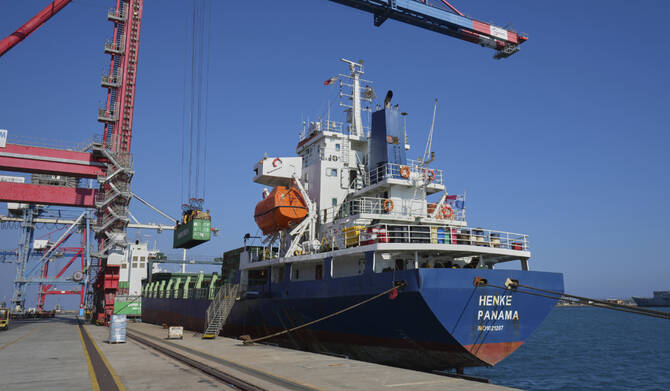
Containers loaded with humanitarian aid for the people of Gaza, including flour, pasta, baby food and canned goods, is being loaded aboard a Panamanian-flagged ship at Cyprus' main port in Limassol, on Monday, Aug. 18, 2025. (AP)
Short Url
Updated 20 August 2025
Follow

A Gaza-bound ship that left Cyprus with 1,200 tons of food aid nears Israeli port

  • The Panamanian-flagged vessel HENKE is loaded with 52 containers carrying food aid such as pasta, rice, baby food and canned good
  • Israel announced plans to reoccupy Gaza City and other heavily populated areas after ceasefire talks stalled last month, raising the possibility of a worsening humanitarian catastrophe in Gaza, which experts say is sliding into famine

LIMASSOL, Cyprus: A ship that set off from Cyprus loaded with 1,200 tons of food supplies for the Gaza Strip approached the Israeli port of Ashdod on Tuesday in a renewed effort to alleviate the worsening crisis in the Palestinian territory, where food security experts say the “worst-case scenario of famine” is unfolding.

The Panamanian-flagged vessel HENKE is loaded with 52 containers carrying food aid such as pasta, rice, baby food and canned goods. Israeli customs officials had screened the aid at the Cypriot port of Limassol, from where the ship departed on Monday.

The ship was expected to dock at Ashdod late Tuesday and start offloading the aid on Wednesday.

Some 700 tons of the aid is from Cyprus, purchased with money donated by the United Arab Emirates to the so-called Amalthea Fund, set up last year for donors to help with seaborne aid. The rest comes from Italy, the Maltese government, a Catholic religious order in Malta and the Kuwaiti nongovernmental organization Al Salam Association.

“The situation is beyond dire,” Cyprus Foreign Minister Constantinos Kombos told The Associated Press.

Cyprus was the staging area last year for 22,000 tons of aid deliveries by ship directly to Gaza through a pier operated by the international charity World Central Kitchen and a US military-run docking facility known as the Joint Logistics Over-the-Shore system.

By late July 2024, aid groups pulled out of the project, ending a mission plagued by repeated weather and security problems that limited how much food and other emergency supplies could get to those in need.

Cypriot Foreign Ministry said the aid mission is led by the United Nations but is a coordinated effort — once offloaded at Ashdod, UN employees will arrange for the aid to be trucked to storage areas and food stations operated by the World Central Kitchen.

The charity, which was behind the first aid shipment to Gaza from Cyprus last year aboard a tug-towed barge, is widely trusted in the battered territory.

“The contribution of everyone involved is crucial and their commitment incredible,” Kombos said.

Shipborne deliveries can bring much larger quantities of aid than the air drops that several nations have recently made in Gaza.

United Nations Office for Operations Chief Jorge Moreira da Silva called Tuesday’s shipment a “crucial step in alleviating suffering in Gaza.”

“We need rapid, unhindered and safe flow of humanitarian aid for all civilians in need,” he posted on X.

The latest shipment comes a day after Hamas said it has accepted a new proposal from Arab mediators for a ceasefire. Israel has not approved the latest proposal so far.

Israel announced plans to reoccupy Gaza City and other heavily populated areas after ceasefire talks stalled last month, raising the possibility of a worsening humanitarian catastrophe in Gaza, which experts say is sliding into famine.

Israeli Prime Minister Benjamin Netanyahu has dismissed reports of starvation in Gaza as “lies” promoted by Hamas. But the UN last week warned that starvation and malnutrition in the Palestinian territory are at their highest levels since the war began with the Hamas-led attack on southern Israel on Oct. 7, 2023, in which the militants abducted 251 people and killed around 1,200, mostly civilians.

Gaza’s Health Ministry, which is part of the Hamas-run government and staffed by medical professionals, said the Palestinian death toll from 22 months of war has passed 62,000. It does not say how many were civilians or combatants, but says women and children make up around half the dead. The United Nations and other independent experts view its figures as the most reliable count of casualties.


Refugee firefighters in Mauritania battle bushfires to give back to the community that took them in

Updated 58 min 36 sec ago
Follow

Refugee firefighters in Mauritania battle bushfires to give back to the community that took them in

  • For the refugee firefighters, battling the blazes is a way of giving back to the community that took them in when they fled violence and instability at home in Mali

MBERA: The men move in rhythm, swaying in line and beating the ground with spindly tree branches as the sun sets over the barren and hostile Mauritanian desert. The crack of the wood against dry grass lands in unison, a technique perfected by more than a decade of fighting bushfires.
There is no fire today but the men — volunteer firefighters backed by the UN refugee agency — keep on training.
In this region of West Africa, bushfires are deadly. They can break out in the blink of an eye and last for days. The impoverished, vast territory is shared by Mauritanians and more than 250,000 refugees from neighboring Mali, who rely on the scarce vegetation to feed their livestock.
For the refugee firefighters, battling the blazes is a way of giving back to the community that took them in when they fled violence and instability at home in Mali.
Newcomers with an old tradition
Hantam Ag Ahmedou was 11 years old when his family left Mali in 2012 to settle in the Mbera refugee camp in Mauritania, 48 kilometers (30 miles) from the Malian border. Like most refugees and locals, his family are herders and once in Mbera, they saw how quickly bushfires spread and how devastating they can be.
“We said to ourselves: There is this amazing generosity of the host community. These people share with us everything they have,” he told The Associated Press. “We needed to do something to lessen the burden.”
His father started organizing volunteer firefighters, at the time around 200 refugees. The Mauritanians had been fighting bushfires for decades, Ag Ahmedou said, but the Malian refugees brought know-how that gave them an advantage.
“You cannot stop bushfires with water,” Ag Ahmedou said. “That’s impossible, fires sometimes break out a hundred kilometers from the nearest water source.”
Instead they use tree branches, he said, to smother the fire.
“That’s the only way to do it,” he said.
The volunteer ‘brigade’
Since 2018, the firefighters have been under the patronage of the UNHCR. The European Union finances their training and equipment, as well as the clearing of firebreak strips to stop the fires from spreading. The volunteers today count over 360 refugees who work with the region’s authorities and firefighters.
When a bushfire breaks out and the alert comes in, the firefighters jump into their pickup trucks and drive out. Once at the site of a fire, a 20-member team spreads out and starts pounding the ground at the edge of the blaze with acacia branches — a rare tree that has a high resistance to heat.
Usually, three other teams stand by in case the first team needs replacing.
Ag Ahmedou started going out with the firefighters when he was 13, carrying water and food supplies for the men. He helped put out his first fire when he was 18, and has since beaten hundreds of blazes.
He knows how dangerous the task is but he doesn’t let the fear control him.
“Someone has to do it,” he said. “If the fire is not stopped, it can penetrate the refugee camp and the villages, kill animals, kill humans, and devastate the economy of the whole region.”
A climate-vulnerable nation
About 90 percent of Mauritania is covered by the Sahara Desert. Climate change has accelerated desertification and increased the pressure on natural resources, especially water, experts say. The United Nations says tensions between locals and refugees over grazing areas is a key threat to peace.
Tayyar Sukru Cansizoglu, the UNHCR chief in Mauritania, said that with the effects of climate change, even Mauritanians in the area cannot find enough grazing land for their own cows and goats — so a “single bushfire” becomes life-threatening for everyone.
When the first refugees arrived in 2012, authorities cleared a large chunk of land for the Mbera camp, which today has more than 150,000 Malian refugees. Another 150,000 live in villages scattered across the vast territory, sometimes outnumbering the locals 10 to one.
Chejna Abdallah, the mayor of the border town of Fassala, said because of “high pressure on natural resources, especially access to water,” tensions are rising between the locals and the Malians.
Giving back
Abderrahmane Maiga, a 52-year-old member of the “Mbera Fire Brigade,” as the firefighters call themselves, presses soil around a young seedling and carefully pours water at its base.
To make up for the vegetation losses, the firefighters have started setting up tree and plant nurseries across the desert — including acacias. This year, they also planted the first lemon and mango trees.
“It’s only right that we stand up to help people,” Maiga said.
He recalls one of the worst fires he faced in 2014, which dozens of men — both refugees and host community members — spent 48 hours battling. By the time it was over, some of the volunteers had collapsed from exhaustion.
Ag Ahmedou said he was aware of the tensions, especially as violence in Mali intensifies and going back is not an option for most of the refugees.
He said this was the life he was born into — a life in the desert, a life of food scarcity and “degraded land” — and that there is nowhere else for him to go. Fighting for survival is the only option.
“We cannot go to Europe and abandon our home,” he said. “So we have to resist. We have to fight.”