Saudi Cabinet condemns Netanyahu’s ‘Greater Israel’ policy, reaffirms support for Palestine

Saudi Arabia’s Cabinet on Tuesday strongly condemned remarks by the Israeli prime minister, Benjamin Netanyahu, regarding his vision for a so-called “Greater Israel,” and rejected what it described as expansionist settlement projects that violate the rule of international law and undermine Palestinian rights. (SPA)
Short Url
Updated 19 August 2025
Follow

Saudi Cabinet condemns Netanyahu’s ‘Greater Israel’ policy, reaffirms support for Palestine

  • Members denounce latest Israeli plans for settlements near Jerusalem, call on international community to take action to halt crimes against the Palestinian people
  • Ministers reiterate Kingdom’s support for diplomatic efforts to resolve war in Ukraine, welcome US president’s meetings with Russian, Ukrainian and European counterparts

NEOM: Saudi Arabia’s Cabinet on Tuesday strongly condemned remarks by the Israeli prime minister, Benjamin Netanyahu, regarding his vision for a so-called “Greater Israel,” and rejected what it described as expansionist settlement projects that violate the rule of international law and undermine Palestinian rights.

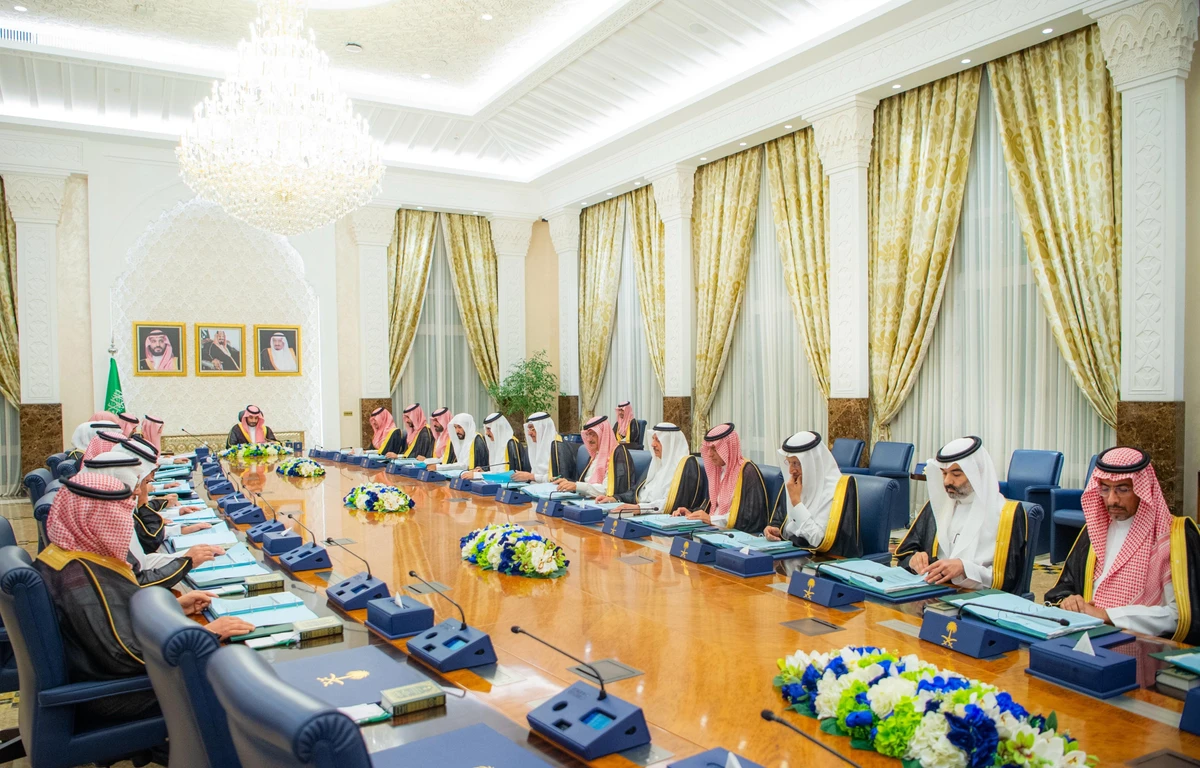
During a meeting in NEOM chaired by Crown Prince Mohammed bin Salman, Cabinet members reaffirmed the Kingdom’s firm stance on the historical and legal right of the Palestinian people to establish an independent, sovereign state on their lands.

Ministers also denounced recent approvals for new Israeli settlements in areas around occupied Jerusalem, and called on the international community, particularly the permanent members of the UN Security Council, to take immediate action to halt what they described as crimes against the Palestinian people and ensure that Israeli authorities comply with UN resolutions, the Saudi Press Agency reported.

After the meeting, the acting minister of media, Essam bin Saad bin Saeed, said the Cabinet had addressed other regional and international issues, and reiterated Saudi support for diplomatic efforts to peacefully resolve the conflict between Russia and Ukraine. Members welcomed US President Donald Trump’s recent meetings with Russian President Vladimir Putin, Ukrainian President Volodymyr Zelensky and European leaders.

Tuesday was World Humanitarian Day, and to mark the occasion the Cabinet highlighted Saudi Arabia’s longstanding commitment to aid efforts, noting the Kingdom’s prominent position among the ranks of the world’s largest donor nations.

On the domestic from, members reviewed achievements in the education sector ahead of the start of the new academic year, including curriculum development, the integration of artificial intelligence, expanded technical training, and support for innovation and the development of talent.

They also approved several cooperation agreements and memorandums of understanding with international partners in a variety of fields including sports and tourism, customs, health, and the development of small and medium enterprises. Agreements with the US, Spain, Syria, Qatar, Azerbaijan, Kyrgyzstan, Grenada and the Maldives were endorsed.

In addition, Cabinet members approved the introduction of new systems governing handicrafts, environmental coordination, and promotions and transfers within senior government ranks, the SPA added.
Northern Borders rock art reveals ancient life

Updated 6 sec ago
Follow

Northern Borders rock art reveals ancient life

  • Among the most notable remains are stone structures scattered northwest of Arar
  • Evidence ranges from the Neolithic era to Islamic times, forming a chronological record

JEDDAH: Saudi Arabia’s Northern Borders region contains numerous archaeological sites, reflecting a long history of human settlement dating back to early periods, the Saudi Press Agency reported.
Among the most notable remains are stone structures scattered northwest of Arar.
Varying in shape, size and design, specialists believe these structures date to the end of the Neolithic period and the beginning of subsequent eras. They are thought to have been used as stone tombs to preserve the remains of the dead.
Evidence ranges from the Neolithic era to Islamic times, forming a chronological record that highlights the diversity of communities that once lived in the region and how they interacted with their natural environment over centuries.
Ajab Al-Otaibi, director general of antiquities at the Heritage Commission, said the stone structures and rock art sites in the Northern Borders region represent an integral part of Saudi Arabia’s national cultural heritage and serve as an important resource for archaeological studies and scientific research.
He highlighted the importance of surveys, documentation and protection efforts to preserve these cultural landmarks as a historical legacy for future generations.
The region is also home to several important rock art sites, such as Shu’ayb Hamer, which features a wide and diverse collection of drawings carved on natural rock surfaces, marking it as a key site that documented early human activity in the area.
The artworks depict scenes of hunting, horsemanship, dancing, daily life and social rituals. They were created using a variety of artistic styles, most notably framed and abstract forms, and produced through different techniques including incizing and pecking, both direct and indirect.
The carvings portray human figures and a range of animals, including camels, horses and gazelles, as well as some wild and predatory species that have long since disappeared.
These images provide insight into the richness of the natural environment in earlier periods and help researchers understand the evolving relationship between humans and their surroundings.