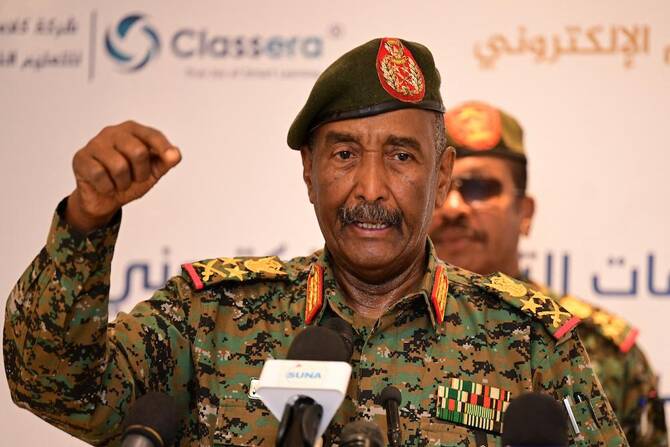
CAIRO: Sudan’s army chief appointed a raft of new senior officers on Monday in a reshuffle that strengthened his hold on the military as he consolidates control of central and eastern regions and fights fierce battles in the west.
Sudan’s army, which controls the government, is fighting a more than two-year civil war with the paramilitary Rapid Support Forces, its former partners in power, that has created the world’s largest humanitarian crisis.
General Abdel Fattah Al-Burhan made new appointments to the Joint Chiefs of Staff a day after announcing the retirement of several long-serving officers, some of whom have gained a measure of fame over the past two years.
Burhan, who serves as Sudan’s internationally recognized head of state, kept the chairman of the Joint Chiefs of Staff, General Mohamed Othman Al-Hussein, but appointed a new inspector general and a new head of the air force.
Another decree from Burhan on Sunday brought all the other armed groups fighting alongside the army – including former Darfur rebels, Islamist brigades, civilians who joined the war effort and tribal militias – under his control.
Sudanese politicians praised the decision, saying it would prevent the development of other centers of power in the military, and potentially the future formation of other parallel forces like the RSF.
The RSF has its roots in Arab militias armed by the military in the early 2000s to fight in Darfur. It was allowed to develop parallel structures and supply lines.
The reshuffle comes a week after Burhan met US senior Africa adviser Massad Boulos in Switzerland, where issues including a transition to civilian rule were discussed, government sources said.
The war erupted in April 2023 when the army and the RSF clashed over plans to integrate their forces.
The RSF made quick gains in central Sudan, including the capital Khartoum, but the army pushed them westward this year, leading to an intensification in fighting in Al-Fashir in Darfur.


![]()

Sudan’s Burhan shakes up army, tightens control
Short Url
https://arab.news/bu4zp
Sudan’s Burhan shakes up army, tightens control
- Sudan’s army is fighting a more than two-year civil war with the paramilitary Rapid Support Forces
- General Abdel Fattah Al-Burhan makes new appointments to the Joint Chiefs of Staff


Latest updates


Recommended


© 2026 SAUDI RESEARCH & PUBLISHING COMPANY, All Rights Reserved And subject to Terms of Use Agreement.