



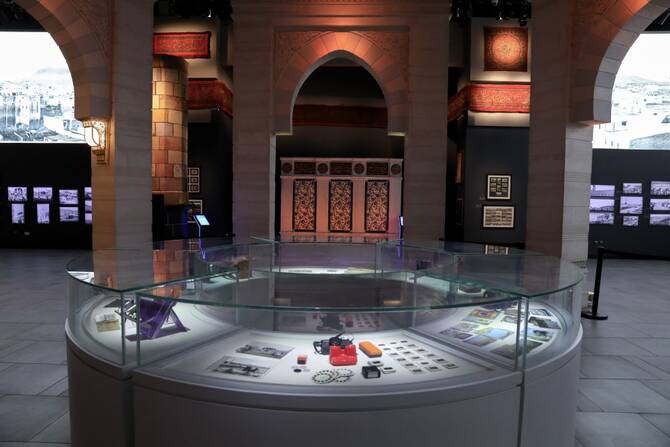



JEDDAH: A treasure trove of rare manuscripts, drawings and photographs at Al-Makkatain Museum is giving visitors an unprecedented view of Makkah and Madinah through the centuries.
Founded by Anas bin Saleh Serafi through the Al-Midad Foundation for Heritage, Culture and Arts, the museum opened in April 2022, to coincide with International Heritage Day.
Located within a 10,000-square-meter space at Jeddah Park Mall, it places culture at the heart of community life and national identity.
In an interview with Arab News, Mohammed Al-Kurbi, general supervisor of the foundation, said the museum’s mission was “to raise both local and global awareness of the exceptional spiritual and cultural significance of the Holy Cities in the collective memory of Muslims and humanity.”
A collection spanning five centuries
Al-Makkatain houses more than 500 original works, including 300 manuscripts, illustrations and prints from the 16th to 19th centuries, and 200 rare photographs taken between the late 1800s and mid-1900s. Together they form a visual archive that preserves the evolving memory of the Two Holy Mosques.
“The museum displays rare books authored by Orientalists, historians and explorers, making it a rich intellectual platform that narrates the story of the Holy Cities through a compelling visual lens,” Al-Kurbi said.
The museum’s name comes from the Arabic dual form “Al-Makkatain,” much like “Al-Abawain” for “parents” or “Al-Qamarain” for “the sun and moon.”
The permanent collection includes a rare manuscript of “Dala’il al-Khayrat” by Imam al-Jazuli, gifted to Serafi, and personal belongings of his father, Sheikh Saleh Hamza Serafi, displayed in a section titled “The Journey of Struggle and Achievement.”
Another wing, Al-Zuhra Museum, features traditional attire and jewelry donated by Serafi’s wife, Zuhra Qattan.
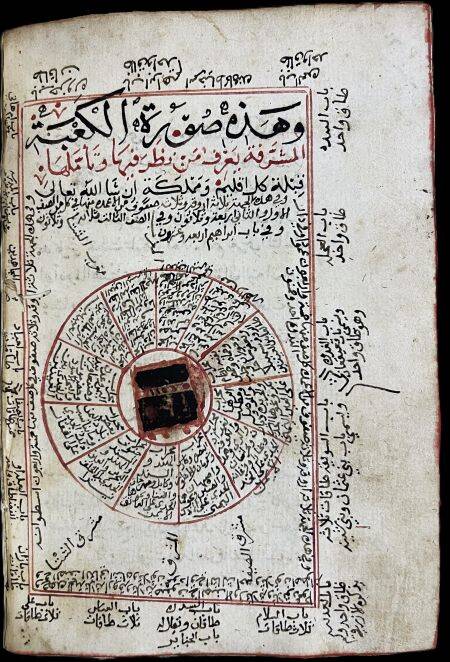
Other notable works include a manuscript of “Kharidat al-‘Aja’ib wa Faridat al-Ghara’ib” by Siraj al-Din ibn Al-Wardi (dated 1007 AH), with one of the earliest known hand-drawn illustrations of the Holy Kaaba.
A detailed schematic of the Grand Mosque dated 1287 AH is also displayed.
Three galleries, one story
The museum is arranged in three chronological galleries:
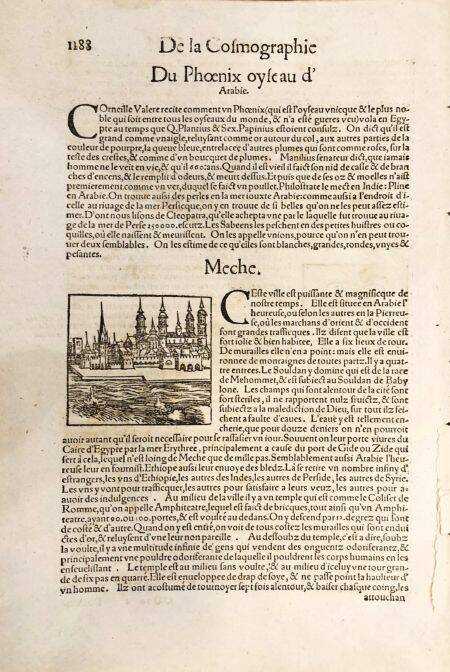
Pre-Camera Art (1550–1880): Early renderings of the Grand Mosque, the Prophet’s Mosque and sacred sites by Muslim and European artists. The oldest depiction is a 16th-century drawing of Makkah by German cartographer Sebastian Munster.
There are contributors from famous Muslim artists like Faqir Hafiz Khuda Bakhsh and European illustrators such as Alain Manesson Mallet and Jean-Baptiste Claude Delisle from France and Bernard Picart of the Netherlands.
Early Photographers (1880–1920): Rare images by pioneers such as Egyptian officer Mohammad Sadiq Bey, Abdul Ghaffar Baghdadi and Dutch Orientalist Snouck Hurgronje, among others. The museum’s oldest known photograph dates to 1880, taken by Bey.
The Golden Age of Photography (1920–present): Saudi photographers, including the Bushnaq family and Shafiq Arab Garli, documented the rapid changes in the holy sites. Works by Mohammad Helmy, commissioned in 1947 to photograph the Two Holy Mosques, mark a turning point in the archive. The gallery traces the advent of color photography and transformations during the early Saudi era. The most recent acquisition is a black-and-white photograph of the Grand Mosque by Princess Reem bint Mohammed bin Faisal Al-Saud.
“Through this chronological sequencing, the museum offers visitors a unique experience that brings together art, history and visual storytelling— demonstrating how global perspectives on the Holy Mosques have evolved,” Al-Kurbi said.
Preserving memory, shaping understanding
The museum highlights both the artistry and limitations of pre-photographic depictions and contrasts them with the accuracy of photographs, which arrived in the 19th century.
Exhibits include copperplate engravings, early prints, stereographs and glass slides once used in “magic lantern” projections.
“Makkah and Madinah were long isolated from the reach of photographers due to several factors,” Al-Kurbi said.
“Most notably, the prohibition of non-Muslims from entering Makkah, as well as the technical limitations of early photographic equipment. Additionally, the region’s harsh geographic and climatic conditions, coupled with security challenges and the local population’s wariness of outsiders, made visual documentation a significant challenge.”
By juxtaposing early artistic imagination with photographic realism, the museum not only preserves images but also illustrates the evolution of documentation itself.
“In doing so, the museum becomes a dynamic cultural and educational space that inspires visitors and deepens their understanding of how imagery has been captured and conveyed through the ages,” Al-Kurbi said.
A space for all generations
For many elderly visitors, the museum rekindles memories of how the Holy Mosques once looked
Mohammed Al-Zahrany, 65, who discovered the museum by chance while shopping with his family, described how the experience evoked deep nostalgia and reflection on the social and architectural transformations that had taken place.
Younger visitors are also struck by the dramatic changes illustrated in the drawings and photographs.
“The exhibits introduce a visual history,” said 19-year-old Samah Ahmad. “It enriched my understanding of the sacred sites and deepened their historical and spiritual significance.”
The museum also serves as a valuable resource for researchers, historians and students, offering a rare archive for studying how Makkah and Madinah have been represented and reimagined over centuries.
For Al-Makkatain, the goal is not only preservation, but linking the past and present through images that continue to resonate with Saudis and Muslims around the world.


