



ISLAMABAD: Pakistan will launch this month a real-time digital tracking system to monitor the complete cycle of all petroleum products from their import to sale at fuel stations to curb smuggling and black marketing of fuel, an official said on Monday.
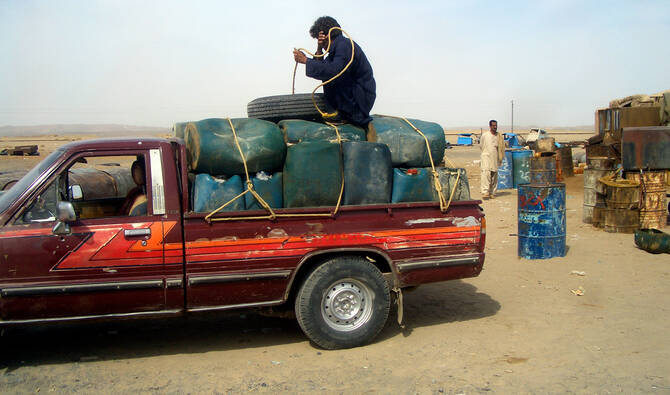
An April 2024 Petroleum Division intelligence report revealed that around 10 million liters of Iranian fuel was being smuggled into Pakistan daily, causing losses of over Rs227 billion ($805 million) annually. On Aug. 13, Pakistan’s National Assembly passed the Petroleum (Amendment) Act 2025, which would amend the decades-old Petroleum Act 1934, giving regulators the authority to introduce IT-based systems for real-time monitoring of petroleum products.
The draft legislation proposes punishments for illegal supply, storage and sale of petroleum products, and aims to strengthen coordination among enforcement agencies by introducing IT-enabled digital tracking of petroleum products by covering storage, transportation and dispensing at fuel stations, storage facilities and along supply routes, with authorities empowered to act jointly or independently.
After its passage by the National Assembly, the lower house of parliament, and the Senate standing committee for petroleum, the draft legislation now awaits a nod from the upper house for it to become a law and pave the way for the implementation of the new tracking system.
“The [draft] law has already been passed by the National Assembly and today [Monday], it was approved by the Senate Standing Committee. Now it will be laid before the Senate within next few days for its final passage to become a law,” Imran Ghaznavi, an Oil and Gas Regulatory Authority (OGRA) spokesperson, told Arab News.
“Once the law is enacted, the real-time digital monitoring system of petroleum products will begin within this month as most of the system is ready,” he said, adding that OGRA had already completed tagging of fuel tankers and stations.
Until now, the end-to-end petroleum delivery was regulated but not digitally monitored, with the manual collection of data causing huge losses, according to Ghaznavi.
OGRA, in collaboration with industry stakeholders, has spent several months on the technical framework to ensure a smooth launch of the digital tracking system.
“The tankers have trackers, but real-time monitoring is not done [at present],” he said. “OGRA has installed digital mapping at almost all petroleum stations which are more than 10,000 across Pakistan.”
In the second phase, he shared, OGRA has decided to digitize the movement of all petroleum products, from port to depot, refinery to depot, depot to depot, and depot to fuel stations, so that it can be monitored in real time.
“The benefit of this step is that smuggled products can be detected by calculating discrepancies,” he said, explaining that if a fuel station purchased a certain amount of product but sold more than that, or if a fuel station had dormant petroleum stock yet continued selling beyond its recorded supply, then such irregularities would be identified through the new system.
The new law also proposes punishments such as confiscation of equipment and vehicles, and penalties for smugglers that would create a deterrent and discourage illegal sales of petroleum products, according to the OGRA spokesman.
“Illegal imports, transports, stores, sales produce, refines or blends of any petroleum [product] shall be punishable by a fine of 1 million rupees ($3,525),” says the draft legislation seen by Arab News, adding that whoever repeats the offense shall be liable to pay a fine of 5 million rupees ($17,627).
The law says any facility used for storage and selling of petroleum products to general public, without a license from relevant authority, shall be liable to sealing.
“All machinery, equipment, materials, storage tanks, receptacles and petroleum products being employed or sold therein shall be liable to confiscation by the Deputy Commissioner or any officer authorized by him and the owner thereof shall pay fine of ten million rupees ($35,255),” it read.
OGRA has signed a contract with the Punjab Information Technology Board (PITB) to develop a complete digital system to monitor the entire supply chain by tracking lorries and trucks from port to retail fuel stations, according to Ghaznavi.
All refineries and 95 percent Oil Marketing Companies (OMCs) already have Enterprise Resource Planning (ERP) systems in place, which would be integrated into the new digital tracking system immediately.
“The remaining five percent will also be added soon. That means that nearly 95 to 98 percent of petroleum products will be tracked,” he added.


