

Pakistan tell Babar to improve strike rate for T20 comeback

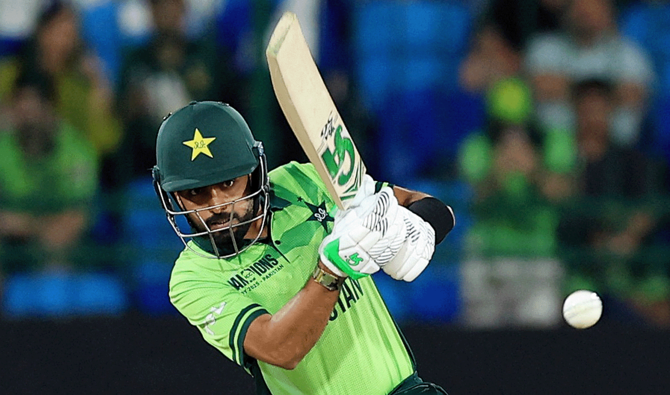
Pakistan cricket team's former captain, Babar Azam, batting during the ICC Men's Champions Trophy match at the National Stadium in Karachi, Pakistan on February 19, 2025. (Reuters/File)
Short Url
Updated 18 August 2025
Follow

Pakistan tell Babar to improve strike rate for T20 comeback

  • Babar Azam is Pakistan’s batting mainstay in other formats but has not played a T20I since South Africa tour last year
  • Thirty-year-old could not find a place in Pakistan squad for Asia Cup next month as team looks for aggressive batters

LAHORE: Former Pakistan captain Babar Azam has been told to improve his batting against spin and boost his overall strike rate to be considered for Twenty20 Internationals, coach Mike Hesson said.

Babar is Pakistan’s batting mainstay in other formats but has not played a T20 International since their tour of South Africa late last year.

The 30-year-old could not find a place in the Pakistan squad for the Asia Cup next month as the team management showed faith in rising players such as Sahibzada Farhan.

“There’s no doubt Babar’s been asked to improve in some areas around taking on spin and in terms of his strike rate,” Hesson said of the top-order batter who has a modest strike rate of 129 in T20 Internationals.

“Those are things he’s working really hard on. But at the moment the players we have, have done exceptionally well.

“Sahibzada Farhan has played six games and won three player-of-the-match awards.”

Babar should use the Big Bash League in Australia to improve his 20-overs batting and stage a comeback, Hesson said.

“A player like Babar has an opportunity to play in the BBL and show he’s improving in those areas in T20s. He’s too good a player not to consider,” he said.

Pakistan will begin their Asia Cup Group A campaign against Oman in Dubai on September 12 before meeting arch-rivals India at the same venue two days later. 


Pakistan, global crypto exchange discuss modernizing digital payments, creating job prospects 

Updated 05 December 2025
Follow

Pakistan, global crypto exchange discuss modernizing digital payments, creating job prospects 

  • Pakistani officials, Binance team discuss coordination between Islamabad, local banks and global exchanges
  • Pakistan has attempted to tap into growing crypto market to curb illicit transactions, improve oversight

ISLAMABAD: Pakistan’s finance officials and the team of a global cryptocurrency exchange on Friday held discussions aimed at modernizing the country’s digital payments system and building local talent pipelines to meet rising demand for blockchain and Web3 skills, the finance ministry said.

The development took place during a high-level meeting between Finance Minister Muhammad Aurangzeb, Pakistan Virtual Assets Regulatory Authority (PVARA) Chairman Bilal bin Saqib, domestic bank presidents and a Binance team led by Global CEO Richard Teng. The meeting was held to advance work on Pakistan’s National Digital Asset Framework, a regulatory setup to govern Pakistan’s digital assets.

Pakistan has been moving to regulate its fast-growing crypto and digital assets market by bringing virtual asset service providers (VASPs) under a formal licensing regime. Officials say the push is aimed at curbing illicit transactions, improving oversight, and encouraging innovation in blockchain-based financial services.

“Participants reviewed opportunities to modernize Pakistan’s digital payments landscape, noting that blockchain-based systems could significantly reduce costs from the country’s $38 billion annual remittance flows,” the finance ministry said in a statement. 

“Discussions also emphasized building local talent pipelines to meet rising global demand for blockchain and Web3 skills, creating high-value employment prospects for Pakistani youth.”

Blockchain is a type of digital database that is shared, transparent and tamper-resistant. Instead of being stored on one computer, the data is kept on a distributed network of computers, making it very hard to alter or hack.

Web3 refers to the next generation of the Internet built using blockchain, focusing on giving users more control over their data, identity and digital assets rather than big tech companies controlling it.

Participants of the meeting also discussed sovereign debt tokenization, which is the process of converting a country’s debt such as government bonds, into digital tokens on a blockchain, the ministry said. 

Aurangzeb called for close coordination between the government, domestic banks and global exchanges to modernize Pakistan’s payment landscape.

Participants of the meeting also discussed considering a “time-bound amnesty” to encourage users to move assets onto regulated platforms, stressing the need for stronger verifications and a risk-mitigation system.

Pakistan has attempted in recent months to tap into the country’s growing crypto market, crack down on money laundering and terror financing, and promote responsible innovation — a move analysts say could bring an estimated $25 billion in virtual assets into the tax net.

In September, Islamabad invited international crypto exchanges and other VASPs to apply for licenses to operate in the country, a step aimed at formalizing and regulating its fast-growing digital market.