

Pakistan’s deadline for receiving Hajj applications under government scheme to expire today

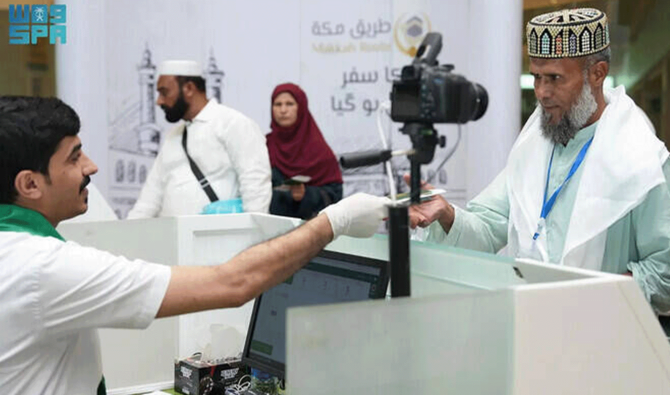
In this file photo, taken and released by the Saudi Press Agency on May 26, 2024, Saudi official handover passport to the Pakistani pilgrim at the Jinnah Internation Airport in Karachi. (SPA/File)
Short Url
Updated 18 August 2025
Follow

Pakistan’s deadline for receiving Hajj applications under government scheme to expire today

  • State media says over 110,000 government scheme Hajj applications received over past 12 days
  • Pakistan’s religious affairs ministry has said only 7,000 seats under government scheme are left

ISLAMABAD: Pakistan’s deadline for receiving Hajj 2026 applications under the government scheme is set to expire today, Monday, state-run media reported as authorities says over 110,000 applications have been received during the last 12 days. 

Pakistan extended the deadline for receiving Hajj applications under the government scheme on Saturday. The country announced earlier this month it has been allocated a quota of 179,210 pilgrims, of which 129,210 seats have been allocated under the government scheme and the rest to private tour operators.

Pakistan’s religious affairs ministry said on Saturday that designated banks will keep receiving Hajj applications on Monday, adding that only 7,000 seats under the government scheme were available. 

“Today is the last date for submission of applications under government Hajj scheme,” state broadcaster Radio Pakistan said in a report. “The process of receiving Hajj applications will be stopped once seats are filled.”

Only designated banks would receive the applications, the ministry had clarified last week, adding that its online portal would stop accepting applications at midnight on Aug. 16.

Pakistan began receiving applications on Aug. 4, advising applicants to obtain computerized receipts and verify their details through the ministry’s portal or the Pak Hajj 2026 app.

Under the government scheme, pilgrims can choose between a long package (38-42 days) and a short package (20-25 days), with costs ranging between Rs1,150,000 and Rs1,250,000 ($4,050–4,236).

Applicants are required to deposit a first installment of Rs500,000 [$1764] or Rs550,000 [$1941] depending on the package, while the remaining dues will be collected in November.

Saudi Arabia had approved the same quota for Pakistan in 2025, though private tour operators last year struggled to utilize their share, saying they faced technical and financial delays, even as the government filled its quota of over 88,000 pilgrims.


Pakistan mulls space-based monitoring to support port expansion, maritime safety

Updated 10 sec ago
Follow

Pakistan mulls space-based monitoring to support port expansion, maritime safety

  • Minister says satellite technology could aid port planning and environmental protection
  • Islamabad seeks to modernize ports as it eyes transshipment role, Central Asian trade

KARACHI: Pakistan is considering the use of space-based monitoring systems to support port expansion, maritime safety and environmental protection, the country’s maritime affairs minister said on Wednesday, as he visited the headquarters of the national space agency.

The visit comes as Islamabad seeks to position itself as a transshipment hub by upgrading cargo handling, streamlining import and export processes and offering its southern ports on the Arabian Sea to landlocked Central Asian states as trade gateways.

“Advanced space-based monitoring systems can play a vital role in safeguarding seas, improving maritime management and strengthening responses to environmental threats,” Maritime Affairs Minister Muhammad Junaid Anwar Chaudhry said, according to a statement released after his visit.

Chaudhry was briefed on satellite-based assessments identifying potential sites for new ports, as well as tools for maritime traffic monitoring and disaster response.

Pakistan has been working to expand and modernize its port infrastructure to improve efficiency and attract regional cargo flows, particularly as it seeks to enhance connectivity through its coastline along the Arabian Sea.

During the visit, officials from the Pakistan Space and Upper Atmosphere Research Commission (SUPARCO) outlined the use of high-resolution satellite imagery, artificial intelligence and digital modelling to monitor ports, track cargo dwell time, detect oil spills and support search-and-rescue operations at sea.

“We can benefit from continuous monitoring of coastal ecosystems to assess water quality, sediment dispersion and overall environmental health,” Chaudhry said, adding that data-driven approaches were essential for informed policymaking in the maritime sector.

He also highlighted the growing risks posed by climate change, including rising sea levels, coastal erosion and extreme weather events, and said stronger cooperation between maritime authorities and scientific institutions was needed to protect coastal communities and infrastructure.

SUPARCO officials said the agency was ready to develop artificial intelligence-based solutions for ports and maritime operations, including systems to address customs-related inefficiencies and improve emergency response times.
The minister said the ministry and SUPARCO would move toward formalizing cooperation through a structured framework to support joint initiatives.