

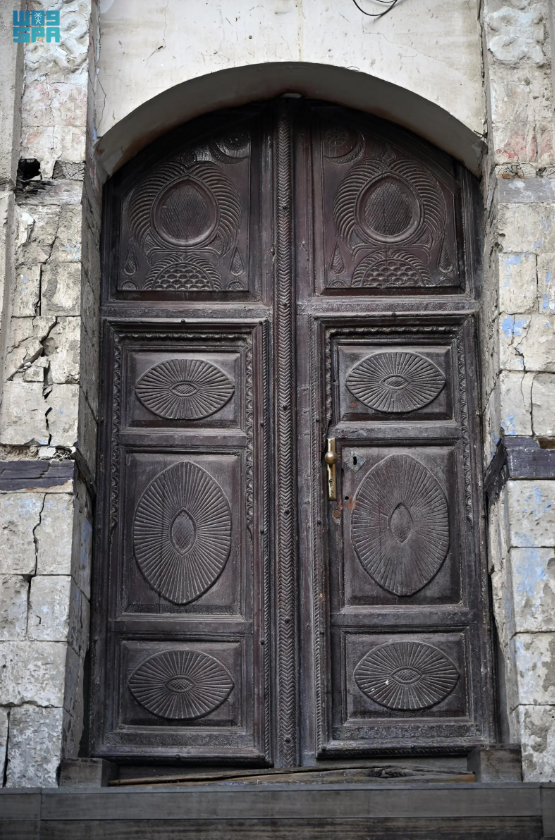
Historic Jeddah’s wooden doors exemplify traditional Hijazi architecture

1 / 2
These wooden doors are testimonies to the evolution of Hijazi society and its adaptation to the environment. (SPA)
2 / 2
These wooden doors are testimonies to the evolution of Hijazi society and its adaptation to the environment. (SPA)
Short Url
Updated 17 August 2025
Follow

Historic Jeddah’s wooden doors exemplify traditional Hijazi architecture

RIYADH: Ancient wooden doors scattered across the alleys of Jeddah’s historic Al-Balad neighborhood exemplify the traditional architecture of the Hijaz region.

Their beauty has been preserved for centuries, and they have become symbolic of the architectural identity that led to the area joining the UNESCO World Heritage List.

These doors are crafted from teak and walnut wood imported from India and East Africa, renowned for their durability and weatherproof quality.

They are reinforced with large iron nails and adorned with arabesque, geometric, and botanical engravings, reflecting the creativity of local craftspeople in Jeddah who developed this craft generation after generation.

The wooden doors serve multiple architectural functions, according to the Saudi Press Agency, most notably protecting homes from summer heat and providing ventilation through finely decorated openings, in addition to their aesthetic appeal.

Some doors feature double layers: a large outer one for visitors and a smaller one allowing easy entry and exit without opening the main door.

As part of Saudi Vision 2030 efforts to preserve historic Jeddah, dozens of wooden doors have undergone meticulous restoration by specialized artisans using the same original wood, with careful documentation of engravings and decorations to ensure their preservation.

These are testimonies to the evolution of Hijazi society and its adaptation to the environment.

They carry in their engravings stories of trade and seafaring, showing how architecture preserves the identity of a place and the spirit of its people.

Al-Balad is believed to have been inhabited since the era before Islam, according to Saudi Commission for Tourism and National Heritage sources.

Some of the buildings that stand there today were built around 400 years ago. 

Old Jeddah includes a number of monuments and heritage buildings such as the Old Jeddah wall and its historical open squares such as Al-Mazloom, Al-Sham, Al-Yemen and Al-Bahr Haras. 

The Old Jeddah wall was built to fortify the city from attacks initiated by the Portuguese coming in from the Red Sea, but it was torn down in the 1940s due to urbanization. 


Lucia festival lights up Swedish Embassy in Riyadh

Updated 11 December 2025
Follow

Lucia festival lights up Swedish Embassy in Riyadh

RIYADH: A celebration of light and traditional choir singing illuminated the Swedish Embassy in Riyadh’s Diplomatic Quarter on Wednesday evening for the country’s Lucia festival.

Based on ancient pre-Christian traditions intertwined with the story of Saint Lucy, who is depicted wearing a crown of candles, the festival is cherished for bringing some respite from the dark Scandinavian winter.

The Riyadh embassy hosted a number of dignitaries and members of the Swedish community in Saudi Arabia, with catering provided by Ikea.

Swedish Ambassador to Saudi Arabia Petra Menander spoke to Arab News about the significance of the festival.

“It's a very, very old tradition that leads back to our peasant times when we needed to fight the darkness with light,” she said.

“And so we actually adopted an old tradition from Italy where Lucia comes with light in her hair and that made us all feel very, very comfortable.

“And it’s something that we actually celebrate just as much as the other holidays, like Christmas or so on. It’s inescapable, at all schools, everywhere.”

Holding the festival in Riyadh was particularly special as it not only brought a glimpse of Swedish culture to Saudi Arabia, but also helped Swedish nationals living in the Kingdom reconnect with their homeland.

“I think it’s a very nice way to bring Swedish culture overseas, but it’s also a nice way of getting the Swedish community together,” said Menander.

“We just have many people who come from mixed backgrounds and they’re very happy that they can introduce their children to this tradition even if they’re living very far away from Sweden. So, it’s a very warm feeling for me.”