


ISLAMABAD: An official of the National Disaster Management Authority (NDMA) warned on Sunday that Pakistan may face floods “of the same scale” as those witnessed in 2022, saying the country was likely to experience three more monsoon rain spells till Sept. 10.
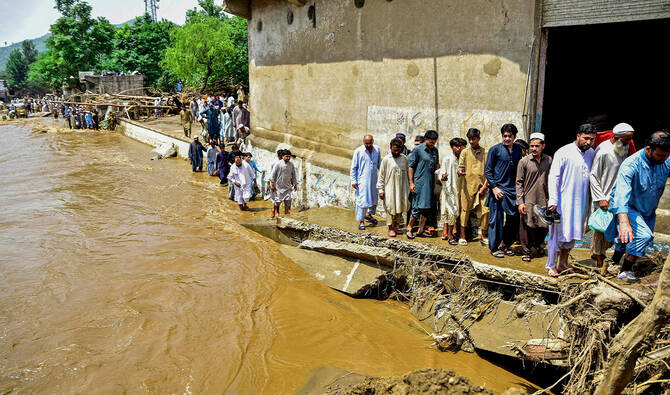
Monsoon rains have wreaked havoc in Pakistan’s northern areas, especially its Khyber Pakhtunkhwa (KP) province, where floods and landslides have killed over 312 people since Aug. 15, as per official figures.
As per the NDMA’s report, Pakistan’s cumulative death toll since Jun. 26 from rain-related incidents has surged to 645. KP has reported the highest number of deaths at 383, followed by Punjab with 164, the northern Gilgit-Baltistan (GB) and Sindh with 28 deaths each, Balochistan 29, Azad Kashmir 14 and Islamabad eight casualties.
The devastation is a grim reminder of the cataclysmic floods of June 2022, where unusually heavy rains and the melting of glaciers triggered flash floods in several parts of the country. Pakistan reported at least 1,700 people dead and losses of over $30 billion, with large swathes of crops and critical infrastructure damaged by raging waters.
“Although the 2022 floods had a different pattern, the ongoing cloudbursts and heavy monsoon spells this year suggest that a similar flood situation cannot be ruled out,” Muhammad Idrees Mehsud, a member of the NDMA’s Disaster Risk Reduction unit, told reporters during a media briefing in Islamabad.
He said the climate change phenomenon was getting worse in Pakistan with every passing year. Mehsud added that with consistent heavy rains expected to continue over the coming weeks, “the country may face floods of the same scale as 2022.”
NDMA Chairman Lt. Gen. Inam Haider Malik noted that Pakistan was receiving 50 to 60 percent more rain this year compared to 2024.
“The current speed which started today will continue till Aug. 23 and two to three more spells are expected till Sept. 10,” Malik said.
Raging hill torrents swept away dozens of people in KP’s Swat, Buner, Bajaur, Torghar, Mansehra, Shangla and Battagram districts since Friday. Malik said efforts were underway to restore communication with flood-affected regions, while the country’s armed forces were supporting stranded citizens.
Rescuers, backed by boats and helicopters, have been working for hours in KP during the last three days to save stranded residents and tourists as ambulances transported bodies to hospitals.
The NDMA on Saturday issued an advisory to limit tourism in mountainous areas. Separately, the KP administration declared an emergency in districts affected by rains and flash floods.
“On the prime minister’s directives, relief packages are being dispatched to the worst-affected areas, while more relief will be dispatched and the search for missing persons is continuously underway,” Malik said.
He highlighted that heavy rains and floods have caused widespread destruction in Buner, Bajaur, and Battagram districts of KP.
The NDMA chief said Babusar area in the northern GB region was severely impacted by the monsoon rains, adding that losses inflicted by rains in the KP province were being assessed.
“After the monsoon, the government will assess the destruction and will compensate losses and also build infrastructure in close coordination with provincial authorities,” he added.
RAINS TO ‘INTENSIFY’ FROM AUG. 17
Earlier, the NDMA said a low-pressure system (LPA) over the Bay of Bengal is likely to move westward from Aug. 17 and intensify the ongoing monsoon activity. A westerly wave is also present over the country under the influence of these meteorological conditions, it said.
Malik said northern Punjab and northern KP would likely face more intense rains in the coming days.
“We are trying to vacate the areas where flash floods are expected in the coming days,” he said.
The NDMA official said Saudi Arabia, Türkiye, Iran, Azerbaijan, Russia and other countries contacted Pakistan to offer assistance in relief efforts.
Pakistan, which contributes less than 1 percent of global greenhouse gas emissions, is among the countries most vulnerable to climate change.
Scientists say rising temperatures are making South Asia’s monsoon rains more erratic and intense, increasing the risk of flash floods and landslides in mountainous regions like KP and GB.


