Northern China flash flood kills 8

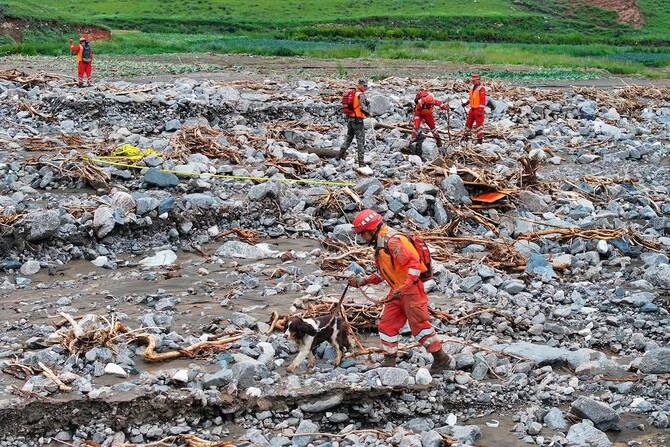
China has suffered weeks of extreme weather since July, battered by heavier-than-usual downpours with the monsoon stalling over its north and south. Above, rescue workers search for victims a day after a flash flood in Yuzhong county. (AFP)
Short Url
Updated 17 August 2025
Follow

Northern China flash flood kills 8

  • The banks of a river running through the grasslands of Inner Mongolia burst at around 10 p.m. on Saturday
  • China has suffered weeks of extreme weather since July, battered by heavier-than-usual downpours

BEIJING: At least eight people have died in a flash flood in northern China, state media reported on Sunday, with four others still missing, as the East Asian monsoon continues to unleash atmospheric chaos across the world’s second-largest economy.
The banks of a river running through the grasslands of Inner Mongolia burst at around 10 p.m. (1400 GMT) on Saturday, the report said, washing away 13 campers on the outskirts of Bayannur city, a major agricultural hub. One person has been rescued.
China has suffered weeks of extreme weather since July, battered by heavier-than-usual downpours with the monsoon stalling over its north and south.
Weather experts link the shifting pattern to climate change, testing officials as flash floods displace thousands and threaten billions of dollars in economic losses.
Bayannur is an important national grain and oil production base, as well as a sheep breeding and processing center.
At the other end of the country, a three-and-a-half-month fishing suspension in the southern province of Hainan ended on Saturday, state media reported, after agricultural affairs officials ordered ships to shelter in port owing to persistent, heavy rain.
The deluge in Inner Mongolia follows a deadly downpour in Beijing – just under 1,000km away – late last month which killed at least 44 people and forced the evacuation of more than 70,000 residents.
The central government announced last week 430 million yuan ($59.9 million) in fresh funding for disaster relief, taking the total allocated since April to at least 5.8 billion yuan.


In South Africa’s affluent Western Cape, farmers lose cattle to drought

Updated 2 sec ago
Follow

In South Africa’s affluent Western Cape, farmers lose cattle to drought

  • Drought in country’s south follows flooding ‌in north
  • Farmers try to adapt but lose livestock
KNYSNA: In South Africa’s most visited and affluent province, Western Cape, one of the worst droughts in living memory is drying up dams, scorching grass and killing livestock, prompting the government to declare a national emergency this month.
Scientists say climate change is causing worsening droughts in the province, which draws tourists to ‌its vineyards, ‌beaches and the lush slopes of ​Table ‌Mountain ⁠above ​Cape Town, ⁠but lies on the edge of the advancing semi-desert Karoo. In 2015, a drought almost dried up the taps in the city; farmers say this one has been even more brutal than a decade ago.
Over the weekend, mixed-race couple Christian and Ilze Pienaar were ⁠distributing feed to keep their hungry cattle alive. ‌One cow had recently ‌starved to death, its bones ​visible through its skin.
“The drought ‌before wasn’t this bad because there was still ... ‌grazing,” Ilze, 40, told Reuters. “Now there’s nothing, the dams are dry ... (and) we’re spending all our money on feed.”
She said she’d lost 16 cattle and 13 sheep since January alone.
The ‌drought, which has also ravaged parts of Eastern Cape and Northern Cape, comes weeks ⁠after ⁠floods blamed on climate change and cyclical La Niña weather washed out the northeastern part of South Africa and killed 200 people across the region.
“The intensity and duration of both droughts and floods in this corner of the world is increasing,” Anton Cartwright, an economist with the African Center for Cities, said.
“Farmers (here) are very good at adapting to weather (but) ... the weather is just becoming much less predictable,” ​he said. “Seasons aren’t occurring, starting, ​ending at the same time of the year. It’s probably going to get worse.”
(Writing by Tim Cocks; editing by ​Philippa Fletcher)