


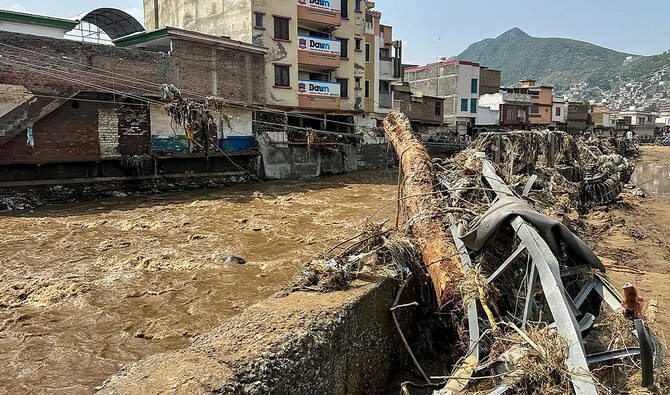
ISLAMABAD: The Pakistan Meteorological Department has warned that the monsoon activity in the country is likely to “intensify” from today, Sunday, with torrential rains already killing over 300 in the last three days in the northern regions.
Raging hill torrents swept away dozens of people in the northwestern Khyber Pakhtunkhwa’s (KP) Swat, Buner, Bajaur, Torghar, Mansehra, Shangla and Battagram districts since Friday. According to the National Disaster Management Authority’s (NDMA) latest situation report, at least 645 people have been killed in rain-related incidents since June 26, while 905 have been injured.
Of these, KP has reported the highest deaths at 383, Punjab 164, the northern Gilgit-Baltistan and Sindh with 28 deaths each, Balochistan 29, Azad Kashmir 14 and Islamabad eight casualties. As per the Provincial Disaster Management Authority (PDMA) KP, 313 people have been killed in the last 72 hours and 156 have been injured.
“According to Met Office, strong monsoon currents from the Arabian Sea and Bay of Bengal are continuously penetrating in the country,” the PMD said on its website on Saturday.
“Low Pressure System (LPA) over the Bay of Bengal is likely to move westward from 17th August and intensify this monsoon activity. A westerly wave is also present over the country under the influence of these meteorological conditions,” it added.
The PMD said widespread rain with thundershowers is expected in KP’s Dir, Chitral, Swat, Kohistan, Shangla, Battagram, Mansehra, Abbottabad, Haripur, Buner, Malakand, Bajaur, Mohmand, Kohat, Peshawar, Charsadda, Nowshera, Mardan, Swabi, Khyber, Orakzai, Kurram, Hangu, Karak, Bannu, Lakki Marwat, Waziristan, Tank and Dera Ismail Khan districts from Aug. 17-19.
It also forecast widespread rain with thundershowers in Islamabad, Rawalpindi, Murree, Galliyat, Attock, Chakwal, Jhelum, Mandi Bahauddin, Gujrat, Gujranwala, Hafizabad, Wazirabad, Lahore, Kasur, Sheikhupura, Sialkot, Narowal cities from Aug. 17-19.
It warned of rain and thundershowers in various parts of Sindh and Balochistan from Aug. 17-22.
Rains have wreaked havoc in KP in the last three days with rescuers, backed by boats and helicopters, working for hours in the northwestern province and other areas to save stranded residents and tourists as ambulances transported bodies to hospitals.
The NDMA on Saturday issued an advisory to limit tourism in mountainous areas after the death toll from torrential rains and floods in Pakistan’s northern regions surged to 332 in the last three days.
Separately, the KP administration declared an emergency in districts affected by rains and flash floods.
“A notification has been issued stating that the emergency will remain in effect from August 15 to August 31, 2025, in the vulnerable districts,” the PDMA said in a statement on Saturday.
“The emergency will be enforced in the districts of Swat, Buner, Bajaur, Torghar, Mansehra, Shangla, Lower Dir, Upper Dir and Battagram, which have been affected by rains and flooding,” it added.
The deluges have evoked memories of 2022 when catastrophic monsoon rains and glacial melt submerged a third of the country, killing more than 1,700 people and causing over $30 billion in damages.
Pakistan, which contributes less than 1 percent of global greenhouse gas emissions, is among the countries most vulnerable to climate change.
Scientists say rising temperatures are making South Asia’s monsoon rains more erratic and intense, increasing the risk of flash floods and landslides in mountainous regions like KP and Gilgit-Baltistan, where at least 20 people have died in similar incidents and several are missing.


