

Prominent religio-political leader’s children killed, wife injured in northwestern Pakistan home shooting

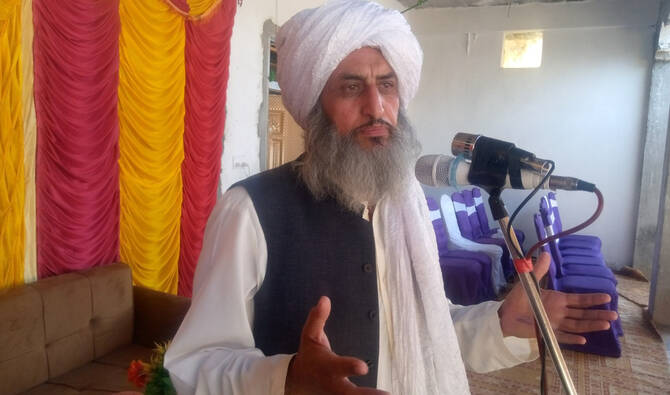
This file photo, released by Pakistan’s Jamiat Ulema-e-Islam-Fazl (JUI-F) party on August 16, 2025, shows prominent party leader Mufti Kifayatullah addressing a rally in Khyber Pakhtunkhwa province. (Handout/JUI)
Short Url
Updated 16 August 2025
Follow

Prominent religio-political leader’s children killed, wife injured in northwestern Pakistan home shooting

  • Mufti Kifayatullah of JUI-F sustained serious injuries after his son opened fire on the family and fled
  • The motive behind the incident remains unclear, though it may have stemmed from a domestic dispute

PESHAWAR: A shooting at the residence of a prominent religio-political party leader, Mufti Kifayatullah, in Pakistan’s northwestern Khyber Pakhtunkhwa province left his son and daughter dead and his wife critically wounded on Saturday, while he himself sustained serious injuries, according to an official statement.

A former provincial lawmaker from Malakand division and district chief of the Jamiat Ulema-e-Islam-Fazl (JUI-F) party, Kifayatullah was attacked inside his residence in Batkhela, Levies officials said in a statement.

“A shooting incident took place at the house of Mufti Kifayatullah, district chief of JUI-F in Batkhela,” the statement said. “As a result of the firing, Kifayatullah was seriously injured, his daughter and son were killed, and his wife was also critically wounded.”

Authorities said the assailant was the JUI-F politician’s own son, who managed to escape after the attack.

The bodies and the injured were taken to the District Headquarters Hospital in Batkhela, where doctors later said Kifayatullah’s condition was out of danger.

The motive behind the shooting was not immediately clear, though the incident appeared to be linked to some domestic dispute.

The JUI-F, a major religio-political party with deep roots in northwestern Pakistan, has long exercised influence in the area.

However, it struggled in the 2024 general elections, with leaders blaming security threats for their inability to run a full campaign.


Pakistan, seven Muslim nations back Palestinian technocratic body, stress Gaza-West Bank unity

Updated 15 January 2026
Follow

Pakistan, seven Muslim nations back Palestinian technocratic body, stress Gaza-West Bank unity

  • The National Committee for the Administration of the Gaza Strip was announced on January 14
  • Muslim nations call for consolidation of the ceasefire and unimpeded humanitarian aid into Gaza

ISLAMABAD: Pakistan and seven other Muslim-majority countries on Thursday welcomed the formation of a temporary Palestinian technocratic body to administer Gaza, stressing that it must manage daily civilian affairs while preserving the institutional and territorial link between the Gaza Strip and the West Bank amid the ongoing peace efforts.

In a joint statement, the foreign ministers of Pakistan, Egypt, Jordan, Saudi Arabia, Qatar, Türkiye, Indonesia and the United Arab Emirates said the newly announced National Committee for the Administration of the Gaza Strip would play a central role during the second phase of a broader peace plan aimed at ending the war and paving the way for Palestinian self-governance.

“The Ministers emphasize the importance of the National Committee commencing its duties in managing the day-to-day affairs of the people of Gaza, while preserving the institutional and territorial link between the West Bank and the Gaza Strip, ensuring the unity of Gaza, and rejecting any attempts to divide it,” the statement said.

The committee, announced on Jan. 14, is a temporary transitional body established under United Nations Security Council Resolution 2803 and is to operate in coordination with the Palestinian Authority, the ministers said.

The statement said the move forms part of the second phase of US President Donald Trump’s Comprehensive Peace Plan for Gaza, which the ministers said they supported, praising Trump’s efforts to end the war, ensure the withdrawal of Israeli forces and prevent the annexation of the occupied West Bank.

The top leaders of all eight Muslim countries attended a meeting with Trump in New York last September, shortly before he unveiled the Gaza peace plan.

The ministers also called for the consolidation of the ceasefire, unimpeded humanitarian aid into Gaza, early recovery and reconstruction and the eventual return of the Palestinian Authority to administer the territory, leading to a just and sustainable peace based on UN resolutions and a two-state solution on pre-1967 lines with East Jerusalem as the Palestinian capital.