

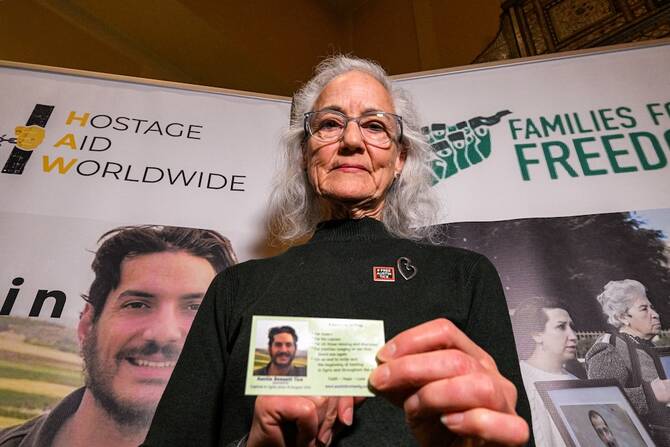

WASHINGTON: The mother of missing American journalist and former US Marine Austin Tice has shared new details from recently declassified intelligence documents, saying the files contain information that could help locate her son.
Speaking at a press conference marking 13 years since her son vanished outside Damascus, Debra Tice said the documents suggested that US agencies had near-daily information on his condition and captivity during the years following his disappearance in the Syrian Arab Republic.
The files were shared earlier this year by US Director of National Intelligence Tulsi Gabbard following long-standing requests from the family to access raw intelligence material related to the case.
“When he had something (wrong) about his teeth, they took him to a dentist. When he had some stomach issues, they took him to the doctor,” Debra Tice was quoted as saying in The Washington Post. She did not specify dates or locations.
Tice, a freelance journalist covering the Syrian conflict for The Washington Post and other US outlets, was abducted on the outskirts of Damascus in August 2012. A video released shortly after his disappearance showed him blindfolded and held by armed men. US officials have long suspected the Syrian government was behind his disappearance, but Damascus has consistently denied involvement.
Debra Tice said she was repeatedly told by officials in past administrations that no new information existed. But she said the files revealed otherwise, reinforcing her belief that her son is alive and can still be found.
She alleged that the Syrian government had attempted to return her son shortly after his disappearance by reaching out to then-US Secretary of State Hillary Clinton.
“The Syrian government reached out to Hillary Clinton and wanted her to come and get Austin in ... August of 2012, and she declined,” she said, reported The Washington Post.
However, the publication quoted former US officials with knowledge of the case denying such an offer was made, saying that the Syrian regime never acknowledged holding Tice and “vigorously denied any knowledge of Austin right to the end.”
US officials have blamed the lack of progress on obstruction by the Bashar Assad regime and the highly secretive nature of Syria’s detention network.
Since the collapse of the Assad regime in December 2024, the CIA has reportedly adopted a “low confidence” assessment that Tice is likely dead — an evaluation the family strongly rejects. Debra Tice said she remains confident her son is alive and that the release of thousands of detainees from collapsed Syrian prisons has yet to yield any definitive information about his case.
The Tice family’s access to intelligence files was granted following lobbying efforts. Debra Tice said the newly declassified information had strengthened her resolve to keep pressure on the US authorities to resolve the case.
“We know Austin is alive. We need to find him,” she said.
Tice’s case remains one of the longest unresolved abductions of an American journalist in the Middle East. Rights groups and press freedom advocates have repeatedly urged the US government to prioritize the search for him and ensure accountability for his captors.


