

Pakistani tribunal upholds ruling against Gulf-bound worker medical centers for price fixing

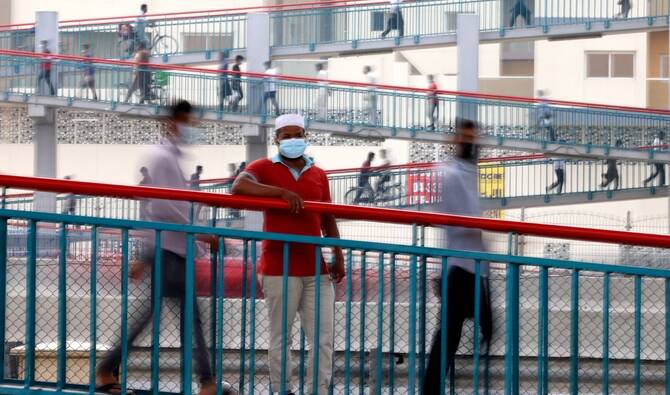
Asian labourers cross a pedestrian bridge as they head to work in Dubai on April 8, 2021. (AFP/ file)
Short Url
Updated 15 August 2025
Follow

Pakistani tribunal upholds ruling against Gulf-bound worker medical centers for price fixing

  • Competition appeals tribunal reduces fines but upholds ruling against price fixing by medical centers
  • Pakistani workers going to Gulf must use approved clinics, where CCP found collusion, overcharging

ISLAMABAD: Pakistan’s competition appeals tribunal has upheld a ruling against 20 medical centers and laboratories that colluded to fix prices and allocate customers for mandatory pre-departure health tests of workers bound for Gulf countries, the competition regulator said on Friday.

The case involves a captive market of low-income Pakistani laborers headed mainly to Saudi Arabia, Qatar, Oman, Bahrain and Kuwait.

Under the rules, these workers must undergo tests at centers approved by the Gulf Approved Medical Centers Association (GAMCA), a network of clinics authorized by Gulf states to carry out the mandatory checks.

The regulator found the centers and their five regional associations divided customers on a rotational basis, eliminating competition on price and service quality, and in some cases charging for unnecessary repeat tests.

“The CCP’s investigation concluded that fee fixation, territorial division and equal allocation of customers by GAMCAs violated the Competition Act, 2010,” the Competition Commission of Pakistan (CCP) said in a statement.

“Any anti-competitive conduct will be dealt with strictly under the competition law,” it quoted its chairman, Dr. Kabir Sidhu, as saying.

The competition appeals tribunal upheld the findings but reduced the penalties from 20 million rupees ($70,000) per medical center and 10 million rupees ($35,000) per GAMCA to 2 million rupees ($7,000) per center and 1 million rupees ($3,500) per GAMCA.

The CCP launched its inquiry after a 2012 complaint from the Pakistan Overseas Employment Promoters Association, which represents manpower exporters.

It ruled against the clinics later that year, though the verdict was not implemented because the medical centers and laboratories obtained stay orders.


Rating firm S&P says it won’t rush Iran war downgrades, sees risks for countries like Pakistan

Updated 12 March 2026
Follow

Rating firm S&P says it won’t rush Iran war downgrades, sees risks for countries like Pakistan

  • Agency says it is monitoring indebted energy importers as higher oil prices strain finances
  • Gulf economies seen better placed to weather shock, though Bahrain flagged as vulnerable

LONDON: S&P Global ‌said it would not make any knee-jerk sovereign rating cuts following the outbreak of war in the ​Middle East, but warned on Thursday that soaring oil and gas prices were putting a number of already cash-strapped countries at risk.

The firm’s top analysts said in a webinar that the conflict, which has involved US and Israeli strikes ‌against Iran and Iranian ‌strikes against Israel, ​US ‌bases ⁠and Gulf ​states, ⁠was now moving from a low- to moderate-risk scenario.

Most Gulf countries had enough fiscal buffers, however, to weather the crisis for a while, with more lowly rated Bahrain the only clear exception.

Qatar’s banking sector could ⁠also struggle if there were significant ‌deposit outflows in ‌reaction to the conflict, although there ​was no evidence ‌of such strains at the moment, they ‌said.

“We don’t want to jump the gun and just say things are bad,” S&P’s head global sovereign analyst, Roberto Sifon-Arevalo, said.

The longer the crisis ‌was prolonged, though, “the more difficult it is going to be,” he ⁠added.

Sifon-Arevalo ⁠said Asia was the second-most exposed region, due to many of its countries being significant Gulf oil and gas importers.

India, Thailand and Indonesia have relatively lower reserves of oil, while the region also had already heavily indebted countries such as Pakistan, Bangladesh and Sri Lanka whose finances would be further hurt by rising energy prices.

“We ​are closely monitoring ​these (countries) to see how the credit stories evolve,” Sifon-Arevalo said.