

More than 300 people killed due to heavy rain, floods in Pakistan

1 / 2
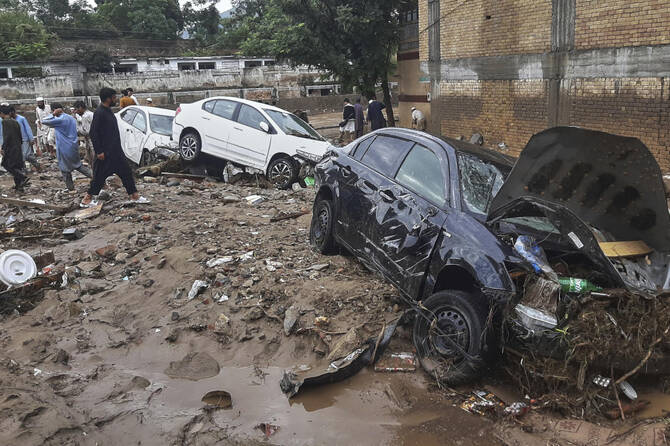
Damaged cars trapped in mud following flash flooding due to heavy rains at a neighborhood of Mingora, the main town of Swat Valley, northwestern Pakistan. (AP)
2 / 2
Flooded streets in Mingora, the main town of Swat Valley, northwestern Pakistan. (AP)
Short Url
Updated 16 August 2025
Follow

More than 300 people killed due to heavy rain, floods in Pakistan

  • Majority of the deaths were recorded in mountainous Khyber Pakhtunkhwa where the rains triggered landslides and flash floods
  • Seven killed when government helicopter crashed due to bad weather during a mission to deliver relief goods

PESHAWAR, Pakistan: The death toll from heavy rains and flooding in Pakistan has crossed 300, local officials said on Saturday.

The majority of the deaths were recorded in mountainous Khyber Pakhtunkhwa province, according to the National Disaster Management Authority.

Five others, including two pilots, were killed when a Khyber Pakhtunkhwa government helicopter crashed due to bad weather during a mission to deliver relief goods, the chief minister of the province, Ali Amin Gandapur, said in a statement.

The provincial government has declared the severely affected mountainous districts of Buner, Bajaur, Mansehra and Battagram as disaster-hit areas.

In Bajaur, a tribal district abutting Afghanistan, a crowd amassed around an excavator trawling a mud-soaked hill, AFP photos showed.

Funeral prayers began in a paddock nearby, with people grieving in front of several bodies covered by blankets.

The meteorological department has issued a heavy rain alert for the northwest, urging people to avoid “unnecessary exposure to vulnerable areas.”

In the Indian-administered part of Kashmir, a region divided with Pakistan, rescuers pulled bodies from mud and rubble on Friday after a flood crashed through a Himalayan village, killing at least 60 people and washing away dozens more.

The monsoon season brings South Asia about three-quarters of its annual rainfall, vital for agriculture and food security, but it also brings destruction.

Landslides and flash floods are common during the season, which usually begins in June and eases by the end of September.

Syed Muhammad Tayyab Shah, a representative of the national disaster agency, told AFP that this year’s monsoon season began earlier than usual and is expected to end later.

“The next 15 days, particularly from August 16 till the 30th of August, the intensity of the monsoon will further exacerbate,” he added.

The provincial government has declared Saturday as a day of mourning, chief minister Gandapur said.

“The national flag will fly at half-mast across the province, and the martyrs will be laid to rest with full state honors,” the statement from his office said.

Scientists say that climate change has made weather events around the world more extreme and more frequent.

Pakistan is one of the world’s most vulnerable countries to the effects of climate change, and its population is contending with extreme weather events with increasing frequency.

The torrential rains that have pounded Pakistan since the start of the summer monsoon, described as “unusual” by authorities, have killed more than 320 people, nearly half of them children.

In July, Punjab, home to nearly half of Pakistan’s 255 million people, recorded 73 percent more rainfall than the previous year and more deaths than in the entire previous monsoon.

In 2022, monsoon floods submerged a third of the country and killed 1,700 people.


Zelensky presses EU to tap Russian assets at crunch summit

Updated 3 sec ago
Follow

Zelensky presses EU to tap Russian assets at crunch summit

  • “Russian assets must be used to defend against Russian aggression and rebuild what was destroyed by Russian attacks. It’s moral. It’s fair. It’s legal,” Zelensky said
  • German Chancellor Friedrich Merz was among those agreeing strongly as he said there was “no better option“

Brussels: Ukrainian President Volodymyr Zelensky told EU leaders Thursday they had the “moral” and legal right to use frozen Russian assets to fund Kyiv — as pressure grew on key player Belgium to drop its opposition at a summit showdown.
The 27-nation bloc is scrambling to bolster its ally Ukraine, as US President Donald Trump pushes for a deal with President Vladimir Putin to end the fighting.
Officials have insisted leaders’ talks in Brussels will last as long as it takes to hammer out an agreement, saying both Ukraine’s survival — nearly four years into the war — and Europe’s credibility are at stake.
“We will not leave the European summit without a solution for the funding of Ukraine,” European Commission head Ursula von der Leyen said.
The EU’s executive wants to fund a loan to Ukraine by using frozen assets from Russia’s central bank, though it is holding on to a back-up plan for the bloc to raise the money itself.
The EU estimates Ukraine needs an extra 135 billion euros ($159 billion) to stay afloat over the next two years — with the cash crunch set to start in April.
Zelensky said Kyiv needed a decision on its financing by the end of the year and that the move could give it more leverage in talks to end the war.
“Russian assets must be used to defend against Russian aggression and rebuild what was destroyed by Russian attacks. It’s moral. It’s fair. It’s legal,” Zelensky said.
German Chancellor Friedrich Merz was among those agreeing strongly as he said there was “no better option.”
But Belgium’s Prime Minister Bart De Wever — who held talks with Zelensky on the sidelines — seemed unconvinced so far.
“I have not seen a text that could persuade me to give Belgium’s agreement,” he told Belgian lawmakers before the summit kicked off.
The vast bulk of the assets are held by international deposit organization Euroclear in Belgium, and the government fears it could face crippling financial and legal reprisals from Moscow.
EU officials say they have gone out of their way to allay Belgian worries and that multiple layers of protection — including guarantees from other member states — mean the risks are minimal.
“At this stage, the guarantees offered by the Commission remain insufficient,” De Wever said.

- Ukraine’s looming cash crunch -

In a bid to plug Kyiv’s yawning gap, the Commission has proposed tapping 210 billion euros of frozen assets, initially to provide Kyiv 90 billion euros over two years.
The unprecedented scheme would see the funds loaned to the EU, which would then loan them on to Ukraine.
Kyiv would then only pay back the “reparations loan” once the Kremlin compensates it for the damage.
In theory, other EU countries could override Belgium and ram the initiative through with a weighted majority, but that would be a nuclear option that few see as likely for now.
De Wever insisted that the EU should go for its alternative plan of raising money itself — but diplomats said that option had been shelved as it needed unanimity and Hungary was firmly against.
Bubbling close to the surface of the EU’s discussion are the US efforts to forge a deal to end the war.
Zelensky said Ukrainian and US delegations would hold new talks on Friday and Saturday in the United States.
He said he wanted Washington to give more details on the guarantees it could offer to protect Ukraine from another invasion.
“What will the United States of America do if Russia comes again with aggression?” he asked. “What will these security guarantees do? How will they work?“