

UK government must suspend Palestine Action prosecutions until ban review: Rights groups

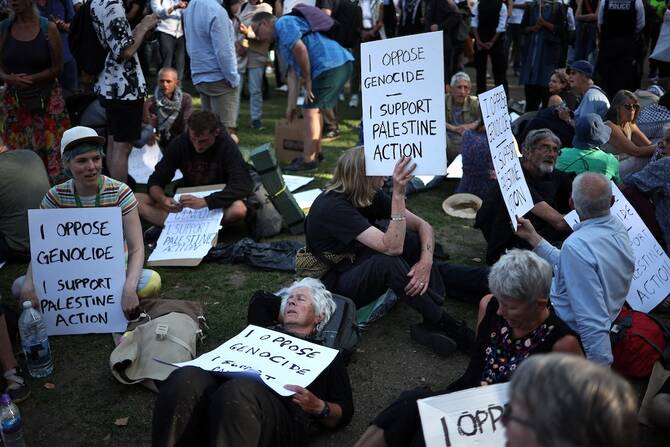
Protesters sit with placards supporting of Palestine Action at a demonstration in Parliament Square, central London on Aug. 9, 2025. (AFP)
Short Url
Updated 15 August 2025
Follow

UK government must suspend Palestine Action prosecutions until ban review: Rights groups

  • Letter urges attorney general to ‘not prejudge the outcome of a judicial review’
  • Prosecuting before ban is potentially overturned would ‘raise significant legal and moral questions’

LONDON: Protesters arrested under the UK’s Terrorism Act for supporting the banned group Palestine Action should not be prosecuted while there is a legal challenge against the ban, rights groups have told the government.

Organizations including Greenpeace and Human Rights Watch sent a letter to Lord Hermer, the attorney general for England and Wales, urging the delay in prosecutions, The Guardian reported on Friday.

More than 500 people, half of whom are aged 60 or older, were arrested at a London demonstration last weekend under Section 13 of the Terrorism Act, which prohibits public displays of support for proscribed groups.

Proceeding with prosecutions amid a judicial review into the ban on Palestine Action would raise significant legal and moral questions, said the letter, which was also signed by Friends of the Earth, Global Witness and the Quakers. The review is expected to be heard in November.

Lord Hermer must act “in the public interest” and take decisive action over the question of prosecution, the letter said.

Rather than the Crown Prosecution Service having decision-making powers over the prosecutions, the attorney general can decide the appropriate course of action on cases falling under the Terrorism Act, it added.

Most of those arrested at the London rally were bailed, but at least 10 protesters have been charged.

In their letter, the rights group said no one else should be charged, and those who have should not be prosecuted before the findings of the judicial reviews, which could overturn the ban on Palestine Action.

Co-executive director of Greenpeace UK, Areeba Hamid, said: “Hundreds of people are facing potential prison sentences for sitting quietly holding placards. It isn’t difficult to see why this could be a disproportionate restriction on people’s freedom of expression, and why so many legal experts have expressed their concern at the government’s decision to extend their definition of terrorism in this way.

“We urge the attorney general to approach the matter with care and some caution, and not prejudge the outcome of a judicial review which could fundamentally change the legal position of these protesters.”

The British judge who granted permission for the judicial review feared that those charged with criminal offenses under the Terrorism Act might individually challenge the Palestine Action ban’s legality when tried.

This could lead to a variation in findings and inconsistencies among different criminal courts, creating “a recipe for chaos,” the judge said.

The letter to Lord Hermer added: “Prosecuting individuals for offences connected to that proscription before the court has determined its legality raises significant legal and moral questions.

“In particular, one of the grounds which the judge held had merit was that the proscription of Palestine Action was a disproportionate interference with human rights.

“We therefore respectfully request that you exercise your constitutional role in the public interest by delaying any decisions to prosecute individuals arrested under terrorism legislation in connection with Palestine Action until the conclusion of the judicial review process.”


Supporters of Venezuelan opposition leader María Corina Machado march in cities worldwide

Updated 6 sec ago
Follow

Supporters of Venezuelan opposition leader María Corina Machado march in cities worldwide

  • Machado went into hiding and has not been seen in public since January

CARACAS: Supporters of Venezuelan opposition leader María Corina Machado demonstrated Saturday in several cities worldwide to commemorate her Nobel Peace Prize win ahead of the prestigious award ceremony next week.
Dozens of people marched through Madrid, Utrecht, Buenos Aires, Lima and other cities in support of Machado, whose organization wants to use the attention gained by the award to highlight Venezuela’s democratic aspirations. The organization expected demonstrations in more than 80 cities around the world on Saturday.
The crowd in Lima carried portraits of Machado and demanded a “Free Venezuela.” With the country’s yellow, blue and red flag draped over their backs or emblazoned on their caps, demonstrators clutched posters that read, “The Nobel Prize is from Venezuela.”
Venezuelan Verónica Durán, who has lived in Lima for eight years, said Machado’s Nobel Peace Prize is celebrated because “it represents all Venezuelans, the fallen and the political prisoners in their fight to recover democracy.”
The gatherings come at a critical point in the country’s protracted crisis as the administration of US President Donald Trump builds up a massive military deployment in the Caribbean, threatening repeatedly to strike Venezuelan soil. Venezuela’s President Nicolás Maduro is among those who see the operation as an effort to end his hold on power, and the opposition has only added to this perception by reigniting its promise to soon govern the country.
“We are living through times where our composure, our conviction, and our organization are being tested,” Machado said in a video message shared Tuesday on social media. “Times when our country needs even more dedication because now all these years of struggle, the dignity of the Venezuelan people, have been recognized with the Nobel Peace Prize.”
Machado won the award Oct. 10 for her struggle to achieve a democratic transition in the South American nation, winning recognition as a woman “who keeps the flame of democracy burning amid a growing darkness.”
Machado, 58, won the opposition’s primary election and intended to run against Maduro in last year’s presidential election, but the government barred her from running for office. Retired diplomat Edmundo González, who had never run for office before, took her place.
The lead-up to the July 28, 2024, election saw widespread repression, including disqualifications, arrests and human rights violations. It all increased after the country’s National Electoral Council, which is stacked with Maduro loyalists, declared him the winner despite credible evidence to the contrary.
González sought asylum in Spain last year after a Venezuelan court issued a warrant for his arrest.
Meanwhile, Machado went into hiding and has not been seen in public since Jan. 9, when she was briefly detained after joining supporters in what ended up being an underwhelming protest in Caracas, Venezuela’s capital. The following day, Maduro was sworn in for a third six-year term.