

Pakistani PM welcomes revival of bilateral mechanisms with Bangladesh, calls for sustaining momentum

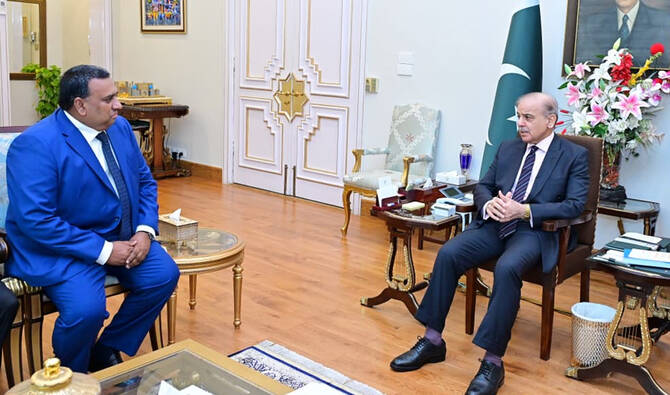
Prime Minister Shehbaz Sharif meets High Commissioner of Bangladesh, Iqbal Hussain Khan (left), in Islamabad, Pakistan, on August 15, 2025. (PID)
Short Url
Updated 15 August 2025
Follow

Pakistani PM welcomes revival of bilateral mechanisms with Bangladesh, calls for sustaining momentum

  • Sharif meets Dhaka envoy, says keen to expand cooperation in political, economic and cultural spheres
  • Fall of Sheikh Hasina has created opening for Pakistan and Bangladesh to move past decades of frosty ties

KARACHI: Pakistani Prime Minister Shehbaz Sharif on Friday underlined the revival of bilateral mechanisms as key to rebuilding relations with Bangladesh as he received Dhaka’s High Commissioned for a courtesy call in Islamabad. 

The meeting with Md. Iqbal Hussain Khan comes amid a remarkable realignment in South Asia’s geopolitics. Since the fall of former Bangladeshi prime minister Sheikh Hasina in 2024 and her subsequent flight to India, Dhaka’s traditionally close relationship with New Delhi has grown strained. The shift has created an opening for Pakistan and Bangladesh — once a single nation until the bloody 1971 war of independence — to move past decades of frosty ties.

“He expressed satisfaction at the revival of various bilateral mechanisms between the two sides,” the Prime Minister’s Office said in a statement, quoting Sharif. “He stressed upon the importance of maintaining this momentum to carry forward their bilateral ties.”

Sharif also recalled his “warm and productive” interactions with Bangladesh’s Chief Adviser Mohammad Yunus, most recently at the D-8 summit in Cairo last December, and said Pakistan was keen to expand cooperation in political, economic and cultural spheres while enhancing trade and people-to-people contacts.

The High Commissioner, according to the PMO, briefed Sharif on steps being taken by both countries to facilitate travel, trade and connectivity, and expressed his desire to continue working to “further strengthen the historic bonds of friendship.”

Sharif wished the envoy success in his assignment and expressed confidence that his tenure would “witness positive developments” in the bilateral relationship.

The outreach reflects what experts widely describe as an unprecedented attempt at rebuilding ties more than half a century after Bangladesh’s independence, since which relations between Islamabad and Dhaka were largely defined by mistrust and India’s dominant role in the region.


Pakistan says it has received no request to join Gaza stabilization force

Updated 5 sec ago
Follow

Pakistan says it has received no request to join Gaza stabilization force

  • Foreign Office says any decision on participating in an international mechanism will be guided by sovereign policy considerations
  • It says Pakistan’s security collaboration with Saudi Arabia is longstanding and should not be narrowly viewed as troop deployment

ISLAMABAD: Pakistan has not taken any decision on joining a proposed International Stabilization Force (ISF) for Gaza and has received no formal request from the United States or any other country in this regard, the foreign office said on Thursday.

Trump’s Gaza plan, outlined as part of a 20-point framework, envisages the deployment of troops from Muslim-majority countries during a transitional stabilization phase, intended to support security and governance as the war-ravaged Palestinian territory moves toward reconstruction and a longer-term political settlement.

International media outlets claim Washington views Pakistan as a potentially significant contributor given its battle-hardened military, which has fought a brief but intense conflict with India this year and continues to combat insurgencies in its remote regions.

Responding to a query during his weekly media briefing, the foreign office spokesperson, Tahir Andrabi, said discussions on ISF for Gaza were ongoing in “certain capitals,” but Pakistan had neither committed to participate nor received any specific request.

“We have not taken a sovereign decision to participate in ISF as yet,” he said. “I am not aware of any specific request made to Pakistan. We will inform you about any development if it takes place.”

He added that while Gaza and Palestine remain part of Pakistan’s broader diplomatic engagements with regional partners, the Organization of Islamic Cooperation (OIC) and members of the United Nations Security Council, the issue of deploying a stabilization force had not been discussed as a standalone, structured agenda item.

“These discussions come up in the broader context of how to stabilize Gaza and ensure peace, but not as a specific, formal proposal,” he added.

The spokesperson maintained Pakistan supports efforts aimed at Gaza’s stabilization and peace but would make any decision on participation in international mechanisms strictly in line with its sovereign policy considerations.

In response to a question about a recent news report by Reuters about a possible visit by Pakistan’s Chief of Defense Forces Field Marshal Asim Munir to the United States to meet US President Donald Trump, Andrabi said there was no confirmation of such plans.

“I can contradict the report in its essence,” he said. “The report suggested as if a visit has been planned or finalized. I do not have any information on the timing or any future visit.”

Earlier, a White House official told Arab News on background no meeting was scheduled between Trump and Munir “at this time.”

The foreign office spokesperson stressed that official visits by Pakistan’s political or military leadership are announced formally by the government ahead of time.

“When an official visit takes place, there is an official announcement. I do not have any such information to share,” he added.

To a question regarding the Pakistan–Saudi Arabia Strategic Mutual Defense Agreement (SMDA) signed in September, he said security collaboration between Islamabad and Riyadh was longstanding, reiterating that the latest pact had only codified and further elaborated the partnership.

Andrabi maintained the pact should not be interpreted narrowly as the deployment of Pakistani forces, noting that defense cooperation covered a wide spectrum including training, joint exercises and institutional collaboration.

“As I said, it’s an ongoing process,” he said. “You should not read it just in the context of sending your forces. There are training, joint exercises that keep on going. If you interpret training as sending forces, I cannot say that. I mean, sending of forces is a very broad term. But our defense corporation, as I said, is ongoing.”