

Over 50 killed in 24 hours as floods, landslides batter northern Pakistan

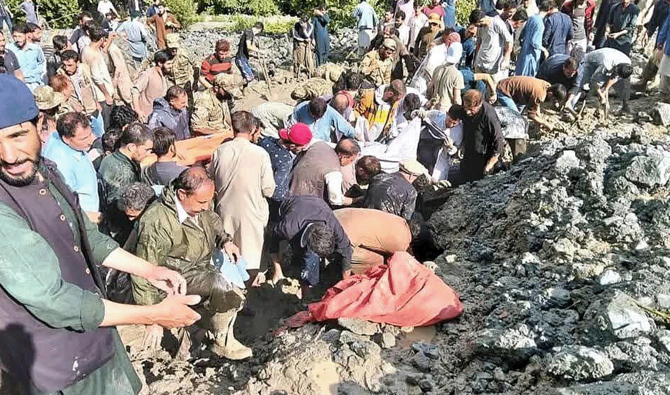
Locals are busy in searching dead bodies after a flash flood in Khalti village of district Ghizer, Gilgit-Baltistan, Pakistan on August 14, 2025. ( Courtesy: Social Media/ Facebook)
Short Url
Updated 15 August 2025
Follow

Over 50 killed in 24 hours as floods, landslides batter northern Pakistan

  • PDMA reports 43 dead in Khyber Pakhtunkhwa province, eight in Gilgit-Baltistan region
  • Latest deaths have taken nationwide toll over 360 with forecasts of more heavy rains

KHAPLU/ISLAMABAD: The death toll from heavy rains, flash floods and landslides in Pakistan’s northern regions rose to at least 51 on Friday, according to figures for the last 24 hours from disaster authorities, taking nationwide deaths to over 360 since the monsoon season began in late June. 

The Provincial Disaster Management Authority (PDMA) said 43 people had died and 14 were injured in Khyber Pakhtunkhwa province, mostly in Bajaur and Battagram districts. 

“Among the deceased are 33 men, 2 women, and 8 children, while the injured include 11 men, 2 women, and 1 child,” the PDMA said, giving a breakdown of the 43 deaths. 

“A total of 30 houses have been damaged due to rains and flash floods, of which 25 were partially damaged and 5 completely destroyed.”

The authority added that the worst affected districts due to heavy rains and flash floods were Bajaur and Battagram, where rescue operations were still ongoing.

Earlier, Amjad Khan, the Bajaur district emergency officer, said rescuers had recovered 16 bodies from the remote Jabarai village after a cloudburst-triggered flood swept the area overnight.

Separately in Gilgit-Baltistan, local officials confirmed eight more deaths in Ghizer and Diamer districts after homes were swept away by landslides and floods in the last 24 hours.

“Six people were buried under the debris of flood in Khalti village of Ghizer … while another five people were injured,” Tahir Shah, a senior Rescue 1122 official, told Arab News.

Two more deaths were reported from Ishkoman Valley and Diamer.

The floods blocked the Karakoram Highway in GB’s Upper Hunza and multiple other roads, while the PDMA has warned that the current spell of heavy rains is expected to continue until Aug. 21. 

“PDMA, all relevant institutions, relief teams, district administration and Rescue 1122 are in contact and monitoring the situation,” DG PDMA said.

Pakistan, which contributes less than 1 percent of global greenhouse gas emissions, has faced repeated climate-induced disasters and is one of the most vulnerable nations to climate change.

The National Disaster Management Authority (NDMA) had put the nationwide monsoon death toll at more than 313 last week, a figure that has risen with the fresh fatalities reported in the last 24 hours. 


EU, Pakistan sign €60 million loan agreement for clean drinking water in Karachi

Updated 17 December 2025
Follow

EU, Pakistan sign €60 million loan agreement for clean drinking water in Karachi

  • Project will finance rehabilitation, construction of water treatment facilities in Karachi city, says European Investment Bank
  • As per a report in 2023, 90 percent of water samples collected from various places in city was deemed unfit for drinking

ISLAMABAD: The European Investment Bank (EIB) and Pakistan’s government on Wednesday signed a €60 million loan agreement, the first between the two sides in a decade, to support the delivery of clean drinking water in Karachi, the EU said in a statement. 

The Karachi Water Infrastructure Framework, approved in August this year by the EIB, will finance the rehabilitation and construction of water treatment facilities in Pakistan’s most populous city of Karachi to increase safe water supply and improve water security. 

The agreement was signed between the two sides at the sidelines of the 15th Pak-EU Joint Commission in Brussels, state broadcaster Radio Pakistan reported. 

“Today, the @EIB signed its first loan agreement with Pakistan in a decade: a €60 million loan supporting the delivery of clean drinking water for #Karachi,” the EU said on social media platform X. 

Radio Pakistan said the agreement reflects Pakistan’s commitment to modernize essential urban services and promote climate-resilient infrastructure.

“The declaration demonstrates the continued momentum in Pakistan-EU cooperation and highlights shared priorities in sustainable development, public service delivery, and climate and environmental resilience,” it said. 

Karachi has a chronic clean drinking water problem. As per a Karachi Water and Sewerage Corporation (KWSC) study conducted in 2023, 90 percent of water from samples collected from various places in the city was deemed unsafe for drinking purposes, contaminated with E. coli, coliform bacteria, and other harmful pathogens. 

The problem has forced most residents of the city to get their water through drilled motor-operated wells (known as ‘bores’), even as groundwater in the coastal city tends to be salty and unfit for human consumption.

Other options for residents include either buying unfiltered water from private water tanker operators, who fill up at a network of legal and illegal water hydrants across the city, or buying it from reverse osmosis plants that they visit to fill up bottles or have delivered to their homes.

The EU provides Pakistan about €100 million annually in grants for development and cooperation. This includes efforts to achieve green inclusive growth, increase education and employment skills, promote good governance, human rights, rule of law and ensure sustainable management of natural resources.