

JOINT BASE ELMENDORF-RICHARDSON, Alaska: President Donald Trump and Russia’s Vladimir Putin met for about 2 1/2 hours on Friday, a summit in Alaska that started with a handshake, a smile and a ride in the presidential limousine — an unusually warm reception for a US adversary responsible for launching the largest land war in Europe since 1945.
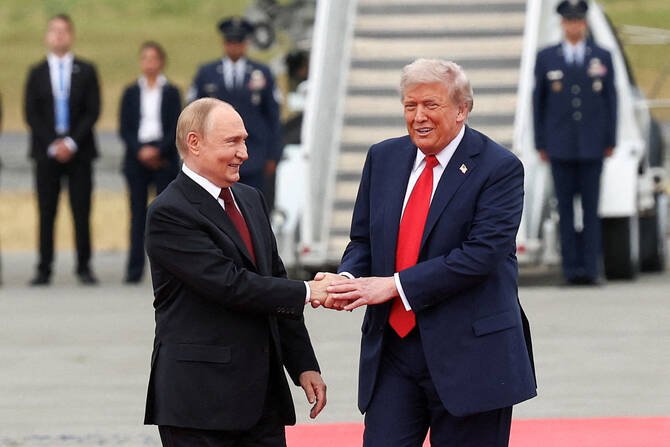
Trump and Putin met behind closed doors with top advisers on efforts to end Russia’s war in Ukraine. When they greeted each other, they gripped hands for an extended period of time on a red carpet rolled out at Joint Base Elmendorf-Richardson in Anchorage. As they chatted, Putin grinned and pointed skyward, where B-2s and F-22s — military aircraft designed to oppose Russia during the Cold War — flew overhead.
Reporters nearby yelled, “President Putin, will you stop killing civilians?” and Russia’s leader put his hand up to his ear as though to indicate he couldn’t hear them. Trump and Putin then shared the US presidential limo known as “The Beast” for a short ride to their meeting site, with Putin offering a broad smile as the vehicle rolled past the cameras.

Trump stands with Putin as they meet to negotiate an end to the war in Ukraine, at Joint Base Elmendorf-Richardson in Anchorage, Alaska on Friday. (Reuters)
It was the kind of reception typically reserved for close US allies and belied the bloodshed and suffering in the war Putin started in Ukraine. Although not altogether surprising considering their longtime friendly relationship, such outward friendliness before hours of closed-door meetings is likely to raise concerns from Ukrainian President Volodymyr Zelensky and European leaders, who fear that Trump is primarily focusing on furthering US interests and not pressing hard enough for Ukraine’s.
Zelensky and European leaders were excluded from Trump and Putin’s discussions, and Ukraine’s president was left posting a video address in which he expressed his hope for a “strong position from the US”
“Everyone wants an honest end to the war. Ukraine is ready to work as productively as possible to end the war,” he said, later adding, “The war continues and it continues precisely because there is no order, nor any signals from Moscow, that it is preparing to end this war.”
The summit was a chance for Trump to prove he’s a master dealmaker and peacemaker. He likes to brag about himself as a heavyweight negotiator and has boasted that he could easily find a way to bring the slaughter to a close — a promise he’s been unable to keep so far.
For Putin, it was an opportunity to try to negotiate a deal that would cement Russia’s gains, block Kyiv’s bid to join the NATO military alliance and eventually pull Ukraine back into Moscow’s orbit.

Trump with Putin before they started Ukraine war talks in Anchorage, Alaska on Friday. (Reuters)
Not meeting one-on-one anymore
White House press secretary Karoline Leavitt said shortly before Air Force One touched down that the previously planned one-on-one meeting between Trump and Putin was now a three-on-three discussion including Secretary of State Marco Rubio and special envoy Steve Witkoff. Putin was joined by Foreign Minister Sergey Lavrov and foreign affairs adviser Yuri Ushakov.
The change seemed to indicate that the White House was taking a more guarded approach than it did during a 2018 meeting in Helsinki, where Trump and Putin met privately with their interpreters and Trump then shocked the world by siding with the Russian leader over US intelligence officials on whether Russia meddled in the 2016 campaign.
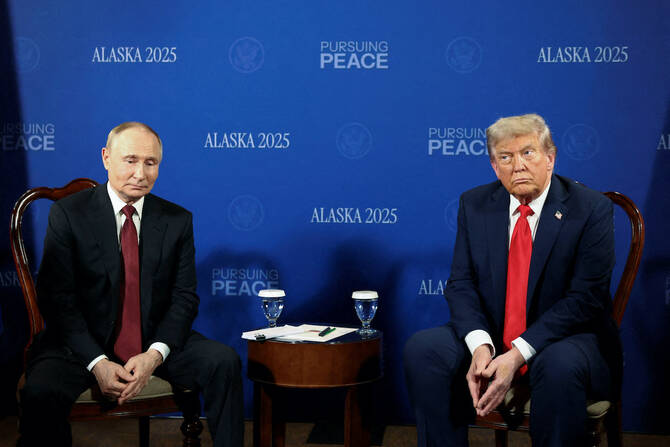
The two leaders began their meeting Friday by sitting with their aides in front of a blue backdrop printed with “Alaska” and “Pursuing Peace.” The pair are expected to hold a joint press conference at the end of the summit.
There are significant risks for Trump. By bringing Putin onto US soil — America bought Alaska from Russia in 1867 for roughly 2 cents per acre — the president is giving him the validation he desires after his ostracization following his invasion of Ukraine 3 1/2 years ago.
Zelensky’s exclusion is also a heavy blow to the West’s policy of “nothing about Ukraine without Ukraine” and invites the possibility that Trump could agree to a deal that Ukraine does not want.
Any success is far from assured, meanwhile, since Russia and Ukraine remain far apart in their demands for peace. Putin has long resisted any temporary ceasefire, linking it to a halt in Western arms supplies and a freeze on Ukraine’s mobilization efforts, which are conditions rejected by Kyiv and its Western allies.
Trump said earlier in the week there was a 25 percent chance that the summit would fail, but he also floated the idea that if the meeting succeeds he could bring Zelensky to Alaska for a subsequent meeting with himself and Putin. He said during an interview on Air Force One that he might walk out quickly if the meeting wasn’t going well, but that didn’t happen.
Trump said before arriving in Alaska that he would push for an immediate ceasefire while expressing doubts about the possibility of achieving one. He has also suggested working for a broad peace deal to be done quickly. Russia has long favored a comprehensive deal to end the fighting, reflecting its demands, and not a temporary halt to hostilities.

Putin flanked by Kremlin aide Yuri Ushakov (L) and Russian Foreign Minister Sergei Lavrov during the US-Russia summit on Ukraine in Anchorage, Alaska,. (AFP)
Trump has offered shifting explanations for his meeting goals
Trump previously characterized the sit-down as ” really a feel-out meeting.” But he’s also warned of “very severe consequences” for Russia if Putin doesn’t agree to end the war.
Trump said his talks with Putin will include Russian demands that Ukraine cede territory as part of a peace deal, and that Ukraine has to decide on those — but he also suggested Zelensky should accept concessions.
“I’ve got to let Ukraine make that decision. And I think they’ll make a proper decision,” Trump told reporters traveling with him to Anchorage.
Trump said there’s “a possibility” of the United States offering Ukraine security guarantees alongside European powers, “but not in the form of NATO.” Putin has fiercely resisted Ukraine joining the trans-Atlantic security alliance, a long-term goal for Ukrainians seeking to forge stronger ties with the West.
Gen. Alexus Grynkewich, NATO’s supreme allied commander Europe, is also in Alaska to provide “military advice” to Trump and Defense Secretary Pete Hegseth, according to a senior NATO military official who wasn’t authorized to speak publicly and spoke on the condition of anonymity.
Grynkewich’s presence is likely to be welcomed by European leaders who have tried to convince Trump to be firm with Putin and not deal over Kyiv’s head.

A B-2 bomber and four F-35 fighter jets fly overhead as Trump greets Putin on the tarmac after they arrived at Joint Base Elmendorf-Richardson in Alaska. (AFP)
War still raging
Foreign governments are watching closely to see how Trump reacts to Putin, likely gauging what the interaction might mean for their own dealings with the US president, who has eschewed traditional diplomacy for his own transactional approach to relationships.
The meeting comes as the war has caused heavy losses on both sides and drained resources. Ukraine has held on far longer than some initially expected since the February 2022 invasion, but it is straining to hold off Russia’s much larger army, grappling with bombardments of its cities and fighting for every inch on the over 600-mile (1,000-kilometer) front line.
Alaska is separated from Russia at its closest point by just 3 miles (less than 5 kilometers) and the international date line.
Joint Base Elmendorf-Richardson was crucial to countering the Soviet Union during the Cold War. It continues to play a role today, as planes from the base still intercept Russian aircraft that regularly fly into US airspace.