

New scholarship program aims to put media students on fast track to the top

1 / 2
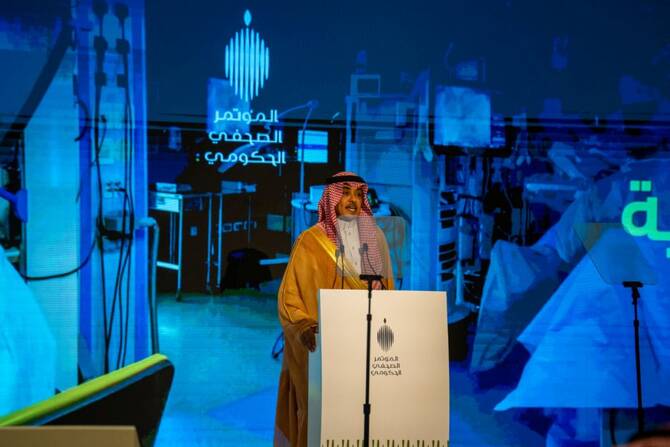
Minister of Media Salman Al-Dossary. (AN Photo)
2 / 2
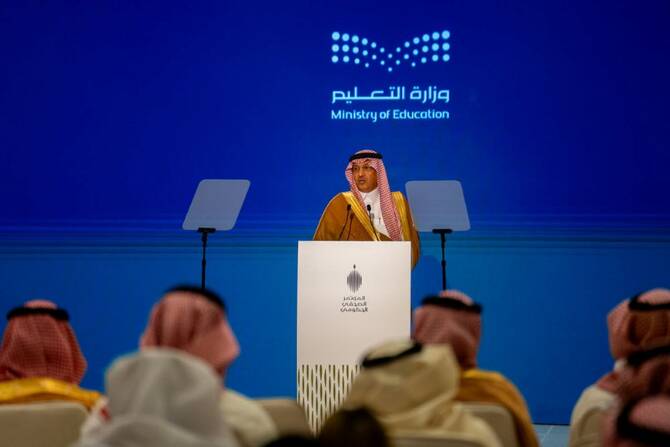
Minister of Education Yousef Al-Benyan. (AN Photo)
Short Url
Updated 14 August 2025
Follow

New scholarship program aims to put media students on fast track to the top

  • Scheme will provide access to ‘world’s best universities and companies,’ media minister says
  • Officials also explain decision to return to two-semester academic year

RIYADH: Officials on Wednesday announced the launch of a new scholarship program designed to prepare Saudi students for a first class-career in the media industry.

Speaking at a press conference, Minister of Media Salman Al-Dossary said the Media Scholarship Project, developed in partnership with the Ministry of Education, would combine “knowledge with empowerment.”

The initiative, he said, was “aimed at preparing male and female students for the job market by training them and sending them to the world’s best universities and companies specializing in the media field.”

Minister of Education Yousef Al-Benyan said the growth in the number of Saudi students at top universities was evidence of the Kingdom’s drive to develop its human capital and expand international education opportunities.

The ministers also discussed the country’s decision to return to a two-semester academic year and the introduction of an artificial intelligence curriculum.

Starting in the 2025-26 academic year, AI studies will be introduced at all stages of education alongside a cybersecurity course for high school students.

Responding to a question from Arab News, Al-Benyan said the 180-day semester “meets the needs of the educational process” in Saudi Arabia.

The decision was made following a “comprehensive study that included input from all parties, starting with the students themselves, parents and teachers, as well as experts from within the ministry and other parties,” he said.

The change comes four years after the introduction of a three-term system that aimed to extend study days, expand the curricula and make fuller use of educational resources.

Al-Benyan said the National Center for Curriculum Development had produced 27 digital courses, reformulated 19 as interactive books and reviewed 50 others to support an advanced digital learning environment.

He also highlighted the center’s role in aligning curricula with national values and identity, and praised the National Institute for Professional Development for its work with teachers.

“There is a program that will detail the number of values, as well as their quality, and link them to the curriculum and classroom activities. And there will be, God willing, a clear plan from the National Center for Curriculum Development,” he said.

Al-Dossary also shared a number of national economic achievements.

“Saudi Arabia’s program to attract regional headquarters for global companies attracted more than 616 global companies in the first quarter of 2021, up from 120 in the previous quarter, exceeding the 2030 target of 500 companies,” he said.

In the industrial sector, he said the number of factories had risen from “about 7,200 to about 250,500,” while investment had increased from SR955 billion to SR1 trillion and non-oil exports had grown from SR150 billion to SR677 billion.

The ministers were speaking at the latest in a series of quarterly ministerial press conferences designed to shed light on important issues and encourage transparency between officials and journalists, values that align with Vision 2030.


University of Hong Kong hosts the first Saudi Economic Forum to boost China–Saudi ties

Updated 17 December 2025
Follow

University of Hong Kong hosts the first Saudi Economic Forum to boost China–Saudi ties

  • The high-level event served as a new platform for bilateral dialogue and cross-sector collaboration

RIYADH: The University of Hong Kong (HKU) has hosted the first-ever Saudi Economic Forum in Riyadh, bringing together nearly 100 senior officials, academics, and business leaders to deepen cooperation between China and Saudi Arabia in education, innovation, and economic growth.

Held under the theme “Enhancing the Global Competitiveness of Chinese and Saudi Institutions,” the forum marked a significant milestone in advancing strategic alignment between China’s Belt and Road Initiative and Saudi Vision 2030.

The high-level event served as a new platform for bilateral dialogue and cross-sector collaboration, with participants exploring joint opportunities in investment, technology, renewable energy, and artificial intelligence.

Professor Hongbin Cai, dean of the faculty of business and economics at HKU, said the university aspires to become a “knowledge bridge” between the two nations, leveraging its global standing and extensive international networks. He noted that educational collaboration would be a cornerstone of the Saudi–Chinese partnership.

Saudi Arabia’s Assistant Deputy Minister of Investment, Fahad Al-Hashem, emphasized the depth of the China–Saudi partnership, noting that bilateral trade now exceeds $150 billion, with a growth rate of around 30 percent annually.

He reaffirmed the Kingdom’s openness to partnerships with China’s leading universities and technology companies, particularly in future-focused sectors aligned with Vision 2030, including education, digital transformation, AI, and clean energy.

The forum featured panel discussions on cross-border education, global city development, and technology transfer, with experts stressing the importance of joint ventures in the digital economy and smart infrastructure.

Participants said Saudi Arabia could benefit from China’s successful experiences in energy transition, infrastructure modernization, and innovation ecosystems as it builds globally competitive cities and institutions.

The Saudi Economic Forum concluded with calls for sustained academic and corporate partnerships to enhance institutional excellence and global competitiveness. Organizers said the initiative will continue to facilitate knowledge exchange and support national transformation goals in both countries, namely in the fields of technology and innovation.