

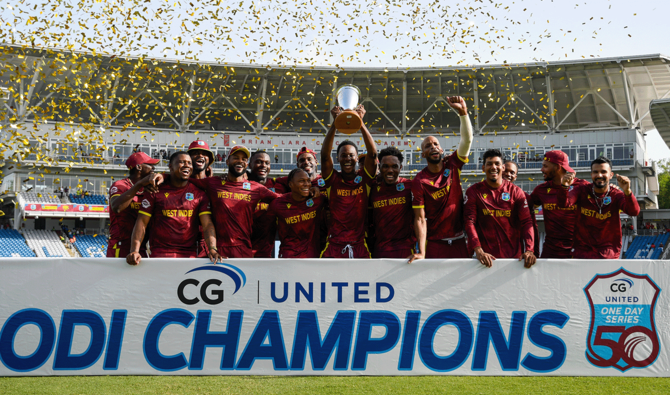
Pakistan skittled for 92 as West Indies wins third ODI by 202 runs for historic 2-1 series win

West Indies team celebrate with the trophy after winning the third and final One Day International (ODI) cricket match between West Indies and Pakistan at Brian Lara Cricket Academy in Tarouba, San Fernando, Trinidad and Tobago on August 12, 2025. (AFP)
Short Url
Updated 13 August 2025
Follow

Pakistan skittled for 92 as West Indies wins third ODI by 202 runs for historic 2-1 series win

  • It was the first bilateral ODI series won by West Indies against Pakistan since 1991
  • Game ended run of home series defeats across test and T20 formats to Australia and Pakistan

TAROUBA, Trinidad and Tobago: Shai Hope helped deliver some long overdue good news for the West Indies with a century to inspire the Caribbean cricketers to a series-clinching, 202-run win Tuesday over Pakistan.

It was the first bilateral ODI series won by West Indies against Pakistan since 1991 and ended a run of home series defeats across the test and Twenty20 formats to Australia and Pakistan.

Hope stroked an unbeaten 120 before pace bowler Jayden Seales destroyed Pakistan’s chase with six wickets in the third and final one-day cricket international.

The West Indies captain said he was extremely proud of his team.

Hope added there’d been a lot of stress on negatives in the game but now there was “positives to shout about” for West Indies cricket.

The big win came in the wake of a two-day emergency summit for Caribbean cricket. Hope attended part of the summit, along with greats including Brian Lara and Clive Lloyd, to help create strategies to lift West Indies back toward the top of the international game.

The summit was called after a West Indian lineup scored just 27 runs in its second innings – one run short of the all-time test record for low totals — while losing the third of three tests to Australia.

After losing eight straight matches to Australia and then losing a Twenty20 series 2-1 to Pakistan in Florida, West Indies lost the ODI series-opener to Pakistan last week by five wickets.

West Indies leveled the series with a five-wicket victory in the second ODI to stoke hope of a revival and dominated the third.
Pakistan was dismissed for 92 in 29.2 overs Tuesday after West Indies posted 294-6 at Brian Lara Stadium in Tarouba, Trinidad and Tobago.

Hope hit five sixes and 10 fours in his 94-ball knock, sharing an unbroken seventh-wicket stand with Justin Greaves of 110 runs in around eight overs.

Greaves was 43 not out in only 24 deliveries, including two sixes and four fours.

Pakistan collapsed early in its chase to 23-4 in the ninth over, with three ducks from its top four batters. Opener Saim Ayub was caught behind on the third ball of the innings, Abdullah Shafique also failed to score, and Pakistan was 8-3 when captain Mohammad Rizwan was bowled by Seales for a golden duck in the third over.

Seales took his fourth wicket by trapping Babar Azam (9) lbw. Seales finished with figures of 6-18 from 7.2 overs.

Hasan Nawaz (13) advanced and was stumped against the bowling of Gudakesh Motie and Roston Chase bowled Hussain Talat (1), leaving Pakistan on 62-6 in the 21st over. Salman Agha top-scored for Pakistan with a 49-ball 30.

The match and series ended with another golden duck when Abrar Ahmed was run out by Chase.


Pakistan PM orders accelerated privatization of power sector to tackle losses

Updated 15 December 2025
Follow

Pakistan PM orders accelerated privatization of power sector to tackle losses

  • Tenders to be issued for privatization of three major electricity distribution firms, PMO says
  • Sharif says Pakistan to develop battery energy storage through public-private partnerships

ISLAMABAD: Pakistan’s prime minister on Monday directed the government to speed up privatization of state-owned power companies and improve electricity infrastructure nationwide, as authorities try to address deep-rooted losses and inefficiencies in the energy sector that have weighed on the economy and public finances.

Pakistan’s electricity system has long struggled with financial distress caused by a combination of factors including theft of power, inefficient collection of bills, high costs of generating electricity and a large burden of unpaid obligations known as “circular debt.” In the first quarter of the current financial year, government-owned distribution companies recorded losses of about Rs171 billion ($611 million) due to poor bill recovery and operational inefficiencies, official documents show. Circular debt in the broader power sector stood at around Rs1.66 trillion ($5.9 billion) in mid-2025, a sharp decline from past peaks but still a major fiscal drain. 

Efforts to contain these losses have been a focus of Pakistan’s economic reform program with the International Monetary Fund, which has urged structural changes in the energy sector as part of financing conditions. Previous government initiatives have included signing a $4.5 billion financing facility with local banks to ease power sector debt and reducing retail electricity tariffs to support economic recovery. 

“Electricity sector privatization and market-based competition is the sustainable solution to the country’s energy problems,” Prime Minister Shehbaz Sharif said at a meeting reviewing the roadmap for power sector reforms, according to a statement from the prime minister’s office.

The meeting reviewed progress on privatization and infrastructure projects. Officials said tenders for modernizing one of Pakistan’s oldest operational hubs, Rohri Railway Station, will be issued soon and that the Ghazi Barotha to Faisalabad transmission line, designed to improve long-distance transmission of electricity, is in the initial approval stages. While not all power-sector decisions were detailed publicly, the government emphasized expanding private sector participation and completing priority projects to strengthen the electricity grid.

In another key development, the prime minister endorsed plans to begin work on a battery energy storage system with participation from private investors to help manage fluctuations in supply and demand, particularly as renewable energy sources such as solar and wind take a growing role in generation. Officials said the concept clearance for the storage system has been approved and feasibility studies are underway.

Government briefing documents also outlined steps toward shifting some electricity plants from imported coal to locally mined Thar coal, where a railway line expansion is underway to support transport of fuel, potentially lowering costs and import dependence in the long term.

State authorities also pledged to address safety by converting unmanned railway crossings to staffed ones and to strengthen food safety inspections at stations, underscoring broader infrastructure and service improvements connected to energy and transport priorities.