

Pakistan issues high alert as seventh spell of monsoon rains set to intensify

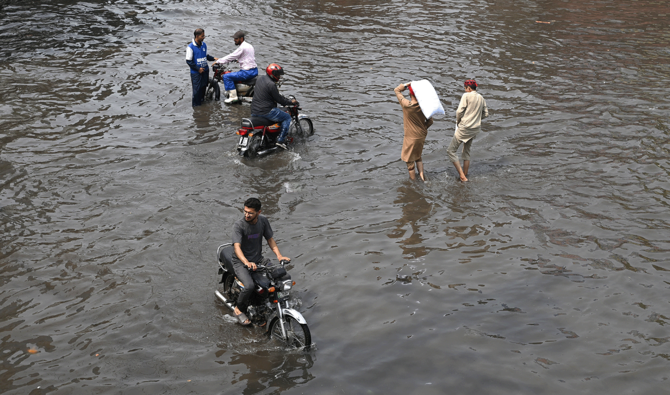
Commuters wade through a flooded street after heavy monsoon rains in Lahore on August 3, 2025. (AFP/File)
Short Url
Updated 13 August 2025
Follow

Pakistan issues high alert as seventh spell of monsoon rains set to intensify

  • PDMA warns of “widespread rain-wind/thundershower” with possible urban and flash flooding from Aug. 13–21
  • Monsoon incidents in Punjab have killed 164 people and injured 582 since mid-June, over 300 people have died nationwide

ISLAMABAD: Authorities in Pakistan’s Punjab province on Wednesday issued a high alert for heavy rains and possible flooding, warning that the seventh spell of the summer monsoons is forecast to be stronger than earlier phases and will persist through much of next week.

Pakistan’s government has reported over 300 deaths and 1,600 damaged houses due to the floods, heavy rain and other weather since June 26.

On Wednesday, the Provincial Disaster Management Authority (PDMA) said “widespread rain-wind/thundershower (with scattered heavy falls at times very heavy) is expected” in upper Punjab from Aug. 13 to 17, with showers spreading to most plains districts from Aug. 18 to 21.

Areas at risk include Murree, Galiyat, Attock, Chakwal, Jhelum, Mandi Bahauddin, Gujrat, Gujranwala, Hafizabad, Lahore, Sheikhupura, Sialkot, Narowal, Kasur, Faisalabad, and Sahiwal, among others.

“More rain-wind/thundershower is predicted in the country in coming days; monsoon activity is likely to intensify during the upcoming week,” the PDMA advisory said, citing the Pakistan Meteorological Department.

Moist currents from the Bay of Bengal are forecast to strengthen from Aug. 17, with a westerly wave influencing upper parts of the country.


People wade through the flooded street after during the monssoon rain in Rawalpindi, Pakistan July 17, 2025. (Reuters/File)

DG PDMA Punjab Irfan Ali Kathia instructed all commissioners and deputy commissioners to remain “alert” and keep emergency control rooms staffed round the clock.

The agency warned of “urban flooding in low-lying areas of Rawalpindi, Gujranwala, Lahore and Sialkot” and possible flash floods in rivers and hill torrents of Dera Ghazi Khan from Aug. 18 to 21.

Landslides are also possible in Murree and Galiyat, while heavy winds could damage weak structures, rooftops and power infrastructure.

Hydrological data from Aug. 13 showed low flood levels in the Indus River at Kalabagh, Tarbela and Chashma, and in the Chenab at Khanki, with normal flows in the Jhelum, Ravi and Sutlej. Mangla Dam was at 65 percent capacity and Tarbela at 96 percent, while Indian reservoirs were around 70 percent full.

Since late June, monsoon-related incidents in Punjab have killed 164 people, injured 582, damaged 216 homes and killed 121 livestock, according to PDMA records.

The agency urged the public to follow safety instructions, keep children away from rivers and canals, and avoid crossing flowing water during floods.
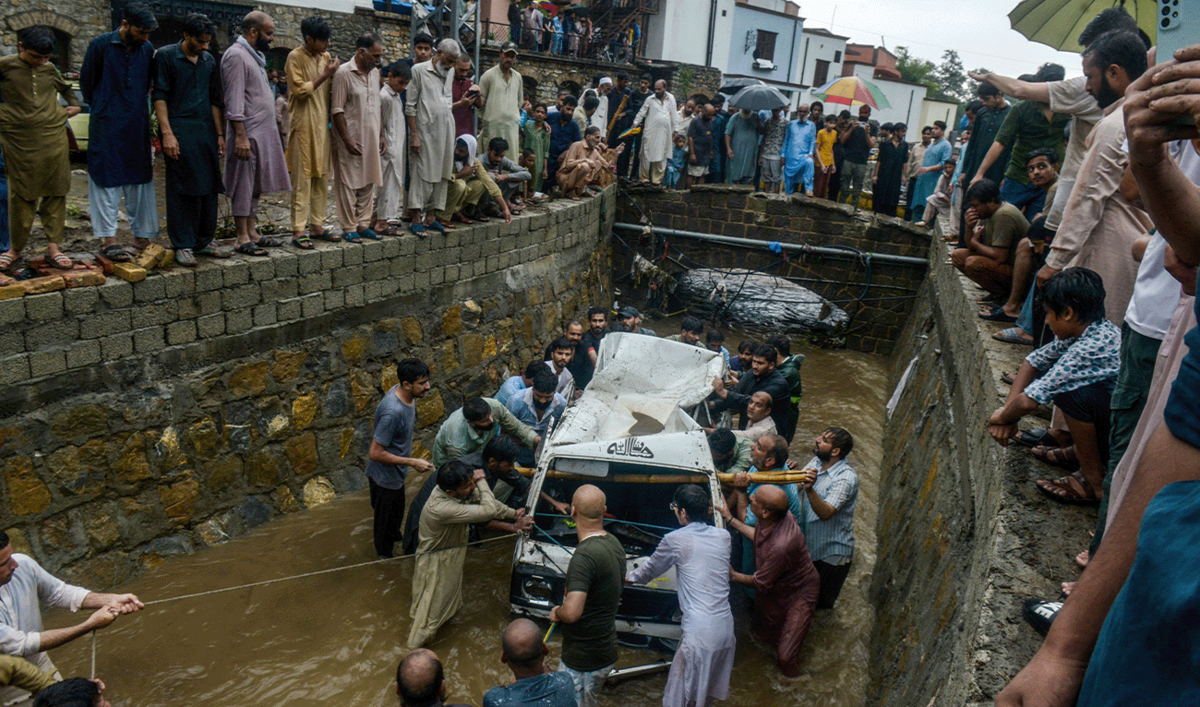


People remove the wreckage of a van from a drainage after heavy monsoon rains in Islamabad on July 21, 2025. (AFP/File)

Pakistan’s June–September monsoon brings around 70 percent of annual rainfall, but climate change is making seasonal patterns more erratic and intense. Scientists say warmer air holds more moisture, increasing the risk of extreme downpours, while glacial melt and poor drainage heighten flood vulnerability.

In 2022, record monsoon rains and glacial floods inundated a third of the country, killing at least 1,700 people and causing damage estimated at more than $30 billion.

Last week, a study by World Weather Attribution, a group of international scientists who study global warming’s role in extreme weather, found that rainfall from June 24 to July 23 in Pakistan was 10 percent to 15 percent heavier because of climate change, leading to many building collapses in urban and rural Pakistan.


Imran Khan not a ‘national security threat,’ ex-PM’s party responds to Pakistan military

Updated 4 sec ago
Follow

Imran Khan not a ‘national security threat,’ ex-PM’s party responds to Pakistan military

  • Pakistan’s military spokesperson on Friday described Khan’s anti-army narrative as a “national security threat”
  • PTI Chairman Gohar Ali Khan says words used by military spokesperson for Khan were “not appropriate”

ISLAMABAD: Former prime minister Imran Khan’s Pakistan Tehreek-e-Insaf (PTI) party on Saturday responded to allegations by Pakistan military spokesperson Lt. Gen. Ahmed Sharif Chaudhry from a day earlier, saying that he was not a “national security threat.”

Chaudhry, who heads the military’s media wing as director general of the Inter-Services Public Relations (ISPR), spoke to journalists on Friday, in which he referred to Khan as a “mentally ill” person several times during the press interaction. Chaudhry described Khan’s anti-army narrative as a “national security threat.”

The military spokesperson was responding to Khan’s social media post this week in which he accused Chief of Defense Forces Field Marshal Asim Munir of being responsible for “the complete collapse of the constitution and rule of law in Pakistan.” 

“The people of Pakistan stand with Imran Khan, they stand with PTI,” the party’s secretary-general, Salman Akram Raja, told reporters during a news conference. 

“Imran Khan is not a national security threat. Imran Khan has kept the people of this country united.”

Raja said there were several narratives in the country, including those that created tensions along ethnic and sectarian lines, but Khan had rejected all of them and stood with one that the people of Pakistan supported. 

PTI Chairman Gohar Ali Khan, flanked by Raja, criticized the military spokesperson as well, saying his press talk on Thursday had “severely disappointed” him. 

“The words that were used [by the military spokesperson] were not appropriate,” Gohar said. “Those words were wrong.”

NATURAL OUTCOME’

Speaking to reporters earlier on Saturday, Pakistan’s Defense Minister Khawaja Asif defended the military spokesperson’s remarks against Khan.

“When this kind of language is used for individuals as well as for institutions, then a reaction is a natural outcome,” he said. 

“The same thing is happening on the Twitter accounts being run in his [Khan’s] name. If the DG ISPR has given any reaction to it, then I believe it was a very measured reaction.”

Khan, who was ousted after a parliamentary vote of confidence in April 2022, blames the country’s powerful military for removing him from power by colluding with his political opponents. Both deny the allegations. 

The former prime minister, who has been in prison since August 2023 on a slew of charges he says are politically motivated, also alleges his party was denied victory by the army and his political rivals in the 2024 general election through rigging. 

The army and the government both deny his allegations.