

Pakistan issues high alert as seventh spell of monsoon rains set to intensify

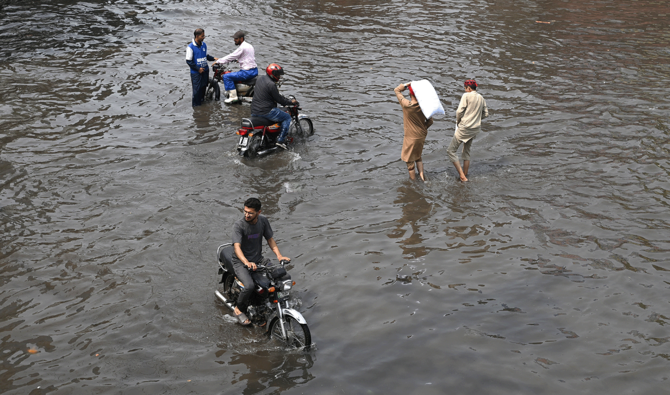
Commuters wade through a flooded street after heavy monsoon rains in Lahore on August 3, 2025. (AFP/File)
Short Url
Updated 13 August 2025
Follow

Pakistan issues high alert as seventh spell of monsoon rains set to intensify

  • PDMA warns of “widespread rain-wind/thundershower” with possible urban and flash flooding from Aug. 13–21
  • Monsoon incidents in Punjab have killed 164 people and injured 582 since mid-June, over 300 people have died nationwide

ISLAMABAD: Authorities in Pakistan’s Punjab province on Wednesday issued a high alert for heavy rains and possible flooding, warning that the seventh spell of the summer monsoons is forecast to be stronger than earlier phases and will persist through much of next week.

Pakistan’s government has reported over 300 deaths and 1,600 damaged houses due to the floods, heavy rain and other weather since June 26.

On Wednesday, the Provincial Disaster Management Authority (PDMA) said “widespread rain-wind/thundershower (with scattered heavy falls at times very heavy) is expected” in upper Punjab from Aug. 13 to 17, with showers spreading to most plains districts from Aug. 18 to 21.

Areas at risk include Murree, Galiyat, Attock, Chakwal, Jhelum, Mandi Bahauddin, Gujrat, Gujranwala, Hafizabad, Lahore, Sheikhupura, Sialkot, Narowal, Kasur, Faisalabad, and Sahiwal, among others.

“More rain-wind/thundershower is predicted in the country in coming days; monsoon activity is likely to intensify during the upcoming week,” the PDMA advisory said, citing the Pakistan Meteorological Department.

Moist currents from the Bay of Bengal are forecast to strengthen from Aug. 17, with a westerly wave influencing upper parts of the country.


People wade through the flooded street after during the monssoon rain in Rawalpindi, Pakistan July 17, 2025. (Reuters/File)

DG PDMA Punjab Irfan Ali Kathia instructed all commissioners and deputy commissioners to remain “alert” and keep emergency control rooms staffed round the clock.

The agency warned of “urban flooding in low-lying areas of Rawalpindi, Gujranwala, Lahore and Sialkot” and possible flash floods in rivers and hill torrents of Dera Ghazi Khan from Aug. 18 to 21.

Landslides are also possible in Murree and Galiyat, while heavy winds could damage weak structures, rooftops and power infrastructure.

Hydrological data from Aug. 13 showed low flood levels in the Indus River at Kalabagh, Tarbela and Chashma, and in the Chenab at Khanki, with normal flows in the Jhelum, Ravi and Sutlej. Mangla Dam was at 65 percent capacity and Tarbela at 96 percent, while Indian reservoirs were around 70 percent full.

Since late June, monsoon-related incidents in Punjab have killed 164 people, injured 582, damaged 216 homes and killed 121 livestock, according to PDMA records.

The agency urged the public to follow safety instructions, keep children away from rivers and canals, and avoid crossing flowing water during floods.
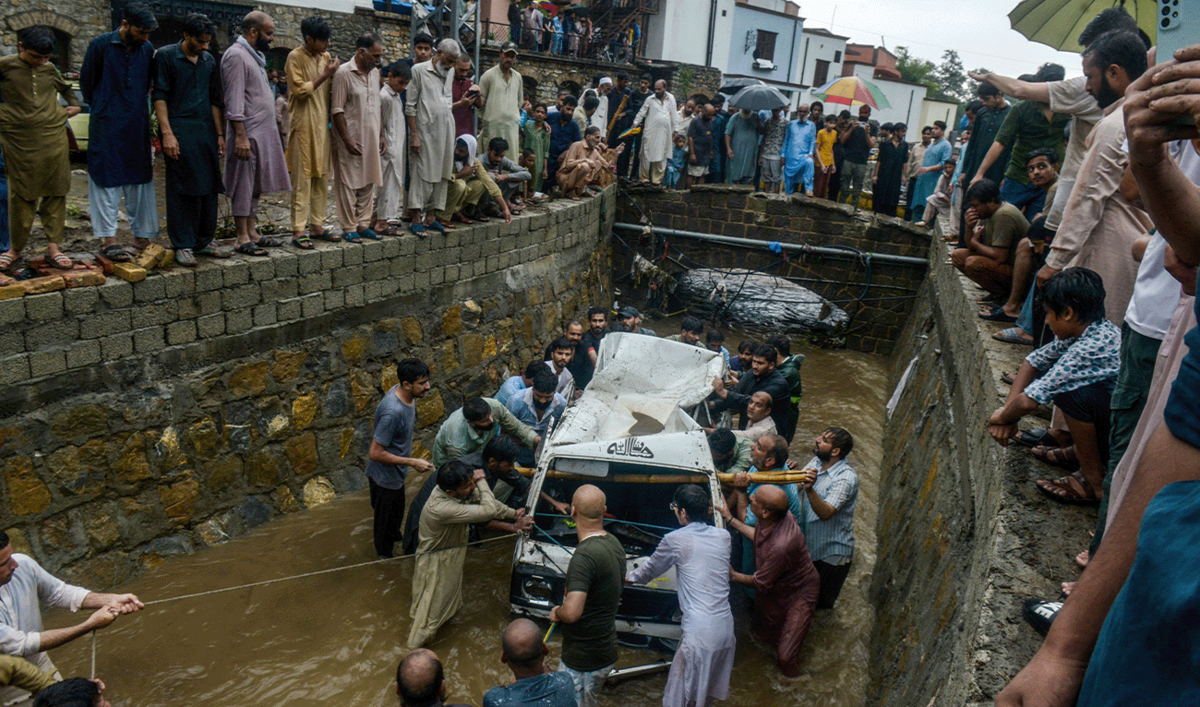


People remove the wreckage of a van from a drainage after heavy monsoon rains in Islamabad on July 21, 2025. (AFP/File)

Pakistan’s June–September monsoon brings around 70 percent of annual rainfall, but climate change is making seasonal patterns more erratic and intense. Scientists say warmer air holds more moisture, increasing the risk of extreme downpours, while glacial melt and poor drainage heighten flood vulnerability.

In 2022, record monsoon rains and glacial floods inundated a third of the country, killing at least 1,700 people and causing damage estimated at more than $30 billion.

Last week, a study by World Weather Attribution, a group of international scientists who study global warming’s role in extreme weather, found that rainfall from June 24 to July 23 in Pakistan was 10 percent to 15 percent heavier because of climate change, leading to many building collapses in urban and rural Pakistan.


Pakistan, global crypto exchange discuss modernizing digital payments, creating job prospects 

Updated 05 December 2025
Follow

Pakistan, global crypto exchange discuss modernizing digital payments, creating job prospects 

  • Pakistani officials, Binance team discuss coordination between Islamabad, local banks and global exchanges
  • Pakistan has attempted to tap into growing crypto market to curb illicit transactions, improve oversight

ISLAMABAD: Pakistan’s finance officials and the team of a global cryptocurrency exchange on Friday held discussions aimed at modernizing the country’s digital payments system and building local talent pipelines to meet rising demand for blockchain and Web3 skills, the finance ministry said.

The development took place during a high-level meeting between Finance Minister Muhammad Aurangzeb, Pakistan Virtual Assets Regulatory Authority (PVARA) Chairman Bilal bin Saqib, domestic bank presidents and a Binance team led by Global CEO Richard Teng. The meeting was held to advance work on Pakistan’s National Digital Asset Framework, a regulatory setup to govern Pakistan’s digital assets.

Pakistan has been moving to regulate its fast-growing crypto and digital assets market by bringing virtual asset service providers (VASPs) under a formal licensing regime. Officials say the push is aimed at curbing illicit transactions, improving oversight, and encouraging innovation in blockchain-based financial services.

“Participants reviewed opportunities to modernize Pakistan’s digital payments landscape, noting that blockchain-based systems could significantly reduce costs from the country’s $38 billion annual remittance flows,” the finance ministry said in a statement. 

“Discussions also emphasized building local talent pipelines to meet rising global demand for blockchain and Web3 skills, creating high-value employment prospects for Pakistani youth.”

Blockchain is a type of digital database that is shared, transparent and tamper-resistant. Instead of being stored on one computer, the data is kept on a distributed network of computers, making it very hard to alter or hack.

Web3 refers to the next generation of the Internet built using blockchain, focusing on giving users more control over their data, identity and digital assets rather than big tech companies controlling it.

Participants of the meeting also discussed sovereign debt tokenization, which is the process of converting a country’s debt such as government bonds, into digital tokens on a blockchain, the ministry said. 

Aurangzeb called for close coordination between the government, domestic banks and global exchanges to modernize Pakistan’s payment landscape.

Participants of the meeting also discussed considering a “time-bound amnesty” to encourage users to move assets onto regulated platforms, stressing the need for stronger verifications and a risk-mitigation system.

Pakistan has attempted in recent months to tap into the country’s growing crypto market, crack down on money laundering and terror financing, and promote responsible innovation — a move analysts say could bring an estimated $25 billion in virtual assets into the tax net.

In September, Islamabad invited international crypto exchanges and other VASPs to apply for licenses to operate in the country, a step aimed at formalizing and regulating its fast-growing digital market.