Gulf tourists say Polish mountain town is a cool place

1 / 5
A tourist takes a picture of a cow on the hill Gubalowka, a hill from which there is a view of Zakopane and the Tatra Mountains, on August 4, 2025. Zakopane, located in southern Poland, has become a major summer destination for holidaymakers from the United Arab Emirates, Saudi Arabia and Kuwait, with as many as seven daily flights from the region at nearby Krakow Airport. (AFP)
2 / 5
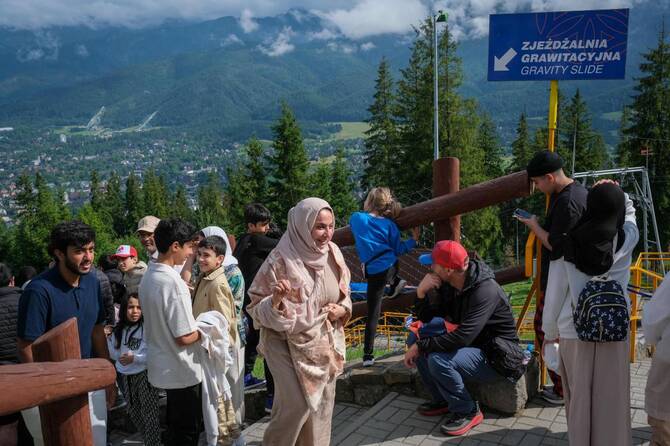
Tourists walk on Gubalowka hill, a hill from which there is a view of Zakopane and the Tatra Mountains, on August 4, 2025. Zakopane, located in southern Poland, has become a major summer destination for holidaymakers from the United Arab Emirates, Saudi Arabia and Kuwait, with as many as seven daily flights from the region at nearby Krakow Airport. (AFP)
3 / 5
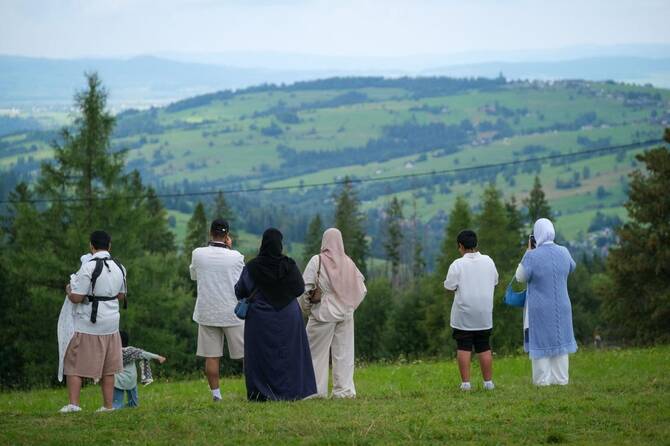
Tourists stand on the hill Gubalowka, a hill from which there is a view of Zakopane and the Tatra Mountains, on August 4, 2025. Zakopane, located in southern Poland, has become a major summer destination for holidaymakers from the United Arab Emirates, Saudi Arabia and Kuwait, with as many as seven daily flights from the region at nearby Krakow Airport. (AFP)
4 / 5
Tourists sit in a chairlift on the hill Gubalowka, a hill from which there is a view of Zakopane and the Tatra Mountains, on August 4, 2025. Zakopane, located in southern Poland, has become a major summer destination for holidaymakers from the United Arab Emirates, Saudi Arabia and Kuwait, with as many as seven daily flights from the region at nearby Krakow Airport. (AFP)
5 / 5
A tourist takes a picture of a dessert on Krupowki, the main pedestrian zone of Zakopane, on August 4, 2025. Zakopane, located in southern Poland, has become a major summer destination for holidaymakers from the United Arab Emirates, Saudi Arabia and Kuwait, with as many as seven daily flights from the region at nearby Krakow Airport. (AFP)
Short Url
Updated 13 August 2025
Follow

Gulf tourists say Polish mountain town is a cool place

  • Thousands of Gulf residents spending their summer vacation in Zakopane, a resort known for its ski lifts and hiking trails, where historic wooden houses mix with modern hotels

ZAKOPANE: Saudi photographer Fahad Alayyash gazed over the Alpine-like panorama of the Tatras, Poland’s highest mountain range — and a surprising new hotspot for Arab tourists.
The 38-year-old is among thousands of Gulf residents spending their summer vacation in Zakopane, a resort known for its ski lifts and hiking trails, where historic wooden houses mix with modern hotels.
“We’ve completely taken over the place,” Alayyash said while standing on Gubalowka, a peak overlooking Zakopane, where dozens of visitors drink coffee, shop for souvenirs and enjoy the view.
Zakopane, located in southern Poland, has become a major summer draw for holidaymakers from the United Arab Emirates, Saudi Arabia and Kuwait, with up to seven daily flights from the region at nearby Krakow Airport.
The boom started with a Saudi travel agency representative, said Agata Wojtowicz, head of the Tatra chamber of commerce.
She said the official came to Zakopane to scout for a new destination with a direct connection to the Gulf and “was astonished” by the town.
Flydubai launched the first Dubai-Krakow connection in 2018 and Emiratis are now coming in droves — helped by their visa-free access to the European Union.
Last year they were Poland’s fastest-growing tourist group, according to the tourism ministry, with numbers 66 percent higher than in 2023.
Manal Alanazy, a 45-year-old educational technology professor at King Saud University, said Zakopane is well-known among Saudis.
“When I told my dad and my brother that I’m going to Poland, my brother didn’t like it. He said: ‘It’s all Gulf people there,’” she told AFP.
Zakopane uses social media to attract Gulf tourists who have created “a snowball effect” of growing interest, said Wojtowicz.
Over the past three years, Arab influencers have been invited on promotional visits, according to Grzegorz Biedron, chairman of its tourism organization.
Both Alanazy and Abdullah Alotaibi, a 30-year-old Kuwaiti ship captain, learnt about Zakopane from X.
“I saw on Twitter (X) a thread about Zakopane, and how it treats all people the same, and there is no racism about religions, so I liked it and I came,” said Alotaibi.
Arab tourists cite the feeling of safety as one of Zakopane’s key assets.
“It was dark and I was walking... I’m like, ‘You’re not in Poland, you’re in one of the Gulf countries. Just look. Nothing will happen,’” said Alanazy.
For Zakopane’s business owners, the Gulf clientele has been a blessing.
“This year, around two-thirds are Arabs,” Anna Stoch-El Einen, who owns a kebab restaurant and souvenir shop, said of her customers.
“We have very few Polish tourists in the region, perhaps because of the weather,” she added.
The hospitality industry has adapted fast to the preferences of Middle East visitors.
Stoch-El Einen offers menus in Polish and Arabic, and has a “halal” certificate displayed over the counter.
“We also make sure that we have a halal menu,” said Wiktor Wrobel, CEO of the region’s Nosalowy hotel group.
Arab customers constitute up to 30 percent of all summer guests at his five-star hotel in Zakopane.
City mayor Lukasz Filipowicz told AFP “local entrepreneurs are very happy about the presence of tourists from the Middle East.”
He said the biggest challenge was the difference in driving cultures, with visitors often breaking parking and entry laws.
“Every municipal police patrol is equipped with a handbook in Arabic... so that tourists from the Middle East can understand and comply with the applicable regulations,” Filipowicz said.
The day is rainy, but the drizzle did not deter Gulf visitors escaping the infernal summer heat in their home region. Temperatures sometimes top 50C in the Gulf, whereas Polish summers are generally mild.
Alanazy initially wanted to vacation in Paris.
“I canceled because the heatwave hit the European countries,” she told AFP, adding that “the weather is perfect” in Zakopane.
Wrobel said climate change is a reason behind the surge in Zakopane’s popularity.
“The respite that visitors from Arab countries are looking for cannot be found in Italy or Spain, where temperatures have also risen significantly,” he told AFP.
Hanka Krzeptowska-Marusarz, whose family runs a guesthouse in Zakopane, recalled seeing a Kuwaiti in full Islamic attire as she stood in a meadow, arms spread out, soaked in torrential rain.
“I thought it was beautiful,” she said.


Egypt reveals restored colossal statues of pharaoh in Luxor

Updated 14 December 2025
Follow

Egypt reveals restored colossal statues of pharaoh in Luxor

  • Amenhotep III, one of the most prominent pharaohs, ruled during the 500 years of the New Kingdom, which was the most prosperous time for ancient Egypt

LUXOR: Egypt on Sunday revealed the revamp of two colossal statues of a prominent pharaoh in the southern city of Luxor, the latest in the government’s archeological events that aim at drawing more tourists to the country.
The giant alabaster statues, known as the Colossi of Memnon, were reassembled in a renovation project that lasted about two decades. They represent Amenhotep III, who ruled ancient Egypt about 3,400 years ago.
“Today we are celebrating, actually, the finishing and the erecting of these two colossal statues,” Mohamed Ismail, secretary-general of the Supreme Council of Antiquities, said ahead of the ceremony.
Ismail said the colossi are of great significance to Luxor, a city known for its ancient temples and other antiquities. They’re also an attempt to “revive how this funerary temple of King Amenhotep III looked like a long time ago,” Ismail said.
Amenhotep III, one of the most prominent pharaohs, ruled during the 500 years of the New Kingdom, which was the most prosperous time for ancient Egypt. The pharaoh, whose mummy is showcased at a Cairo museum, ruled between 1390–1353 BC, a peaceful period known for its prosperity and great construction, including his mortuary temple, where the Colossi of Memnon are located, and another temple, Soleb, in Nubia.
The colossi were toppled by a strong earthquake in about 1200 BC that also destroyed Amenhotep III’s funerary temple, said Ismail.
They were fragmented and partly quarried away, with their pedestals dispersed. Some of their blocks were reused in the Karnak temple, but archeologists brought them back to rebuild the colossi, according to the Antiquities Ministry.
In late 1990s, an Egyptian German mission, chaired by German Egyptologist Hourig Sourouzian, began working in the temple area, including the assembly and renovation of the colossi.
“This project has in mind … to save the last remains of a once-prestigious temple,” she said.
The statues show Amenhotep III seated with hands resting on his thighs, with their faces looking eastward toward the Nile and the rising sun. They wear the nemes headdress surmounted by the double crowns and the pleated royal kilt, which symbolizes the pharaoh’s rule.
Two other small statues on the pharaoh’s feet depict his wife, Tiye.
The colossi — 14.5 meters and 13.6 meters respectively — preside over the entrance of the king’s temple on the western bank of the Nile. The 35-hectare complex is believed to be the largest and richest temple in Egypt and is usually compared to the temple of Karnak, also in Luxor.
The colossi were hewn in Egyptian alabaster from the quarries of Hatnub, in Middle Egypt. They were fixed on large pedestals with inscriptions showing the name of the temple, as well as the quarry.
Unlike other monumental sculptures of ancient Egypt, the colossi were partly compiled with pieces sculpted separately, which were fixed into each statue’s main monolithic alabaster core, the ministry said.
Sunday’s unveiling in Luxor came just six weeks after the inauguration of the long-delayed Grand Egyptian Museum, the centerpiece of the government’s bid to boost the country’s tourism industry. The mega project is located near the famed Giza Pyramids and the Sphinx.
In recent years, the sector has started to recover after the coronavirus pandemic and amid Russia’s war on Ukraine — both countries are major sources of tourists visiting Egypt.
“This site is going to be a point of interest for years to come,” said Tourism and Antiquities Minister Sherif Fathy, who attended the unveiling ceremony. “There are always new things happening in Luxor.”
A record number of about 15.7 million tourists visited Egypt in 2024, contributing about 8 percent of the country’s GDP, according to official figures.
Fathy, the minister, has said about 18 million tourists are expected to visit the country this year, with authorities hoping for 30 million visitors annually by 2032.