

Pakistan’s Nadeem, India’s Chopra to reignite javelin rivalry in Poland in August

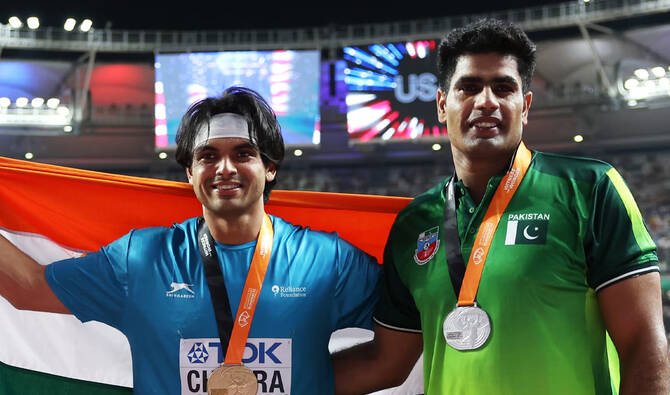
Arshad Nadeem and Neeraj Chopra (left) pose for a picture after the final of Men’s Javelin Throw at the World Athletics Championship in Budapest, Hungary, on August 27, 2023 (Getty Images/File)
Short Url
Updated 13 July 2025
Follow

Pakistan’s Nadeem, India’s Chopra to reignite javelin rivalry in Poland in August

  • Arshad Nadeem and Neeraj Chopra to face off in Wanda Diamond League 2025 competition in Silesia in August
  • Two last faced each other in August 2024 at Paris Olympics where Nadeem won gold with 92.97-meter throw5

ISLAMABAD: Pakistan’s javelin star Arshad Nadeem and India’s Neeraj Chopra will reignite their rivalry in August when the two sportsmen compete at the Silesia Wanda Diamond League 2025 competition scheduled to be held in Poland, the official website of the Olympics said this week. 

This will be the first time Nadeem and Chopra will face each other since their charged encounter at the Paris 2024 Olympic final, where Nadeem clinched gold ahead of Neeraj with an Olympic record-shattering throw of 92.97 meters. 

The Wanda Diamond League is an annual sports competition featuring elite athletes across sprints, jumps, throws and distance events. The competition is set to take place next month in Silesia on August 16. 

“Neeraj Chopra will face Arshad Nadeem,” the Olympics website said, quoting the Diamond League organizers.

“The Indian-Pakistani battle awaiting the Polish fans will be the first opportunity for revenge after the Paris Olympics.”

Chopra has had an impressive year so far, kicking off his season with a win at the Potch Invitational in South Africa before finishing second at the Doha Diamond League, where he breached the coveted 90-meter barrier with a massive 90.23m throw — a new national record. 

The Indian athlete then had to settle for a second-place finish again at the Janusz Kusocinski Memorial in Poland but returned to winning ways at the Paris Diamond League. Since then, he has logged back-to-back wins at the Ostrova Golden Spike in Czechia and the NC Classic in India.

Nadeem, meanwhile, recently marked a triumphant return to action by winning gold at the Asian Athletics Championships in Gumi, Korea. He hadn’t competed since his Paris 2024 exploits.

Rivalries, particularly between athletes or teams from bitter rivals India and Pakistan, have always been one of the most intriguing aspects of sports. 

However, next month’s competition will have added flair to it, considering the militaries of the two countries engaged in the worst fighting between them in decades in May.

An attack in Indian-administered Kashmir triggered a conflict between the two states that saw them target each other with missiles, drones, fighter jets and artillery fire before agreeing to a ceasefire on May 10.


Pakistan says economy stabilizing as it looks to 2026 growth

Updated 4 sec ago
Follow

Pakistan says economy stabilizing as it looks to 2026 growth

  • Inflation averages 5 percent, remittances hit $16.1 billion as government cites signs of recovery
  • IT exports, industry and development spending highlighted as focus shifts to next year’s targets

ISLAMABAD: Pakistan’s economy has shown signs of stabilization in the first half of the current fiscal year, Planning Minister Ahsan Iqbal said on Thursday, as the government looks ahead to sustaining growth momentum into 2026 after several years of economic volatility.

Briefing the media on economic performance through November, Iqbal said key indicators including inflation, industrial output, exports, remittances and fiscal revenues had improved, creating what he described as a more stable base for forward planning.

Pakistan has spent much of the past two years navigating high inflation, external financing pressures and fiscal tightening under an IMF-backed reform program. While growth remains modest, officials say recent data suggests the economy has moved out of crisis mode and into a consolidation phase.

“During July to November of fiscal year 2025–26, stability has returned to Pakistan’s economy,” Iqbal said, adding that average inflation during the period stood at around 5 percent, compared with 7.9% last year, easing pressure on households and businesses.

Large-scale manufacturing posted growth of 4.1 percent, which Iqbal described as “clear evidence of recovery in industrial activity.”

The planning minister said government revenues also improved, with Federal Board of Revenue collections reaching Rs4,733 billion ($16.9 billion) during July–November, reflecting a 10.2% increase.

External inflows remained resilient, with workers’ remittances rising 9.3% to $16.1 billion, while IT services exports increased 19% to $1.8 billion over the same period, he said.

On the public investment side, Iqbal said Rs196 billion ($700 million) were released under the development budget during the quarter, of which Rs92 billion ($329 million) had already been spent. He added that cost rationalization in development projects between July and October saved Rs3.3 billion ($11.8 million) billion in public funds.

In November, the planning minister said, the Central Development Working Party approved 10 development projects, while six major schemes were referred to the Executive Committee of the National Economic Council.

Iqbal said the approved projects were expected to create 994 immediate jobs, with nearly 24,859 direct and 40,873 indirect employment opportunities projected overall.

Looking ahead, he said all future development schemes would be required to comply with green building codes to ensure environmental protection and sustainable growth.

He also highlighted skills and innovation initiatives, saying that under the “Uraan Pakistan” program, partnerships with Oxford and Cambridge universities were being pursued to promote research, technology and innovation.

Under an IT industry revival plan, he said more than 20,000 young people were being trained in advanced technologies, with over 14,000 new jobs expected to be created.

The government has said maintaining macroeconomic stability while gradually lifting growth remains its central challenge as Pakistan moves into 2026, with officials emphasising disciplined spending, export growth and job creation as key priorities.