‘You can’t snatch even a drop,’ Pakistan warns India against restricting Indus waters

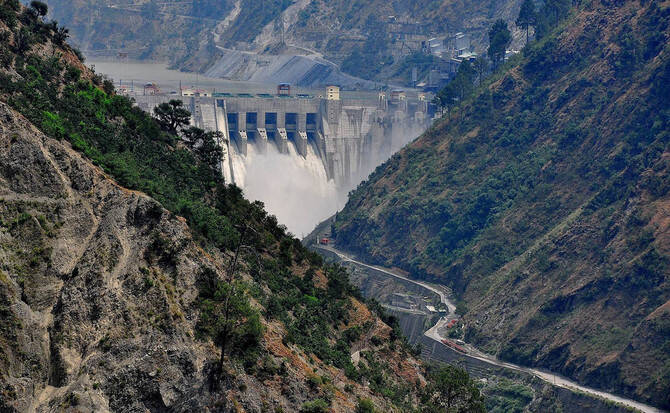
A photo of Kishanganga Hydroelectric Plant, which is part of a run-of-the-river hydroelectric scheme that is designed to divert water from the Kishanganga River (Neelum River in Pakistan) to a power plant in the Jhelum River basin. It will have an installed capacity of 330 MW. (Photo courtesy: ICIMOD)
Short Url
Updated 12 August 2025
Follow

‘You can’t snatch even a drop,’ Pakistan warns India against restricting Indus waters

  • India announced in April it was putting Indus Waters Treaty, which ensures water for 80 percent of Pakistani farms, in abeyance over an attack in Kashmir
  • Pakistan has previously said the treaty has no provision for one side to unilaterally pull back and any blocking of its water will be ‘an act of war’

ISLAMABAD: Pakistan on Tuesday warned India against restricting the flow of its share of the Indus waters, saying New Delhi could not “snatch even a drop” of water from Pakistan.

India announced in April it was putting the 1960 World Bank-mediated Indus Waters Treaty (IWT), which ensures water for 80 percent of Pakistani farms, in abeyance a day after an attack in Indian-administered Kashmir that New Delhi blamed on Pakistan, an allegation Islamabad denies.

The IWT grants Pakistan rights to the Indus basin’s western rivers — Indus, Jhelum, and Chenab — for irrigation, drinking, and non-consumptive uses like hydropower, while India controls the eastern rivers — Ravi, Beas, and Sutlej — for unrestricted use but must not significantly alter their flow. India can use the western rivers for limited purposes such as power generation and irrigation, without storing or diverting large volumes, according to the agreement.

Pakistan has previously said the treaty has no provision for one side to unilaterally pull back and that any blocking of river water flowing to Pakistan will be considered “an act of war,” while Islamabad said on Monday that the Court of Arbitration in the Hague last week issued a ruling with regard to the design of new Indian hydro-electric power stations on the western rivers that was in line with Pakistan’s interpretation of the relevant provisions of the treaty.

“I want to tell this to the enemy today that you threaten to cut off our water, remember this you cannot snatch even a drop of Pakistan’s share [of Indus water],” Prime Minister Shehbaz Sharif said at a ceremony in Islamabad. “If you attempt such an act, we will again teach you such a lesson that you will regret it.”

Pakistan had brought a case to the Hague-based Permanent Court of Arbitration in 2023 over the design of Indian hydro-power projects on rivers that were awarded to Pakistan under the IWT.

In a ruling on Friday that was posted on its website on Monday, the court said it had jurisdiction over the dispute and ruled the treaty “does not permit India to generate hydro-electric power on the Western Rivers based on what might be the ideal or best practices approach for engineering” of these projects.

Instead, the design of these projects must adhere “strictly” to the specifications laid down in the treaty, the court said.

Pakistan’s Attorney General, Mansoor Usman, said in an interview on Tuesday that, by and large, the court had accepted Pakistan’s position, especially on the design issue of the new hydropower projects.

“I am sure it is clear now that India cannot construct any of these projects in violation of the court’s decision,” he told Reuters.

Pakistan’s foreign ministry said late Monday that the court ruling said that India had to “let flow” the waters of the three rivers for Pakistan’s unrestricted use.

The court said its findings are final and binding on both countries, according to the foreign office statement.

But an Indian official pointed to a June statement by India’s foreign ministry, which said that New Delhi has never recognized the existence in law of the Court of Arbitration.

Pakistan and India engaged in a four-day military conflict in May this year, attacking each other with fighter jets, missiles, drones and artillery. The standoff killed around 70 people on both sides before the United States announced a ceasefire on Monday, although India denies agreeing to the truce on the request of Washington.


Islamabad hits back after Indian minister blames Pakistan army for ‘ideological hostility’

Updated 10 sec ago
Follow

Islamabad hits back after Indian minister blames Pakistan army for ‘ideological hostility’

  • Jaishankar tells a public forum most of India’s problems with Islamabad stem from Pakistan’s military establishment
  • Pakistan condemns the remarks, accusing India of waging a propaganda drive to deflect from its destabilizing actions

ISLAMABAD: Pakistan accused India on Sunday of running a propaganda campaign to malign its state institutions, a day after Indian External Affairs Minister Subrahmanyam Jaishankar attributed what he described as Pakistan’s “ideological hostility” toward New Delhi to the country’s powerful army.

Addressing a public forum in New Delhi, Jaishankar said most of India’s problems with Pakistan stemmed from its military establishment, which he argued had cultivated and sustained an entrenched animosity toward India.

His remarks came months after a brief but intense military confrontation between the nuclear-armed neighbors, during which both sides exchanged artillery and missile fire and deployed drones and fighter jets.

Responding to the comments, Pakistan’s Foreign Office spokesperson Tahir Andrabi called them “highly inflammatory, baseless and irresponsible.”

“Pakistan is a responsible state and its all institutions, including armed forces, are a pillar of national security, dedicated to safeguarding the sovereignty and territorial integrity of the country,” Andrabi said in a statement. “The May 2025 conflict vividly demonstrated Pakistan armed forces’ professionalism as well as their resolve to defend the motherland and the people of Pakistan against any Indian aggression in a befitting, effective yet responsible manner.”

“The attempts by Indian leadership to defame Pakistan’s state institutions and its leadership are a part of a propaganda campaign designed to distract attention from India’s destabilising actions in the region and beyond as well as state-sponsored terrorism in Pakistan,” he said, adding that such “incendiary rhetoric” showed the extent of India’s disregard for regional peace and stability.

Andrabi said that rather than making “misleading remarks about the armed forces of Pakistan,” India should confront the “fascist and revisionist Hindutva ideology that has unleashed a reign of mob justice, lynchings, arbitrary detentions and demolition of properties and places of worship.”

He warned that the Indian state and its leadership had become hostage to “this terror in the name of religion.”

India and Pakistan have fought three wars since independence in 1947. They have also engaged in countless border skirmishes and major military standoffs, including the 1999 Kargil conflict.

The four-day conflict in May 2025 ended with a US-brokered ceasefire, after Washington said both sides had expressed willingness to pursue dialogue.

Pakistan said it was ready to discuss all outstanding issues, but India declined talks.


-End