

‘You can’t snatch even a drop,’ Pakistan warns India against restricting Indus waters

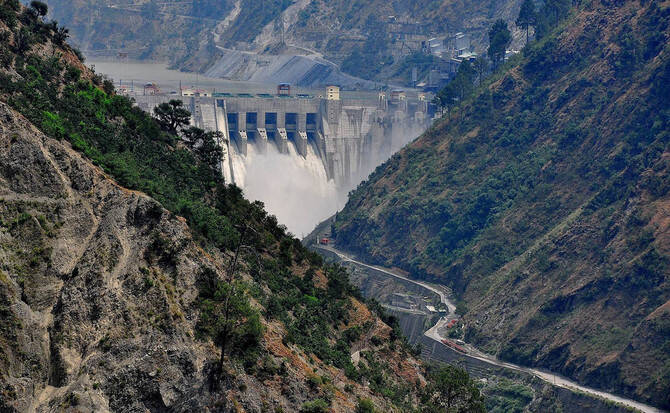
A photo of Kishanganga Hydroelectric Plant, which is part of a run-of-the-river hydroelectric scheme that is designed to divert water from the Kishanganga River (Neelum River in Pakistan) to a power plant in the Jhelum River basin. It will have an installed capacity of 330 MW. (Photo courtesy: ICIMOD)
Short Url
Updated 12 August 2025
Follow

‘You can’t snatch even a drop,’ Pakistan warns India against restricting Indus waters

  • India announced in April it was putting Indus Waters Treaty, which ensures water for 80 percent of Pakistani farms, in abeyance over an attack in Kashmir
  • Pakistan has previously said the treaty has no provision for one side to unilaterally pull back and any blocking of its water will be ‘an act of war’

ISLAMABAD: Pakistan on Tuesday warned India against restricting the flow of its share of the Indus waters, saying New Delhi could not “snatch even a drop” of water from Pakistan.

India announced in April it was putting the 1960 World Bank-mediated Indus Waters Treaty (IWT), which ensures water for 80 percent of Pakistani farms, in abeyance a day after an attack in Indian-administered Kashmir that New Delhi blamed on Pakistan, an allegation Islamabad denies.

The IWT grants Pakistan rights to the Indus basin’s western rivers — Indus, Jhelum, and Chenab — for irrigation, drinking, and non-consumptive uses like hydropower, while India controls the eastern rivers — Ravi, Beas, and Sutlej — for unrestricted use but must not significantly alter their flow. India can use the western rivers for limited purposes such as power generation and irrigation, without storing or diverting large volumes, according to the agreement.

Pakistan has previously said the treaty has no provision for one side to unilaterally pull back and that any blocking of river water flowing to Pakistan will be considered “an act of war,” while Islamabad said on Monday that the Court of Arbitration in the Hague last week issued a ruling with regard to the design of new Indian hydro-electric power stations on the western rivers that was in line with Pakistan’s interpretation of the relevant provisions of the treaty.

“I want to tell this to the enemy today that you threaten to cut off our water, remember this you cannot snatch even a drop of Pakistan’s share [of Indus water],” Prime Minister Shehbaz Sharif said at a ceremony in Islamabad. “If you attempt such an act, we will again teach you such a lesson that you will regret it.”

Pakistan had brought a case to the Hague-based Permanent Court of Arbitration in 2023 over the design of Indian hydro-power projects on rivers that were awarded to Pakistan under the IWT.

In a ruling on Friday that was posted on its website on Monday, the court said it had jurisdiction over the dispute and ruled the treaty “does not permit India to generate hydro-electric power on the Western Rivers based on what might be the ideal or best practices approach for engineering” of these projects.

Instead, the design of these projects must adhere “strictly” to the specifications laid down in the treaty, the court said.

Pakistan’s Attorney General, Mansoor Usman, said in an interview on Tuesday that, by and large, the court had accepted Pakistan’s position, especially on the design issue of the new hydropower projects.

“I am sure it is clear now that India cannot construct any of these projects in violation of the court’s decision,” he told Reuters.

Pakistan’s foreign ministry said late Monday that the court ruling said that India had to “let flow” the waters of the three rivers for Pakistan’s unrestricted use.

The court said its findings are final and binding on both countries, according to the foreign office statement.

But an Indian official pointed to a June statement by India’s foreign ministry, which said that New Delhi has never recognized the existence in law of the Court of Arbitration.

Pakistan and India engaged in a four-day military conflict in May this year, attacking each other with fighter jets, missiles, drones and artillery. The standoff killed around 70 people on both sides before the United States announced a ceasefire on Monday, although India denies agreeing to the truce on the request of Washington.


Pakistan urges developed nations, global institutions to expand role in climate financing

Updated 07 December 2025
Follow

Pakistan urges developed nations, global institutions to expand role in climate financing

  • Pakistan is recognized among countries worldwide most affected by climate-induced disasters
  • Planning minister stresses redesigning global financial system on principles of responsibility, equity

ISLAMABAD: Pakistan’s Planning Minister Ahsan Iqbal this week called on developed nations and international financial institutions to play a greater role in helping developing countries adopt green technologies at lower costs, state-run media reported. 

Pakistan has suffered frequent climate change-induced disasters over the past couple of years, ranging from floods, droughts, heatwaves, cyclones and other irregular weather patterns. 

This year the South Asian country reported over 1,000 deaths from floods and landslides triggered by heavy rains and the melting of glaciers. 

“He [Iqbal] said Pakistan has urged developed countries and international financial institutions to expand their role in climate financing to enable developing nations to adopt green technologies at lower costs,” state-run Associated Press of Pakistan (APP) reported on Saturday. 

The minister was speaking at the Second Asia Energy Transition Summit held at Pakistani university LUMS on Saturday. 

Iqbal warned that climate change is intensifying emergencies and increasing economic burdens on vulnerable countries, adding that financial incentives and concessional financing have become indispensable for sustainable climate action.

“He further emphasized the need to redesign the global financial system based on the principles of collective responsibility and equity,” APP said. 

The minister noted that Pakistan has been introducing comprehensive reforms in its development agenda to promote renewable energy, solar power and green technological solutions. 

The country, he said, possesses “strong solar potential,” a robust renewable energy market, a wide talent pool in engineering and science and an enabling environment for green innovation.

Pakistan has regularly urged developed countries to fulfill past pledges and provide easy access to climate funding without attaching conditions, especially at Conference of Parties (COP30) climate summits. 

Islamabad was instrumental in getting the Fund for Responding to Loss and Damage (FRLD) established at the COP27 climate summit in Egypt in 2022. The Loss and Damage Fund aims to help developing and least developed countries cope with both economic and non-economic impacts of climate change, such as extreme weather events and slow-onset crises like sea-level rise and droughts.