

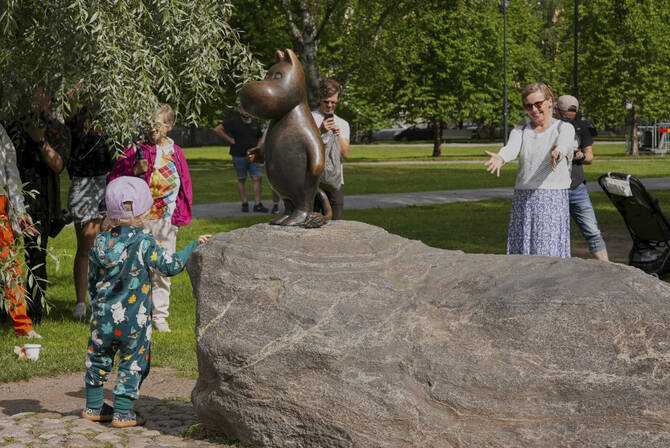

TAMPERE, Finland: The Moomins, Finland’s most lovable literary cartoon family, are celebrating their 80th birthday this year.
The chubby, white, hippopotamus-like characters have captivated readers worldwide since author and illustrator Tove Jansson published “The Moomins and the Great Flood” in 1945. The children’s book features Moomintroll and Moominmamma in their search for the missing Moominpappa.
Jansson, a Swedish-speaking Finn who died in 2001, went on to write eight more books, multiple picture books and a comic strip about the Moomins in Swedish.
The series, set in the fictional Moominvalley, has been translated into more than 60 languages, and sparked movie and TV adaptations, children’s plays, art gallery exhibitions and an eponymous museum – plus theme parks in Finland and Japan. Finnair, the national carrier, has even put Moomins on its airplanes.
On Saturday, fans flocked to Tampere in southern Finland – home of the Moomin Museum – to celebrate the 80th anniversary of the 1945 publication as well as Jansson’s Aug. 9, 1914, birthday.
Fans from childhood to adulthood
For Rosa Senn of the United Kingdom, the festivities reminded her of her childhood. Her Norwegian mother, a fan since her own youth, read all of the tales to Senn and her sister growing up.
“Moomins have been such a special thing in my life, my whole life,” Senn said. “I just carried that love for Moomin, for Tove Jansson, with me into my adult life.”
When Senn met her now-wife, Lizzie, they were initially in a long-distance relationship for the first year and a half. Senn introduced Lizzie to the books and the couple used a plush doll of Moomintroll to feel closer to each other while they were apart. The doll was the ringbearer at their wedding, and they traveled to Tampere on their honeymoon.
The Senns also made an Instagram page documenting the trio’s adventures, which now has nearly 11,000 followers. The social media account has connected them with Moomin fans all over the world, including Stefanie and Michael Geutebrück from Germany.
Moomin merchandise
Stefanie Geutebrück said she remembers falling in love with the Moomins while watching their animations during her childhood in East Germany. She also brought the Moomins into her husband’s life, to the point where they also traveled to Tampere for Saturday’s entertainment.
“Now he’s a total fan and our apartment looks like a Moomin shop,” she said.
Beyond the Geutebrücks’ home, Moomin merchandise is hugely popular. There’s a massive market for Moomintroll, Moominmamma and Moominpappa souvenirs across the globe, and secondary characters like their friends Stinky, Sniff, Snufkin, Snork Maiden and Hattifatteners are also well-loved.
“The Moomin mug is one of the best-known collector items worldwide,” Selma Green, director of the Moomin Museum, said. “You buy a Moomin mug, you like the characters, you maybe see something on TV – but we all go back to the books, the original illustrations.”
Depictions of the character Stinky, described as a lovable rogue who has captured Moominmamma’s heart, generated debate and outcry in Finland this summer after reports emerged in Finnish media that Stinky was removed from a mural in an exhibit at the Brooklyn Public Library in New York due to concerns that the cartoon might be perceived as racist.
“A single image of Stinky was removed from the youth wing – which had the potential to be negatively misconstrued by young children without a fuller understanding of the Moomin universe,” the library said Monday in a statement to The Associated Press. “However, Stinky does appear in other areas of the exhibition and the Moomins books remain available for patrons to check out as they always have.”
Jansson’s drawings of Stinky shows the character with a dark, fuzzy body, with skinny legs and antennae. He has a reputation as an unsuccessful criminal – whose plans get foiled or he gets caught in the act – with an appetite for furniture and other wooden things.
“To me, this became as quite a big surprise because I have more thought about Stinky being close to a mole or a vole,” Sirke Happonen, a Moomins scholar and associate professor at the University of Helsinki, said of the library’s decision. “He’s an interesting character in many ways, like controversial and fun.”
Moominvalley as an escape
The Moomin stories honor the idea of family as a flexible concept. Diverse gender roles and queer themes also come across in Moominvalley, as well as in Jansson’s other works, reflecting her LGBTQ+ identity.
Her partner of more than 45 years, engraver and artist Tuulikki Pietilä, was memorialized as the character Too-ticky in “Moominland Midwinter.” The couple lived in Helsinki and spent their summers on the small rocky island of Klovharu in the Gulf of Finland until the 1990s.
Jansson’s stories also reflect war and catastrophe. The first book, “The Moomins and the Great Flood,” features the displaced Moomin family and was published in the final months of World War II. The conflict had ruined Finland, even though it had remained independent, and one of the author’s brothers went missing during part of his time at the front.
While Jansson sought to portray Moominvalley as an escape, Moomin stories have always had a mixture of peril and comfort.
“Her first Moomin book came out in a dark era. She felt it was very difficult to paint, and she started writing what she called a fairy tale, but she excused herself not to include princesses or princes,” Happonen said.
Moominvalley was borne of a need to find beauty at a time when Jansson’s existence, along with everyone else in Finland, felt frail.
“I think she wanted to make a contrast – Tove Jansson loved contrasts – by writing about this beautiful world, full of friendship and love,” Happonen said.


