Pakistan court orders top Khan aide Shah Mahmood Qureshi’s release following acquittal

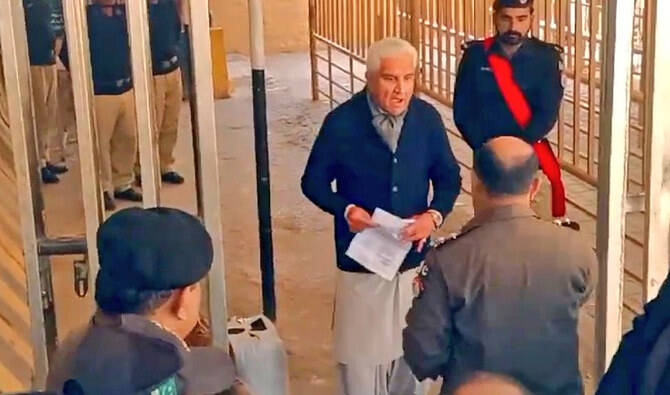
Police arrests former foreign minister Shah Mahmood Qureshi shortly after he was released from prison in a high-profile case in Rawalpindi, Pakistan, on December 27, 2023. (Photo courtesy: @PTIofficial/X/Screengrab/File)
Short Url
Updated 12 August 2025
Follow

Pakistan court orders top Khan aide Shah Mahmood Qureshi’s release following acquittal

  • Pakistani anti-terrorism court acquitted Qureshi on Monday in two cases related to violent protests in Lahore on May 9, 2023
  • Qureshi, who served as foreign minister in Imran Khan’s government from 2018-2022, has been in custody since August 2023

ISLAMABAD: The judge of an anti-terrorism court (ATC) in Pakistan’s eastern city of Lahore this week ordered the release of former prime minister Imran Khan’s top aide, Shah Mahmood Qureshi, a day after he was acquitted in cases related to the violent riots on May 9, 2023, in the eastern city. 

Qureshi, who served as foreign minister under Khan’s government from 2018-2022, has been in custody since August 2023 after he was arrested over his alleged role in leaking the contents of a secret diplomatic cable. The Islamabad High Court set aside Khan and Qureshi’s convictions in the case in June 2024, according to which they were both serving 10 years in prison. 

Cases against the senior Pakistan Tehreek-e-Insaf (PTI) leader were also registered for his alleged involvement in the May 9 riots of 2023 involving an attack on the Shadman police station and the burning of police vehicles near Jinnah House in the eastern Pakistani city, as per local media reports. 

Scores of Khan supporters attacked government buildings and military installations nationwide in violent protests on May 9, 2023, after the former premier was briefly detained on corruption charges. The Lahore ATC held a hearing on two cases related to the May 9 riots on Monday, sentencing over a dozen PTI members to as much as 10 years in prison, which included top Khan aides. Qureshi was acquitted in both May 9 cases by the same court. 

“This is to authorize and require you, the said superintendent, to release the accused Shah Mahmood Qureshi, s/o Syed Sajjad Hussain, from this case forthwith if he is not required to you in any other case,” ATC Judge Manzer Ali Gill wrote in a letter to Kot Lakhpat Jail’s superintendent on Monday. 

Previously detained in Rawalpindi’s Adiala prison, Qureshi was moved last year to Kot Lakhpat jail in Lahore due to logistical reasons. The former foreign minister, like Khan, denies any wrongdoing in the charges leveled against him. 

While Qureshi was acquitted in both cases on Monday, the ATC sentenced PTI leaders Yasmin Rashid, Ejaz Chaudhry, Mahmood-ur-Rashid and Umar Sarfaraz Cheema to 10 years in prison. Two other PTI members, Aliya Hamza Malik and Sanam Javed, were sentenced to five years.

This was the third such verdict against members of Khan’s party since July 22, when an ATC in Sargodha sentenced Ahmed Chattha, Bilal Ejaz and Punjab Assembly Opposition Leader Ahmed Khan Bachar to 10 years.

It was followed by the sentencing of 108 PTI members, including Omar Ayub Khan, Shibli Faraz, Hamid Raza and Zartaj Gul Wazir, to 10 years in prison by an ATC in Faisalabad on July 31.

Information Minister Attaullah Tarar had welcomed the court’s ruling last month, accusing PTI supporters of setting fire to government buildings, damaging military property and injuring law enforcement personnel during the May 9, 2023 unrest.

Meanwhile, PTI spokesperson Zulfikar Bukhari described Monday’s sentencing of PTI leaders as a “flagrant travesty of justice.”

“It is unfortunate that transparency [was] set aside in these cases and the accused were not even given the opportunity to defend themselves,” Bukhari said in a statement on Monday. 

Khan’s party denies encouraging the May 9 violence and has rejected the terrorism charges against its members. Khan says he was in jail when the protests took place and did not direct the violence. The party has said it would challenge the convictions in higher courts.


Pakistan, global crypto exchange discuss modernizing digital payments, creating job prospects 

Updated 05 December 2025
Follow

Pakistan, global crypto exchange discuss modernizing digital payments, creating job prospects 

  • Pakistani officials, Binance team discuss coordination between Islamabad, local banks and global exchanges
  • Pakistan has attempted to tap into growing crypto market to curb illicit transactions, improve oversight

ISLAMABAD: Pakistan’s finance officials and the team of a global cryptocurrency exchange on Friday held discussions aimed at modernizing the country’s digital payments system and building local talent pipelines to meet rising demand for blockchain and Web3 skills, the finance ministry said.

The development took place during a high-level meeting between Finance Minister Muhammad Aurangzeb, Pakistan Virtual Assets Regulatory Authority (PVARA) Chairman Bilal bin Saqib, domestic bank presidents and a Binance team led by Global CEO Richard Teng. The meeting was held to advance work on Pakistan’s National Digital Asset Framework, a regulatory setup to govern Pakistan’s digital assets.

Pakistan has been moving to regulate its fast-growing crypto and digital assets market by bringing virtual asset service providers (VASPs) under a formal licensing regime. Officials say the push is aimed at curbing illicit transactions, improving oversight, and encouraging innovation in blockchain-based financial services.

“Participants reviewed opportunities to modernize Pakistan’s digital payments landscape, noting that blockchain-based systems could significantly reduce costs from the country’s $38 billion annual remittance flows,” the finance ministry said in a statement. 

“Discussions also emphasized building local talent pipelines to meet rising global demand for blockchain and Web3 skills, creating high-value employment prospects for Pakistani youth.”

Blockchain is a type of digital database that is shared, transparent and tamper-resistant. Instead of being stored on one computer, the data is kept on a distributed network of computers, making it very hard to alter or hack.

Web3 refers to the next generation of the Internet built using blockchain, focusing on giving users more control over their data, identity and digital assets rather than big tech companies controlling it.

Participants of the meeting also discussed sovereign debt tokenization, which is the process of converting a country’s debt such as government bonds, into digital tokens on a blockchain, the ministry said. 

Aurangzeb called for close coordination between the government, domestic banks and global exchanges to modernize Pakistan’s payment landscape.

Participants of the meeting also discussed considering a “time-bound amnesty” to encourage users to move assets onto regulated platforms, stressing the need for stronger verifications and a risk-mitigation system.

Pakistan has attempted in recent months to tap into the country’s growing crypto market, crack down on money laundering and terror financing, and promote responsible innovation — a move analysts say could bring an estimated $25 billion in virtual assets into the tax net.

In September, Islamabad invited international crypto exchanges and other VASPs to apply for licenses to operate in the country, a step aimed at formalizing and regulating its fast-growing digital market.