

Pakistan denies India’s ‘sabre rattling’ allegations, vows ‘matching response’ to aggression

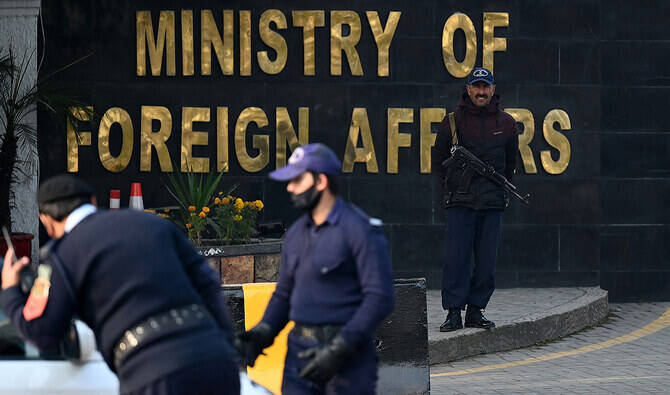
Pakistani police officers stand guard outside the Ministry of Foreign Affairs in Islamabad on January 18, 2024. (AFP/File)
Short Url
Updated 11 August 2025
Follow

Pakistan denies India’s ‘sabre rattling’ allegations, vows ‘matching response’ to aggression

  • India accused Pakistan of sabre rattling after reports of remarks about nuclear threats in South Asia by Pakistani army chief on US visit
  • Islamabad says it remains firmly opposed to the use or threat of use of force, adding that Indian allegations are ‘bereft of rationality’

ISLAMABAD: Pakistan’s foreign office on Monday rejected Indian allegations of “sabre rattling” as misleading, promising a “matching response” to any aggression by New Delhi.

India’s ministry of external affairs (MEA) accused Pakistan of “sabre rattling” and “irresponsibility” after media reports on remarks about nuclear threats in South Asia made by Pakistan’s army chief while on a visit to the United States (US).

Pakistan’s Field Marshal Asim Munir was said to have made the remarks at a black-tie dinner hosted by a Pakistani-origin businessman in Florida on Saturday, where he spoke to a crowd of more than 100 people.

An excerpt of his speech shared by Pakistani security officials did not include such remarks, while the foreign office in Islamabad said the Indian MEA’s statement was yet another demonstration of their “chronic tendency to distorting facts and twisting statements out of context.”

“The Indian narrative of an alleged ‘nuclear blackmail’ is a misleading and self-serving construct,” it said in a statement. “Pakistan remains firmly opposed to the use or threat of use of force. India’s sabre rattling and war mongering, whenever confronted, invite unfounded allegations bereft of rationality.”

India and Pakistan both possess nuclear weapons and fought their deadliest battle in decades in May, sparked by an attack on tourists the previous month in Indian-administer Kashmir, which killed 26 civilians.

“Nuclear sabre-rattling is Pakistan’s stock-in-trade,” Randhir Jaiswal, the spokesperson of India’s MEA, said, adding that it was regrettable that the reported remarks have been made while in a friendly third country.

“The international community can draw its own conclusions on the irresponsibility inherent in such remarks.”

In a version of the speech shared by Pakistani security officials, Munir said: “The (Indian) aggression has brought the region to the brink of a dangerously escalating war, where a bilateral conflict due to any miscalculation will be a grave mistake.”

The Pakistani army chief was on a visit to the US to attend a farewell event for General Michael Kurilla, the 15th commander of the United States Central Command. India previously lodged a private diplomatic protest with Washington when President Donald Trump hosted Munir for a lunch at the White House in June.

In its statement on Monday, the foreign office said Pakistan is a responsible nuclear weapon state with an elaborate command and control structure under full civilian control, and it has always exercised discipline and restraint while dealing with the issues of such importance.

“The Indian MEA’s spurious insinuations are irresponsible and without a shred of evidence,” it said. “We also note with concern a pointless reference to the third countries, in a bid to exert pressure on Pakistan. This not only reflects India’s lack of diplomatic confidence but also constitutes a futile attempt to unnecessarily involve other countries.”

Some analysts believe that India’s disagreement with Washington over the May 10 ceasefire with Pakistan, and Trump’s renewed engagement with Islamabad, have contributed to a recent setback in ties between New Delhi and Washington under the Trump administration.

Pakistan shall continue to act as a responsible member of the comity of nations, its foreign office reiterated.

“However, any act of Indian aggression or violation of Pakistan’s sovereignty and territorial integrity will be met with an immediate and matching response,” it said. “The onus of any ensuing escalation will rest squarely with the Indian leadership.”


Pakistan raises fuel prices by Rs55 per liter as Middle East conflict drives oil surge

Updated 06 March 2026
Follow

Pakistan raises fuel prices by Rs55 per liter as Middle East conflict drives oil surge

  • Government says adequate fuel stocks in place despite global energy shock
  • Oil prices jump from about $78 to over $106 per barrel amid regional conflict

ISLAMABAD: Pakistan on Friday increased petrol and diesel prices by Rs55 ($0.20) per liter each as escalating conflict in the Middle East sent global oil prices sharply higher and disrupted energy supply routes, officials said.

Global oil markets have been rattled since coordinated strikes by the United States and Israel against Iran began last week, triggering retaliatory attacks across the region, raising fears of disruption to key energy shipping routes and pushing petroleum prices sharply upward.

The price adjustment in Pakistan was announced after a joint press conference by Finance Minister Muhammad Aurangzeb, Deputy Prime Minister and Foreign Minister Ishaq Dar and Petroleum Minister Ali Pervaiz Malik, who said the government was monitoring international energy markets and domestic supply conditions amid the crisis.

“So, the decision we have made by changing the levy a little bit is that we are going ahead with increasing the price of both fuels, petrol and diesel, by Rs55 ($0.20),” Malik told reporters. 

“And as soon as this matter settles, we will revise the prices downward with the same speed and take steps on how to increase people’s income and purchasing power.”

He said Pakistan entered the crisis with “comfortable energy reserves” due to earlier planning but rising global prices had forced the government to adjust domestic fuel rates to maintain supply continuity.

He said international petrol prices had climbed from roughly $78 per barrel on March 1 to around $106.8 per barrel, while diesel prices had risen to about $150 per barrel.

Malik added that the government had taken steps to minimize the burden on consumers, noting diesel plays a critical role in agriculture, transportation and public mobility.

Malik also warned that authorities would take strict action against anyone attempting to hoard fuel or manipulate supply for profiteering.

The minister said Pakistan was working with international partners to secure additional energy supplies, including arrangements with Saudi Aramco and the use of Pakistan National Shipping Corporation vessels to transport crude oil imports.

Finance Minister Aurangzeb said a high-level government committee formed by Prime Minister Shehbaz Sharif had been meeting daily to review developments in global petroleum markets and their potential impact on Pakistan’s economy.

“Pakistan currently maintains adequate energy stocks and macroeconomic stability,” Aurangzeb said, adding that the government’s response was based on preparedness rather than panic.

He said the committee, which includes senior ministers, the governor of the State Bank of Pakistan and other officials, was assessing short-, medium- and long-term implications of the crisis for inflation, foreign exchange reserves and broader economic indicators.

Deputy PM Dar said the regional conflict had significantly disrupted global energy markets, with international petroleum prices rising by as much as 50–70 percent in recent days.

The deputy prime minister added that Pakistan was also engaged in diplomatic efforts aimed at de-escalating tensions and restoring stability in the region.

Petroleum prices will now be reviewed more frequently, potentially on a weekly basis, and any reduction in global oil prices would be passed on to consumers.

Pakistan, which relies heavily on imported fuel to meet its energy needs, is particularly vulnerable to global oil price shocks that can quickly feed into inflation and pressure the country’s external accounts.