Indian journalists face criticism at home after meeting Netanyahu amid Gaza war

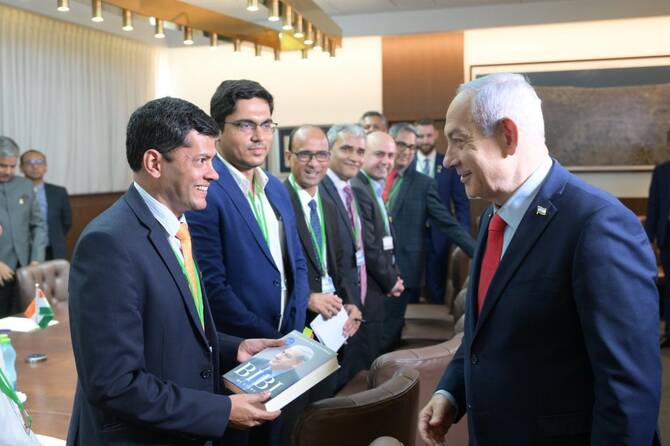
Indian journalists meet Israel’s Prime Minister Benjamin Netanyahu in Jerusalem, Aug. 7, 2025. (Office of PM of Israel)
Short Url
Updated 12 August 2025
Follow

Indian journalists face criticism at home after meeting Netanyahu amid Gaza war

  • Several Indian reporters met Netanyahu during Israel tour last week
  • New Delhi has largely remained quiet since Israel launched its deadly assault on Gaza in October 2023

NEW DELHI: A recent visit by a group of Indian reporters to Israel, and their meeting with its Prime Minister Benjamin Netanyahu, has sparked outrage at home, with senior journalists calling out both the reporters and their publications for violating professional standards and ethics.

Photos posted on social media by Netanyahu’s office showed him last week receiving journalists from India, including Sidhant Sibal from WION TV, Manash Pratim Bhuyan from the Press Trust of India, Aditya Raj Kaul, former senior executive editor at TV9 network, Shubhajit Roy from the Indian Express, and Abhishek Kapoor from Republic TV.

The fact that they accepted the Israeli prime minister’s invitation was “deplorable,” one of the most prominent figures in Indian journalism N. Ram, publisher of The Hindu Group, which includes The Hindu, Frontline, and Sportstar, told Arab News.

“They should have boycotted a man like Netanyahu. And, also, to accept this kind of invitation at this juncture shows the complete lack of sensitivity towards what ethical journalism is about,” he said.

“It only speaks poorly of these journalists and the organizations they represent.”

In the face of Israel’s ongoing war in Gaza, the killing of tens of thousands of Palestinians, imposed starvation, and assassination of more than 200 journalists since October 2023, revealing war crimes is what, according to Ram, could help restore some credibility to the Indian journalists who met Netanyahu.

“Everybody can see what kind of war crimes have been committed,” he said


“If they use the opportunity to expose the atrocities, then that will to some extent redeem their journalism, but I don’t know if they’ve done that.”

For Manoj Sharma, a member of the Press Club of India, seeing his colleagues shake hands with Netanyahu was shocking — not only because Netanyahu is wanted by the International Criminal Court for war crimes, but also given the mass killing of fellow journalists by the Israeli regime.

“That is totally unpardonable,” he said. “As journalists we have a moral responsibility toward all our journalist friends across the globe … We should stand in solidarity with them.”

For Ashutosh, senior journalist and founder of the popular Satya Hindi channel on YouTube, the Israel visit cast doubt on the journalists’ independence and credibility.

“Netanyahu government is facing serious charges of genocide in Gaza. How can one claim to be independent if one is availing the facilities of the regime, and when the whole world knows how Netanyahu’s army is indulging in genocide in Gaza,” he said. “It is against humanity, too.”

Arab News reached out for comment to the journalists who participated in the Israel trip, but none were available.

New Delhi has largely remained quiet since Israel launched its deadly assault on Gaza in October 2023.

But India’s civil society, including the younger generation, is increasingly involved in raising awareness of Israeli war crimes, organizing solidarity protests as well as on-the-ground and online campaigns — in contrast to the mainstream media that often reflects the government’s silence.

“Mainstream journalists have gone way beyond ethics and their moral compass is now completely unhinged,” Ghazala Wahab, executive editor of the Force magazine, told Arab News.

“A good journalist should be on the side of justice, whether it’s within the country or outside the country, but our mainstream media doesn’t stand on the side of justice. It always stands on the side of the powerful. I don’t think it is journalism any longer.”


First climate migrants arrive in Australia from sinking Tuvalu in South Pacific

Updated 3 sec ago
Follow

First climate migrants arrive in Australia from sinking Tuvalu in South Pacific

SYDNEY: The first climate migrants to leave the remote Pacific island nation of Tuvalu have arrived in Australia, hoping to preserve links to their sinking island home, foreign affairs officials said on Thursday.
More than one-third of Tuvalu’s 11,000 population applied for a climate visa to migrate to Australia, under a deal struck between the two countries two years ago.
The intake is capped at 280 visas annually to prevent a brain drain in the small island nation.
Among the islanders selected in the initial intake of climate migrants is Tuvalu’s first female forklift driver, a dentist, and a pastor focused on preserving their spiritual life thousands of kilometers (miles) from home, Australian government officials said.
Tuvalu, one of the countries at greatest risk from climate change because of rising sea levels, is a group of low-lying atolls scattered across the Pacific between Australia and Hawaii.
Manipua Puafolau, from Tuvalu’s main island of Funafuti, arrived in Australia a fortnight ago. A trainee pastor with the most prominent church in Tuvalu, he plans to live in the small town of Naracoorte in the state of South Australia, where several hundred Pacific Islanders work in seasonal agriculture and meat processing jobs.
“For the people moving to Australia, it is not only for their physical and economic well-being, but also calls for spiritual guidance,” he said in a video released by Australia’s foreign affairs department.
Tuvalu Prime Minister Feleti Teo visited the Tuvaluan community in Melton, Melbourne, last month to emphasize the importance of maintaining strong ties and cultural bonds across borders as citizens migrate, Tuvalu officials said.
On Tuvalu’s main atoll of Funafuti, the land is barely wider than the road in many stretches. Families live under thatched roofs, and children play football on the airport runway due to space constraints.
By 2050, NASA scientists project daily tides will submerge half of Funafuti atoll, home to 60 percent of Tuvalu’s residents, where villagers cling to a strip of land as narrow as 20 meters (65 feet). The forecast assumes a one-meter rise in sea levels, while the worst case, double that, would put 90 percent of the country’s main atoll under water.

CLIMATE VISAS OFFER ‘MOBILITY WITH DIGNITY’
Australia’s Foreign Minister Penny Wong said the climate migrants would contribute to Australian society.
The visa offered “mobility with dignity, by providing Tuvaluans the opportunity to live, study and work in Australia as climate impacts worsen,” Wong said in a statement to Reuters.
Support services are being established by Australia to help Tuvaluan families set up in the east coast city of Melbourne, Adelaide in South Australia and in the northern state of Queensland.
Kitai Haulapi, the first female forklift driver in Tuvalu, recently married and will relocate to Melbourne, population five million. In a video released by Australia’s foreign affairs department she says that she hopes to find a job in Australia and continue to contribute to Tuvalu by sending money back to her family.
Dentist Masina Matolu, who has three school-aged children and a seafarer husband, will move with her family to the northern Australian city of Darwin. She plans to work with indigenous communities.
“I can always bring whatever I learn new from Australia back to my home culture, just to help,” she said in a video statement.