

Pakistan begins second phase of receiving Hajj 2026 applications

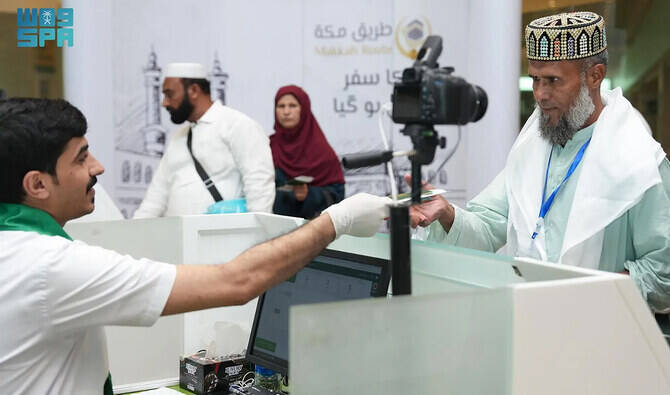
In this file photo, taken and released by the Saudi Press Agency on May 26, 2024, Saudi official handover passport to the Pakistani pilgrim at the Jinnah Internation Airport in Karachi. (SPA/File)
Short Url
Updated 11 August 2025
Follow

Pakistan begins second phase of receiving Hajj 2026 applications

  • Pakistan’s religion ministry received over 71,000 applications in first phase of Hajj form submissions
  • Hajj 2026 applications containing first installment of expenses will be accepted until August 16

ISLAMABAD: Pakistan’s government has started the second phase of receiving applications for Hajj 2026, the spokesperson of the religious affairs ministry said on Monday, as Islamabad undertakes preparations for next year’s annual Islamic pilgrimage. 

Pakistan’s Ministry of Religious Affairs received more than 71,000 applications in the first phase of Hajj form submissions, state-run Associated Press of Pakistan (APP) reported on Saturday.

Pakistan has a Hajj quota of 179,210 pilgrims for 2026, with 129,210 seats allocated for the government scheme and the rest for private tour operators.

“The second phase of receiving Hajj applications has begun,” the religious affairs ministry spokesperson said. “Hajj applications are being accepted through the ministry’s online portal and designated banks.”

The spokesperson said applications containing the first installment of Hajj expenses will be accepted until August 16. He said unregistered Hajj pilgrims will also be allowed to submit their applications during the second round of submissions. 

“Overseas Pakistanis can also apply for Hajj through a close relative via designated banks,” the spokesperson said. “Medical fitness certificates for overseas applicants must be submitted upon arrival in Pakistan.”

The ministry said the government will stop accepting Hajj applications as soon as the quota for intending pilgrims is filled. 

Under the government scheme, Pakistani pilgrims can choose between a long Hajj package of 38 to 42 days or a short package of 20 to 25 days, with costs estimated between Rs1.15 million and Rs1.25 million ($4,050-$4,236).

Saudi Arabia approved the same overall quota for Pakistan in 2025, but a significant portion of the private allocation went unused due to delays by tour operators in meeting payment and registration deadlines, while the government fulfilled its share of over 88,000 pilgrims.

Private operators blamed the shortfall on technical issues, including payment processing and communication problems.


Pakistan launches crypto testing framework to regulate digital assets

Updated 59 min 23 sec ago
Follow

Pakistan launches crypto testing framework to regulate digital assets

  • Regulatory ‘sandbox’ to let firms test crypto products under supervision
  • Move comes amid broader push to formalize Pakistan’s digital asset sector

ISLAMABAD: Pakistan’s Virtual Assets Regulatory Authority (PVARA) on Friday launched a crypto testing framework to regulate digital assets, allowing firms to trial new products and services under official supervision.

The initiative, formally structured as a regulatory “sandbox,” creates a controlled environment where companies can test crypto-related services under the oversight of the regulator before full-scale approval.

According to PVARA, the sandbox will support real-world use cases including tokenization, stablecoins, remittances and on- and off-ramp infrastructure.

Tokenization refers to converting real-world assets into digital tokens on a blockchain, while stablecoins are cryptocurrencies pegged to a fiat currency to maintain a stable value. On- and off-ramp infrastructure allows users to convert between fiat money and digital assets, enabling the practical use of virtual asset products.
“The Pakistan Virtual Assets Regulatory Authority has formally approved and launched its Regulatory Sandbox for virtual assets,” PVARA said in a post on X. “Sandbox Guidelines and the application process will be published shortly on our website.”


The move comes as the government seeks to build a formal regulatory framework for digital assets while attracting investment and strengthening oversight of the sector.

Pakistan has stepped up efforts recently to regulate its digital asset sector and is exploring digital currency initiatives as part of broader measures to reduce cash usage.

In January, Pakistan signed a memorandum of understanding with a company affiliated with World Liberty Financial, a crypto-based finance platform launched in September 2024 and linked to US President Donald Trump’s family to explore the use of a dollar-linked stablecoin for cross-border payments.