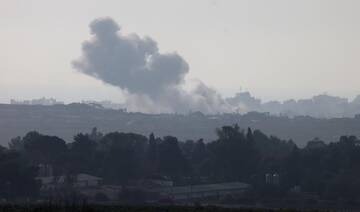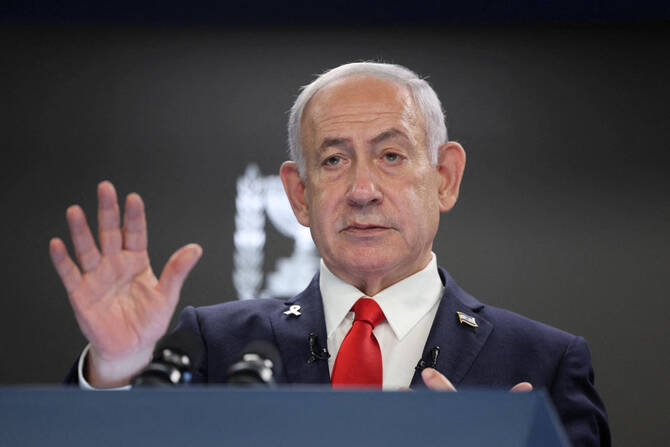

JERUSALEM: Israeli Prime Minister Benjamin Netanyahu said Sunday that his new plan to expand the war in Gaza and target the remaining Hamas strongholds there was “the best way to end the war,” defying growing calls to stop the fighting.
Defending his plan in a press conference in Jerusalem, the premier said the new operation would be implemented on “a fairly short timetable because we want to bring the war to an end.”
More than 22 months into the war, sparked by Hamas’s unprecedented attack on Israel, the country is gripped by a yawning divide pitting those demanding an end to the conflict and a deal for the release of the hostages against others who want to see the Palestinian militants vanquished once and for all.
Criticism has only intensified after Netanyahu’s security cabinet announced plans Friday to expand the conflict and capture Gaza City.
But Netanyahu was defiant on Sunday, telling journalists: “This is the best way to end the war, and the best way to end it speedily.”
The premier said the new operation’s aim was “to dismantle the two remaining Hamas strongholds in Gaza City and the central camps,” while establishing secure corridors and safe zones to allow civilians to leave the area.
“Israel has no choice but to finish the job and complete the defeat of Hamas. Now we’ve done a great deal. We have about 70 to 75 percent of Gaza under Israeli control, military control,” he said.
“But we have two remaining strongholds, OK? These are Gaza City and the central camps in Al Mawasi.”
The press conference came ahead of a UN Security Council meeting on the situation in Gaza.
It also came a day after thousands of people took to the streets in Tel Aviv to protest the security cabinet’s decision.
“The new plan is just another plan that is gonna fail, and it could very well be the end of our hostages, and of course, it will take probably more lives of our soldiers,” protester Joel Obodov told AFP.
The premier has faced regular protests over the course of the war, with many rallies calling for the government to strike a ceasefire and hostage-release deal after past truces saw captives exchanged for Palestinian prisoners in Israeli custody.
Netanyahu, however, has also come under pressure from the far right to go harder on Hamas, with Finance Minister Bezalel Smotrich slamming the new plan as half-hearted.
“They decided once again to repeat the same approach, embarking on a military operation that does not aim for a decisive resolution,” Smotrich said.
The far-right members of Netanyahu’s cabinet, including Smotrich, have maintained considerable influence in the premier’s coalition government throughout the war — with their support seen as vital to holding at least 61 seats for a parliamentary majority.
National Security Minister Itamar Ben Gvir, also of the far right, told Kan radio on Sunday: “It is possible to achieve victory. I want all of Gaza, transfer and colonization. This plan will not endanger the troops.”
Meanwhile, the cabinet’s decision to expand the war in Gaza has touched off a wave of criticism across the globe.
On Sunday, the UN Security Council met to discuss the latest development.
“If these plans are implemented, they will likely trigger another calamity in Gaza, reverberating across the region and causing further forced displacement, killings and destruction,” UN Assistant Secretary-General Miroslav Jenca told the Security Council.
Foreign powers, including some of Israel’s allies, have been pushing for a negotiated truce to secure the hostages’ return and help alleviate a humanitarian crisis in the territory following repeated warnings of famine taking hold.
Despite the backlash and rumors of dissent from Israeli military top brass, Netanyahu has remained firm.
“We will win the war, with or without the support of others,” he told the press on Sunday.
“Our goal is not to occupy Gaza, but to establish a civilian administration in the Strip that is not affiliated with Hamas or the Palestinian Authority,” he said.
Out of 251 hostages captured during Hamas’s 2023 attack, 49 are still being held in Gaza, including 27 the military says are dead.
Israel’s offensive has killed at least 61,430 Palestinians, according to Gaza’s health ministry, figures the United Nations says are reliable.
According to Gaza’s civil defense agency, at least 27 people were killed by Israeli fire across the territory Sunday, including 11 who were waiting near aid distribution centers.
Hamas’s 2023 attack on Israel, which triggered the war, resulted in the deaths of 1,219 people, according to an AFP tally based on official figures.