Pakistan space agency, local bank launch satellite-powered agri-lending solution

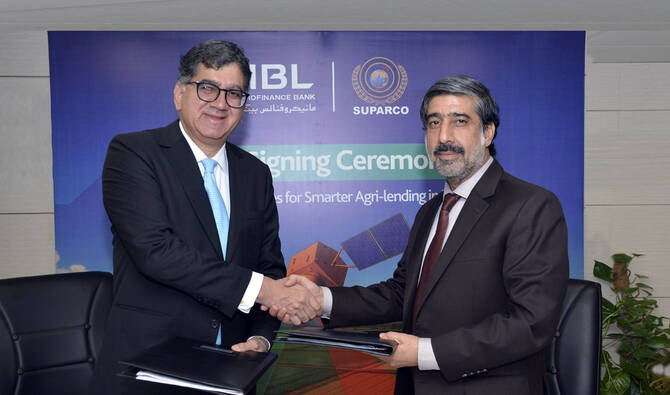
President and CEO, HBL Microfinance Bank (MfB), Amir Khan (left), shakes hands with Member (SAR), Space and Upper Atmosphere Research Commission (SUPARCO), Zafar Iqbal, after signing a memorandum of understanding (MoU) in Islamabad, Pakistan, on August 10, 2025. (HBL MfB)
Short Url
Updated 10 August 2025
Follow

Pakistan space agency, local bank launch satellite-powered agri-lending solution

  • SUPARCO to provide pre-loan assessments to banks using high-resolution satellite imagery, crop health analytics
  • After pilot project in Okara, project will include post-loan satellite monitoring to allow early detection of crop anomalies

ISLAMABAD: Pakistan’s national space agency said on Sunday it has signed a “landmark” memorandum of understanding (MoU) with HBL Microfinance Bank (HBL MfB) to introduce, for the first time, satellite-based agricultural analytics into the country’s lending ecosystem. 

The Pakistan Space and Upper Atmosphere Research Commission (SUPARCO) said the initiative represents a major step forward in applying space technology to support climate-smart agriculture and enhance access to finance for farmers. 

The pilot will involve remote pre-loan assessments using high-resolution satellite imagery, crop health analytics, yield estimation, risk profiling, and a scoring engine to assess farm-level creditworthiness by SUPARCO. A secure API and dashboard interface will enable HBL MfB to integrate this data into its loan decision-making processes, eliminating the need for manual field verification.

“The pilot phase will be implemented in Okara District, Punjab— one of the country’s most important agricultural regions,” the statement said. 

“SUPARCO’s secure API and dashboard interface will integrate directly with HBL MfB’s systems, eliminating the need for manual field verification and enabling remote pre-loan assessments.”

The next phase of the partnership includes post-loan satellite monitoring, enabling the bank to track crop activity and raise early alerts in case of anomalies, the space agency said. 

The development takes place as Pakistan aims to strengthen its space program. China last month launched a Pakistani remote sensing satellite (PRSS-1) from the Xichang Satellite Launch Center in southwest China’s Sichuan Province.

The satellite, being primarily used in the fields of land resource surveys and disaster prevention and mitigation, will help promote the development of Pakistan, Pakistan’s planning minister had said. 

In January, China launched Pakistan’s indigenously developed Electro-Optical (EO-1) satellite into space from its Jiuquan Satellite Launch Center, aiming to predict natural disasters and monitor resources, Chinese and Pakistani state media reported.

In November 2024, SUPARCO announced its rover will join China’s Chang’E 8 mission to explore the moon’s surface in 2028.

In May 2024, Pakistan launched its first lunar satellite aboard China’s Chang’e-6 probe, which was tasked with landing on the far side of the moon that perpetually faces away from the Earth.


Pakistan to launch last 2025 anti-polio nationwide drive targeting 45 million children next week

Updated 08 December 2025
Follow

Pakistan to launch last 2025 anti-polio nationwide drive targeting 45 million children next week

  • Over 400,000 frontline health workers will participate in Dec. 15-21 nationwide polio vaccination campaign, say authorities
  • Pakistan is one of only two countries in the world, the other being Afghanistan, where wild poliovirus remains endemic

KARACHI: Pakistan will kick off the last nationwide anti-polio vaccination campaign of 2025 targeting 45 million children next week, the National Emergencies Operation Center (NEOC) said on Monday, urging parents to coordinate with health workers during the drive. 

The campaign takes place days after Pakistan launched a nationwide vaccination drive from Nov. 17-29 against measles, rubella and polio. Pakistan said it had targeted 22.9 million children across 89 high-risk districts in the country with oral polio vaccination drops during the drive. 

Over 400,000 health workers will perform their duties during the upcoming Dec. 15-21 nationwide polio vaccination campaign, the NEOC said in a statement. 

“Parents are urged to cooperate with polio workers and ensure their children are vaccinated,” the NEOC said. “Complete the routine immunization schedule for all children up to 15 months of age on time.”

Health authorities aim to vaccinate 23 million children in Punjab, 10.6 million in Sindh, over 7.2 million in Khyber Pakhtunkhwa, over 2.6 million in Balochistan, more than 460,000 in Islamabad, over 228,000 in Gilgit-Baltistan and more than 760,000 children in Pakistan-administered Kashmir during the seven-day campaign, it added. 

Pakistan is one of only two countries in the world where wild poliovirus remains endemic.

Polio is a highly infectious and incurable disease that can cause lifelong paralysis. The only effective protection is through repeated doses of the Oral Polio Vaccine for every child under five during each campaign, alongside timely completion of all routine immunizations.

Islamabad’s efforts to eliminate poliovirus have been hampered by parental refusals, widespread misinformation and repeated attacks on anti-polio workers by militant groups. In remote and volatile areas, vaccination teams often operate under police protection, though security personnel themselves have also been targeted and killed in attacks.