


RIYADH: Startups across the Middle East and North Africa region continued to attract significant investor interest this week, with funding rounds spanning sectors such as fintech, logistics, artificial intelligence, and digital infrastructure.
From Saudi Arabia to Egypt and Iraq, emerging ventures are scaling operations, launching new platforms, and forging strategic partnerships to address regional market gaps and support broader economic transformation.
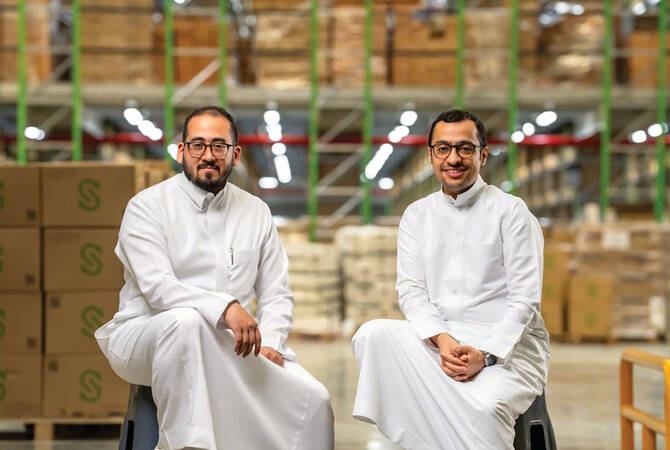
Saudi-based e-commerce logistics company Salasa secured $30 million in a series B round led by Artal Capital, with participation from Saudi Venture Capital, Wa’ed Ventures, 500 Global, Alsulaiman Group, and other strategic investors.
The company, founded in 2017 by Abdulmajeed Al-Yemni and Hasan Al-Hazmi, offers end-to-end logistics services including warehousing, inventory management, last-mile delivery, bonded zones, and cross-border shipping.
The funds will be used to expand Salasa’s fulfillment network and integrate AI into its logistics operations to enhance predictive planning and automation.
“This funding marks a major milestone,” said Al-Yemni, co-founder and CEO. “We’re scaling across fulfillment, technology, and talent to become a tech-first logistics company.”
Al-Hazmi added, “We’re embedding AI across planning, inventory, and fulfillment to create predictive, self-optimising logistics.”
UAE’s Alaan raises $48m series A to scale B2B fintech
Alaan, a UAE-based B2B fintech startup, has raised $48 million in a series A funding round led by Peak XV Partners.
The round also saw participation from Pioneer Fund, 885 Capital, Y Combinator, 468 Capital, and angel investors.

Founded in 2022 by Parthi Duraisamy and Karun Kurien, Alaan offers solutions that allow businesses to issue cards and automate data extraction and financial consolidation. (Supplied)
Founded in 2022 by Parthi Duraisamy and Karun Kurien, Alaan offers solutions that allow businesses to issue cards and automate data extraction and financial consolidation.
Following its recent expansion into Saudi Arabia, Alaan plans to use the capital to broaden its regional footprint across MENA and enhance its product suite.
In 2023, the company closed a $4.5 million pre-series A round backed by Presight Capital and Y Combinator.
Deep.SA secures $1.2m pre-seed to develop AI for Saudi market
Saudi-based AI startup Deep.SA has raised $1.2 million in a pre-seed funding round led by Tam Development and Raed Ventures, with support from additional investors.
The capital will support Deep.SA’s efforts to enhance its AI capabilities and expand operations within Saudi Arabia.
The startup aims to create advanced AI solutions tailored to local business needs, in line with the Kingdom’s Vision 2030 objectives of technological innovation and digital transformation.
RIFD lands strategic investment from Antler to scale SME securitization
RIFD, the first Saudi-born fintech enabling institutional securitization of SME trade receivables, has received strategic investment from global venture capital firm Antler.
The investment will help RIFD build the country’s first Shariah-compliant securitization infrastructure and scale its offering across Saudi Arabia and the wider region.
“SME credit in Saudi Arabia surpassed SR351.7 billion in Q4 2024, growing over 27.6 percent year-on-year. Yet, receivables-based financing still accounts for less than 6 percent,” said Abdulrahman Al-Dakheel, CEO of RIFD.
“With Antler’s backing, we are poised to scale our vision across Saudi Arabia and the wider region.” RIFD was recently selected by the Ministry of Communications and Information Technology for its Tech Champions 5 program.

Abdulrahman Al-Dakheel, chief executive officer of RIFD. (Supplied)
Suplyd raises $2m pre-series A to expand Egypt’s HORECA tech
Cairo-based digital procurement startup Suplyd has closed a $2 million pre-series A round led by 4DX Ventures, Camel Ventures, and Plus VC, with participation from Seedstars and existing investors.
Founded in 2022, Suplyd helps hotels, restaurants, and cafes digitize supply chain procurement and order directly from suppliers.
Suplyd claims to have seen 20 times growth since its $1.6 million pre-seed round, and is now serving over 5,000 restaurants.
The company plans to use the new funds to expand its offerings beyond procurement and deepen its presence across Egypt’s restaurant ecosystem.
Iraq’s Boxy raises $1.5m pre-seed to unify last-mile logistics
Iraq-based logistics aggregator Boxy has raised $1.5 million in a pre-seed round led by EQIQ, as part of the firm’s venture-building efforts to enhance Iraq’s digital infrastructure.
Founded in 2024 by Ahmed Baqer and Mehrshad Pezeshk, Boxy aims to streamline the fragmented last-mile delivery sector by integrating couriers into a single, intelligent shipping platform.
The investment will allow Boxy to leverage EQIQ’s network and resources as it builds real-time, optimized delivery solutions for merchants in Iraq.
F6 Ventures launches $90m fund to support early-stage startups
F6 Group, in partnership with Flat6Labs, has launched F6 Ventures, a new seed-stage venture capital firm with over $90 million in assets under management.
The fund will invest in early-stage startups across the Middle East and Africa, addressing gaps at the pre-seed and seed funding levels.
Co-founded by Dina El-Shenoufy and Ramez El-Serafy, F6 Ventures will launch region-specific funds in Africa, the GCC, and the Levant.
The firm aims to raise $200 million and back over 200 startups within five years.
Wuilt raises $2m to expand no-code website builder to GCC
Egypt-based Software-as-a-Service startup Wuilt has raised $2 million in a new funding round led by Flat6Labs and MTF VC, with participation from Hub71, JIMCO, Purity Tech, and angel investors.
Founded in 2019 by Ahmed Rostom and Mahmoud Metwaly, Wuilt enables users to create websites and e-stores without coding.
The company will use the funding to launch a free platform in the UAE by the fourth quarter of 2025, followed by expansion into the GCC and Turkiye in early 2026. Wuilt previously raised a $535,000 seed round in 2020.
Wamda and Inc. Arabia partner to amplify MENA entrepreneurship coverage
Wamda and Inc. Arabia have announced a strategic collaboration aimed at enhancing journalistic coverage of the Middle East and North Africa startup ecosystem.
The partnership brings together Wamda’s regional network and insights with Inc. Arabia’s editorial reach, offering broader access to stories about founders, innovation, and ecosystem enablers.
The initiative aims to highlight the ideas and individuals shaping the region’s entrepreneurship landscape through inclusive and accessible media.
Saudi Arabia becomes first regional host of OpenAI models via HUMAIN-Groq partnership
Saudi Arabia has become the first country in the region to host OpenAI’s publicly available models, gpt-oss-120B and gpt-oss-20B, through a local deployment by HUMAIN and Groq.
The models are hosted within HUMAIN’s sovereign data centers and powered by Groq’s high-speed inference infrastructure.
HUMAIN, backed by the Public Investment Fund, said the deployment enables Saudi developers, researchers, and enterprises to access advanced AI tools under national data regulations.
“With the deployment of OpenAI’s most powerful open models, hosted right here inside the Kingdom, Saudi developers, researchers, and enterprises now have direct access to the global frontier of AI,” said HUMAIN CEO Tareq Amin.


