BAGHDAD: Iraq’s prime minister approved sweeping disciplinary and legal measures against senior commanders in a paramilitary force after clashes with police at a government facility that left three people dead last month, his office said Saturday.
Gunmen descended on the agricultural directorate in Baghdad’s Karkh district on July 27 and clashed with federal police. The raid came after the former head of the directorate was ousted and a new one appointed.
A government-commissioned investigation found that the former director — who was implicated in corruption cases — had called in members of the Kataib Hezbollah militia to stage the attack, Sabah Al-Numan, a spokesperson for Prime Minister Mohammed Shia Al-Sudani, said in a statement Saturday.
Al-Sudani, who also serves as commander in chief of the armed forces, ordered the formation of a committee to investigate the attack.
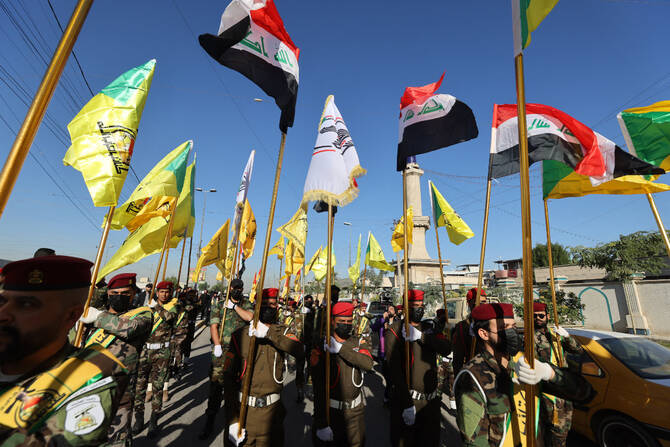
Kataib Hezbollah is part of the Popular Mobilization Forces, a coalition of mostly Shiite, Iran-backed militias that formed to fight the Islamic State extremist group as it rampaged across the country more than a decade ago.
The PMF was formally placed under the control of the Iraqi military in 2016, but in practice it still operates with significant autonomy. Some groups within the coalition have periodically launched drone attacks on bases housing US troops in Syria.
The Kataib Hezbollah fighters who staged the attack in Karkh were affiliated with the 45th and 46th Brigades of the PMF, the government statement said.
Al-Sudani approved recommendations to remove the commanders of those two brigades, refer all those involved in the raid to the judiciary, and open an investigation into “negligence in leadership and control duties” in the PMF command, it said.
The report also cited structural failings within the PMF, noting the presence of formations that act outside the chain of command.
The relationship between the Iraqi state and the PMF has been a point of tension with the United States as Iraq attempts to balance its relations with Washington and Tehran.
The Iraqi parliament is discussing legislation that would solidify the relationship between the military and the PMF, drawing objections from Washington, which considers some of the armed groups in the coalition, including Kataib Hezbollah, to be terrorist organizations.
In an interview with The Associated Press last month, Al-Sudani defended the proposed legislation, saying it’s part of an effort to ensure that arms are controlled by the state. “Security agencies must operate under laws and be subject to them and be held accountable,” he said.


![]()

Iraqi prime minister removes paramilitary commanders after deadly clash with police
Short Url
https://arab.news/jp2q7
Iraqi prime minister removes paramilitary commanders after deadly clash with police
- Clashes happened after Kataib Hezbollah members tried to stop the installation of a new agricultural directorate head in Baghdad’s Karkh district
- The former director, who was being replaced after he was implicated in corruption cases, called the militia in a bid to cling to his position


Latest updates


Recommended


© 2026 SAUDI RESEARCH & PUBLISHING COMPANY, All Rights Reserved And subject to Terms of Use Agreement.