

Saudi crown prince invites Pakistan PM to ‘Davos in the Desert’ investment forum

Pakistan Prime Minister Shehbaz Sharif speaks during a meeting with Saudi Ambassador Nawaf bin Said Al-Malki at the Prime Minister’s Office in Islamabad on August 9, 2025. (Handout/PMO)
Short Url
Updated 10 August 2025
Follow

Saudi crown prince invites Pakistan PM to ‘Davos in the Desert’ investment forum

  • Future Investment Initiative in Riyadh gathers global leaders each year to discuss pressing world issues
  • Saudi Arabia has boosted Pakistan’s reserves with large deposits and signed $2.8 billion in deals in 2024

ISLAMABAD: Saudi Crown Prince Mohammed bin Salman on Saturday invited Prime Minister Shehbaz Sharif to attend the ninth Future Investment Initiative (FII) Forum, the annual investment gathering often dubbed “Davos in the Desert.”

The FII brings together global policymakers, investors, entrepreneurs and innovators to explore investment trends, emerging technologies and global economic strategies in line with Saudi Arabia’s Vision 2030.

Sharif attended the event in Riyadh last October during a two-day official visit, engaging with Saudi leadership and participating in high-level discussions on economic and strategic cooperation.

“Amb. Nawaf bin Said Al-Malki, Ambassador of the Kingdom of Saudi Arabia, called on the Prime Minister at the Prime Minister House earlier today,” Sharif’s office said in a statement after the meeting.

“The Ambassador handed over to the Prime Minister a signed invitation letter from His Royal Highness Crown Prince Mohammed bin Salman bin Abdul Aziz Al Saud to participate in the ninth Future Investment Initiatives (FII) Forum to be held in Riyadh from 27-30 October, 2025.”
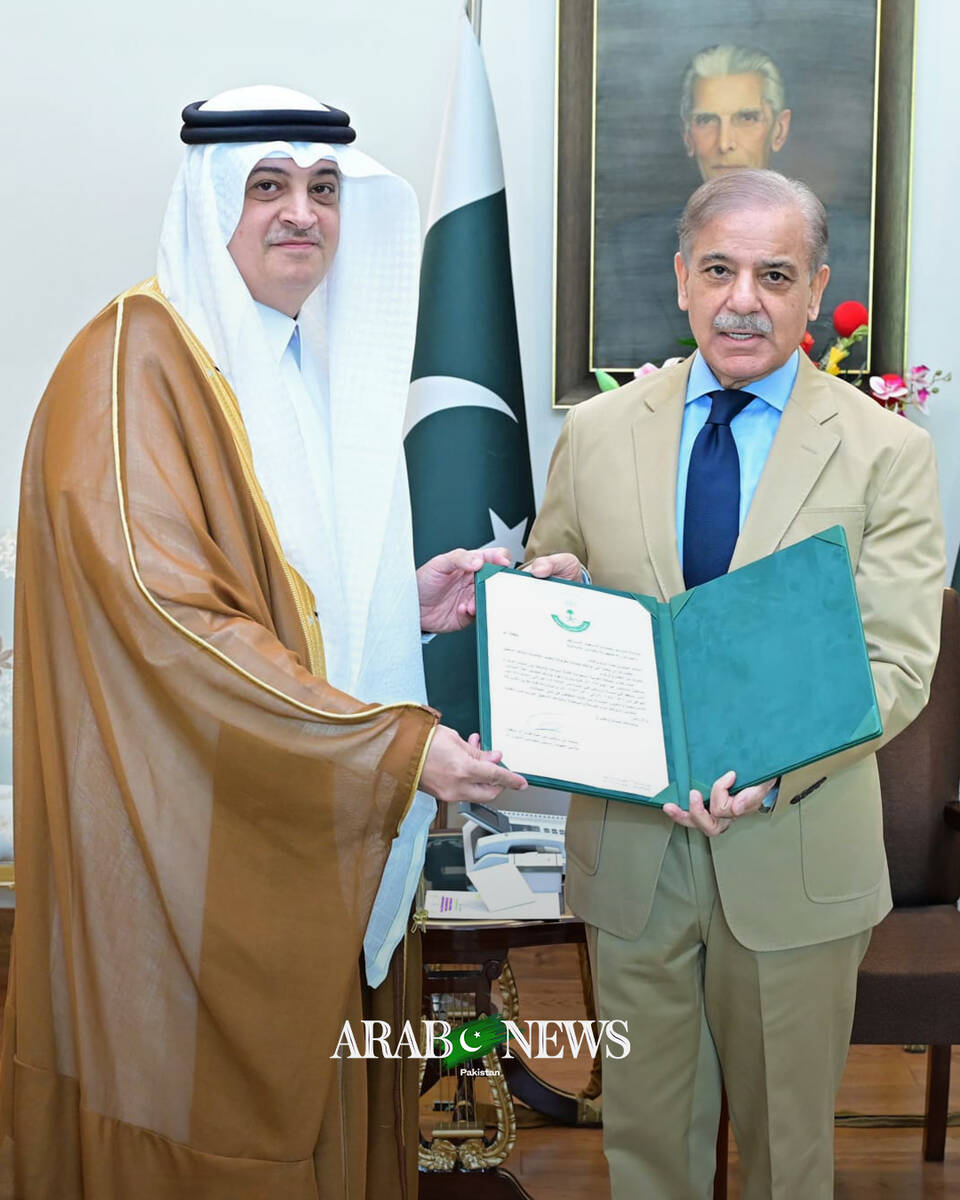


Saudi Ambassador Nawaf bin Said Al-Malki presenting PM Sharif an invitation from Crown Prince Mohammed bin Salman to attend the ninth Future Investment Initiative Forum in Riyadh this October. (Handout/PMO)

Upon accepting the invitation, Sharif conveyed warm greetings and respect to both King Salman bin Abdul Aziz as well as to the Saudi crown prince.

The prime minister also discussed recent regional developments in what the statement described as a warm and cordial atmosphere.


Saudi Ambassador Nawaf bin Said Al-Malki speaks during a meeting with PM Sharif at the Prime Minister’s Office in Islamabad on August 9, 2025. (Handout/PMO)

Pakistan and Saudi Arabia enjoy close ties, with Riyadh bolstering Islamabad’s foreign currency reserves in recent years by depositing money into Pakistan’s central bank.

The support helped unlock International Monetary Fund (IMF) bailout packages and stabilize the South Asian country’s external finances.

During Sharif’s visit to the kingdom in October 2024, the two nations signed 34 memoranda of understanding worth $2.8 billion, seven of which have since been converted into agreements valued at $560 million.


IMF board approves $1.3 billion disbursement for Pakistan after completing loan reviews

Updated 4 sec ago
Follow

IMF board approves $1.3 billion disbursement for Pakistan after completing loan reviews

  • The approval comes after an October staff-level deal that awaited the board’s formal endorsement
  • Economists say the money will boost Pakistan’s forex reserves, send positive signals to investors

KARACHI: The International Monetary Fund’s (IMF) executive board approved the release of $1.3 billion for Pakistan under two of its loan facilities, the Pakistani state media reported on Monday.

The board meeting was scheduled to take place during the day to decide on the Fund’s second review under the $7 billion Extended Fund Facility (EFF) and first review under the $1.4 billion Resilience and Sustainability Facility (RSF), a financing tool that provides long-term, low-cost loans to help countries address climate risks.

“The IMF executive board meeting has approved the third tranche of the loan program amounting to $1.3 billion,” the state-owned Pakistan Television reported.

It described the development as a major boost for Pakistan’s economy.

The IMF executive board’s meeting came nearly two months after a staff-level agreement (SLA) was signed between the two sides in October.

Procedurally, the SLAs are subject to approval by the executive board, though it is largely viewed as a formality.

A senior finance ministry official also confirmed to Arab News on condition of anonymity that the IMF had approved the tranche.

Economic experts said earlier in the day that the IMF disbursements would help Pakistan strengthen its balance of payments position.

Samiullah Tariq, group head of research at Pakistan Kuwait Investment Company Limited, said the IMF board’s approval would be an indication that Pakistan’s economy is on the right path.

“It obviously will help strengthen [the country’s] external sector, the balance of payments,” he told Arab News.

Until recently, Pakistan grappled with a macroeconomic crisis that drained its financial resources and triggered a balance of payments crisis.

However, the country witnessed financial gains in the last two years, recording current account surpluses and taming inflation that touched unprecedented levels in mid-2023.

Economists also viewed the IMF’s bailout packages as crucial for cash-strapped Pakistan, which has relied heavily on financing from bilateral partners such as Saudi Arabia, China and the United Arab Emirates, as well as multilateral lenders.

Saudi Arabia, through the Saudi Fund for Development, last week extended the term of its $3 billion deposit for another year to help Pakistan boost its foreign exchange reserves, which stood at $14.5 billion as of November 28, according to State Bank of Pakistan statements.

“In our view this [IMF tranche] will be approved,” said Shankar Talreja, head of research at Karachi-based brokerage Topline Securities Limited.

“This will help strengthen reserves and will eventually help a rating upgrade going forward,” he said.

The IMF board’s nod, Talreja said, would also send a signal to international and local investors regarding the continuation of the reform agenda by Pakistan’s government.