Pakistani military says 47 militants killed in two-day operation in southwest

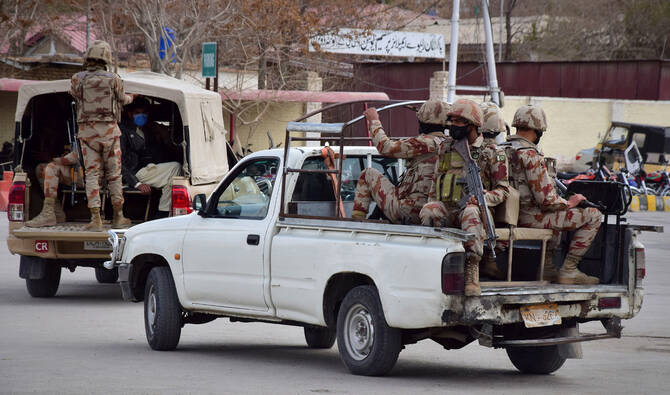
Pakistani soldiers arrive at the railway station in Quetta on March 12, 2025. (AP/File)
Short Url
Updated 09 August 2025
Follow

Pakistani military says 47 militants killed in two-day operation in southwest

  • The deceased militants belonged to the Tehreek-e-Taliban Pakistan, primarily active in Pakistan’s northwest
  • Islamabad has frequently a surge in militancy on India and Afghanistan, New Delhi and Kabul deny the allegation

ISLAMABAD: Pakistani security forces have killed 47 “Indian-sponsored militants” belonging to the Tehreek-e-Taliban Pakistan (TTP) near the country’s border with Afghanistan in the restive Balochistan province, the Pakistani military said on Saturday.

Pakistani forces engaged and killed 33 militants while attempting to infiltrate the border in Sambaza area of Balochistan’s Zhob district on August 7-8, according to the Inter-Services Public Relations (ISPR), the military’s media wing.

The military, following the successful engagements, conducted a sanitization operation on the night August 8-9 in surrounding areas of Sambaza along Pakistan-Afghanistan border and neutralized 14 more “Indian-sponsored khwarij [militants].”

In recent months, Islamabad has frequently accused India of backing militant groups and Afghanistan of allowing the use of its soil for attacks against Pakistan. Kabul and New Delhi deny the allegation.

“Weapons, ammunition and explosives were also recovered from the killed khwarij,” the ISPR said in a statement. “Security Forces remain committed to secure the nation’s frontiers and thwart attempts at sabotaging peace, stability and progress of Pakistan.”

Pakistan has witnessed a sharp rise in violence in its western regions bordering Afghanistan.

While the recent infiltration attempt took place in the volatile Balochistan province, the site of a long-running insurgency by Baloch separatists, the TTP has primarily carried out attacks in Pakistan’s northwestern Khyber Pakhtunkhwa region, targeting security personnel, police and civilians.

On Friday, Balochistan’s Chief Minister Sarfraz Bugti welcomed the operation, calling it a successful counter-infiltration move that “made the nation proud.”

“The people of Balochistan stand united against the enemies of peace,” he said. “Every obstacle to peace and prosperity in Balochistan will be eliminated.”


Pakistan unveils world’s ‘largest’ Markhor sculpture in Kaghan Valley

Updated 3 sec ago
Follow

Pakistan unveils world’s ‘largest’ Markhor sculpture in Kaghan Valley

  • Massive structure, standing 105 feet high and 38 feet wide, took five years to complete
  • Authorities aim to draw tourists to mountainous north, raise awareness about species

ISLAMABAD: Pakistan has unveiled the world’s “largest” sculpture of the Markhor, the country’s national animal, in the scenic Kaghan Valley, Radio Pakistan reported on Friday, highlighting cultural pride, wildlife heritage and the country’s growing focus on tourism. 

By immortalizing the Markhor in stone, authorities aim to draw tourists to the mountainous north and raise awareness about the species, a symbol of national identity and a conservation-success story.

“The massive structure, standing 105 feet high and 38 feet wide, took five years to complete,” Radio Pakistan reported. “The Kaghan Valley, known for its breath-taking landscapes, now hosts this record-breaking tribute, attracting visitors from across the country and beyond.”

The Markhor, a wild mountain goat native to the high-altitude regions of northern Pakistan, including Gilgit-Baltistan and Khyber Pakhtunkhwa, has distinctive corkscrew-shaped horns and remarkable agility on rocky terrain. 

Once heavily threatened by overhunting and habitat loss, the Markhor’s fortunes have rebounded in recent decades thanks to conservation efforts and community protection programs. Its increasing population has led to its conservation status being downgraded from “Endangered” to “Near Threatened.” 

Local tourism officials say the new sculpture is expected to draw significant numbers of visitors to Kaghan Valley, giving a boost to local economies while reinforcing interest in wildlife conservation and Pakistan’s natural heritage.